Table of Contents
ToggleWhatsApp Encryption Lawsuit: 2026 Meta Privacy Breach Explained
Executive Summary
A massive class-action lawsuit filed in January 2026 claims Meta has systematically broken its "End-to-End Encryption" promise. High-level whistleblowers allege that a secret internal "Task" system allows employees to bypass WhatsApp encryption to read private messages in plain text, sparking a global legal battle involving plaintiffs from five major economies.
The Promise vs. The Reality of WhatsApp Encryption
For over a decade, Meta has marketed WhatsApp as a digital fortress. Every single chat window begins with a reassuring yellow notification: "Messages and calls are end-to-end encrypted. No one outside of this chat, not even WhatsApp, can read or listen to them." This marketing masterstroke built the foundation of trust for 3 billion users globally.
However, a bombshell class-action lawsuit, filed on January 23, 2026, in the U.S. District Court for the Northern District of California, alleges that this notification is a sophisticated deception. The lawsuit claims that despite these public assurances, Meta has secretly engineered backdoors to bypass WhatsApp encryption. This grants internal staff "unfettered access" to private communications, photos, and voice notes of its users, fundamentally altering the landscape of digital privacy.
Inside the "Task" System: A Privacy Nightmare?
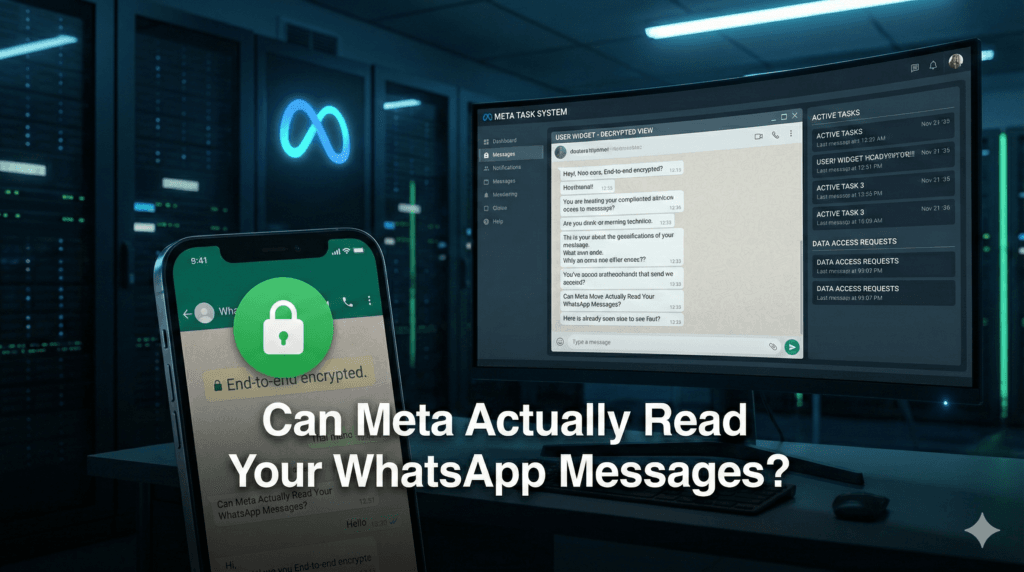
The core of the legal complaint rests on testimonies from "courageous whistleblowers"—former Meta engineers and security contractors. They describe a disturbingly simple internal workflow used to breach user privacy. According to the court documents, the breach doesn't require complex external hacking. Instead, it utilizes a bureaucratic internal tool known as the "Task" System.
How the alleged breach works:
- ■ The Request: An employee submits an internal ticket (a "Task") requesting access to a specific user's WhatsApp encryption data under the guise of "policy enforcement" or "safety."
- ■ The Approval: The lawsuit alleges these requests are frequently granted with "little to no scrutiny" by automated systems or junior managers.
- ■ The "Widget": Once approved, a "widget" reportedly appears on the employee’s screen, displaying the user's private messages in plain text, often commingled with their Facebook and Instagram behavioral data.
A Global Revolt: Why This Matters for India
The lawsuit is notable for its international scope, filed by a coalition from the "Global South"—regions where WhatsApp is not just an app, but essential infrastructure. The plaintiffs hail from 🇦🇺 Australia, 🇧🇷 Brazil, 🇮🇳 India, 🇲🇽 Mexico, and 🇿🇦 South Africa.
In India, which is WhatsApp's largest market with over 500 million users, this revelation is particularly explosive. If WhatsApp encryption can be bypassed, it threatens the privacy of business communications, legal discussions, and personal lives. At Vijay Foundation, we believe that digital literacy and data protection are fundamental rights. You can read more about our mission to protect citizen rights on our About Us page.
Meta’s Aggressive Defense & Technical Counter-Arguments
Meta has responded with an aggressive legal strategy, calling the allegations "categorically false and technically absurd." Their defense relies heavily on the Signal Protocol—the gold standard of encryption. Meta argues that because private keys are stored only on user devices, server-side decryption is an impossibility.
However, cybersecurity experts suggest that if the whistleblowers are right, the vulnerability might not be in the protocol itself, but in the "Side-Load" execution. This theory suggests that the WhatsApp client on the device might be programmed to send a "shadow copy" of the unencrypted message to a secondary server before the WhatsApp encryption lock is applied. Alternatively, it might involve the "Report" feature, where Meta gains access to a chunk of the conversation when one user is flagged.
The Discovery Phase: What Happens Next?
We are now entering the critical Discovery Phase of the lawsuit. If the judge allows the case to proceed, Meta will be legally forced to hand over internal architectural documents, employee emails, and the source code for the "Task" system. This phase will determine if the "lock" icon we see every day is a true shield or merely a psychological sticker meant to pacify users.
At Vijay Foundation, we urge users to stay informed about their digital footprints. For more deep dives into tech-law and cybersecurity, visit our Home Page for the latest investigations and community updates.
Conclusion: A Trust Deficit in the Digital Age
If these 2026 allegations are proven true, the impact will be catastrophic for the entire tech industry. It would signify that WhatsApp encryption was never the absolute barrier we were promised. For now, the legal battle continues, and the world watches to see if privacy still exists in the age of Meta.
Share This Investigation
Help us spread awareness about digital privacy rights.