
Legal Insight • March 2026
Understanding Passive Euthanasia in India: The Legal Framework and the Right to Die with Dignity
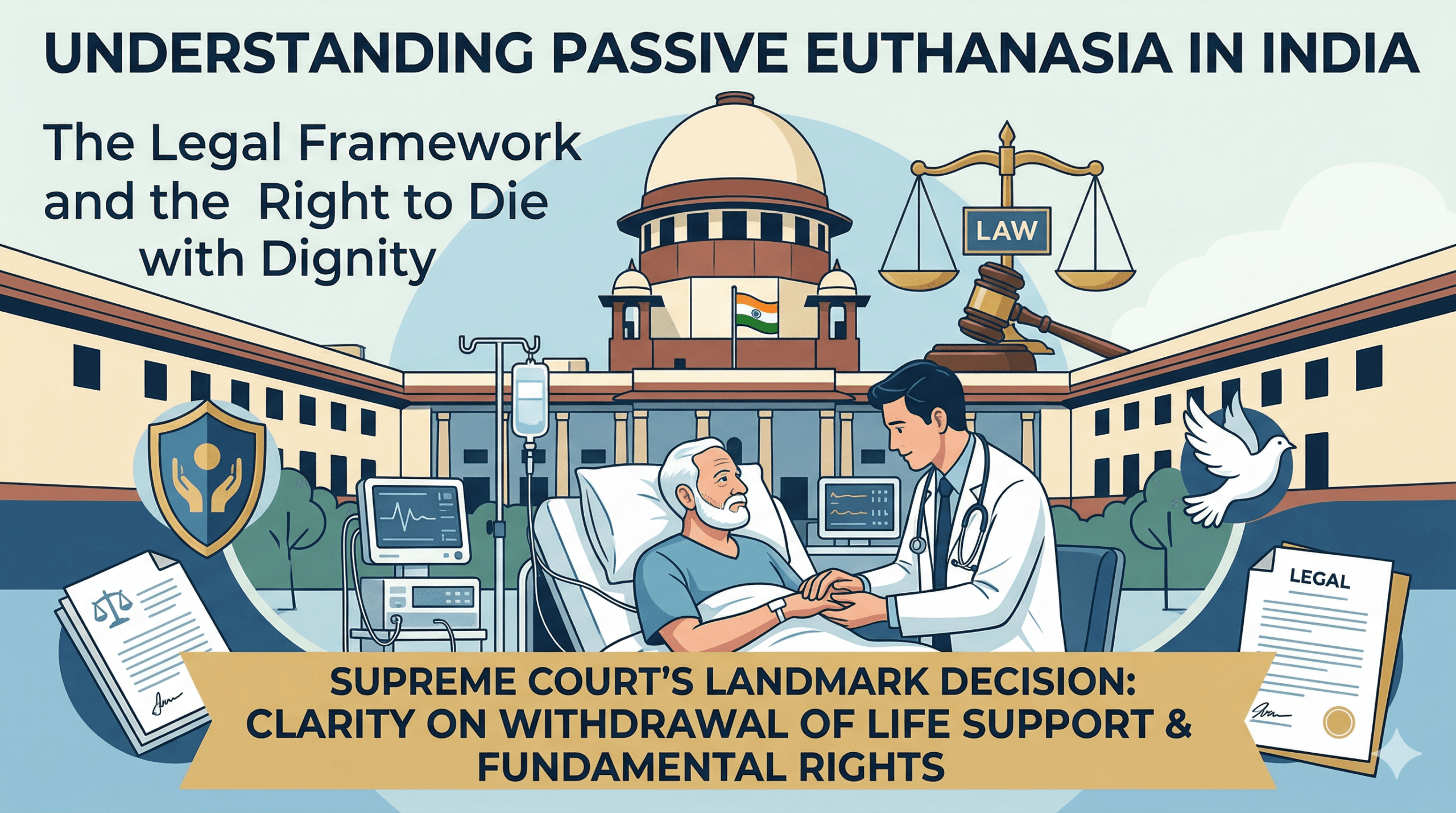
The Supreme Court of India has provided clarity on the withdrawal of life support, emphasizing the fundamental right to die with dignity.
Executive Summary
Advances in medical science have significantly increased human life expectancy, allowing healthcare professionals to sustain life even in the most critical conditions. However, this progress has introduced profound ethical and legal dilemmas. One of the most complex debates in modern jurisprudence is the concept of passive euthanasia in India.
In India, the legal landscape surrounding end-of-life care has evolved dramatically over the last decade. Shifting from absolute prohibition to a nuanced understanding of a patient’s fundamental rights, the nation has established a comprehensive framework to ensure compassion in medical care. This blog explores the legal, medical, and ethical dimensions of withholding or withdrawing life support, providing clarity on a subject that touches the very core of human dignity and the current laws governing passive euthanasia in India.
Defining the Terms: Active vs. Passive Euthanasia
Before diving into the legalities, it is crucial to understand the terminology, as public discourse often confuses the concepts.
- ✔
Active Euthanasia: This involves a deliberate, positive medical intervention to end a patient’s life, such as administering a lethal injection. Under Indian penal law, active euthanasia is strictly illegal and is treated as a criminal offense. - ✔
Passive Euthanasia: Historically known as passive euthanasia, the Supreme Court of India now prefers the legally precise term “withdrawal or withholding of medical treatment.” This involves stopping life-sustaining treatments—such as ventilators, artificial nutrition (feeding tubes), or dialysis—for a terminally ill patient, allowing death to occur naturally from the underlying disease or injury. This procedure defines the modern scope of passive euthanasia in India.
The Legal Evolution of the Right to Die with Dignity
The legal foundation for passive euthanasia in India is intrinsically tied to Article 21 of the Indian Constitution, which guarantees the right to life and personal liberty. Over time, the judiciary interpreted this to mean that the right to a dignified life inherently includes the right to a dignified death.
1. The Aruna Shanbaug Case (2011)
The conversation gained national prominence during the tragic case of Aruna Shanbaug, a nurse who lived in a permanent vegetative state for 42 years following a brutal assault. While the Supreme Court ultimately rejected the plea to withdraw her life support—ruling that the hospital staff, not her friend who filed the petition, were her legal next friend—the judgment laid the initial groundwork by officially recognizing passive euthanasia under strict judicial supervision.
2. The Common Cause Judgment and Advance Directives (2018)
A monumental shift occurred in 2018 when a five-judge Constitution Bench of the Supreme Court recognized the legal validity of Advance Medical Directives (Living Wills). The court ruled that an adult with a sound mind has the right to refuse artificial medical life support if they reach a state where recovery is impossible.
3. Procedural Simplifications (2023)
While the 2018 ruling was historic, the guidelines were heavily bureaucratic, requiring a Judicial Magistrate to countersign a Living Will. In 2023, the Supreme Court simplified these guidelines. Today, a Living Will simply needs to be attested by a notary or a gazetted officer in the presence of two witnesses, making the process far more accessible for the general public and clarifying the rules for passive euthanasia in India.
Internal Link: Understanding Your Fundamental Rights: A Deep Dive into Article 21 of the Indian Constitution
A Landmark Moment: The 2026 Harish Rana Case
The practical application of these legal frameworks was prominently highlighted in the recent, heartbreaking case of Harish Rana. In March 2026, the 31-year-old, who had been in a permanent vegetative state for 13 years following a traumatic brain injury, became the center of a landmark Supreme Court directive regarding passive euthanasia in India.
After multiple medical boards confirmed his condition was irreversible, the apex court permitted the withdrawal of his life support at AIIMS, New Delhi. The court poignantly noted to his parents, “You are not giving up on your son. You are allowing him to leave with dignity.” This case served as a critical real-world implementation of the Supreme Court’s updated guidelines, proving that the legal system can prioritize compassionate end-of-life care over medically futile biological survival.
The Procedure: How is the Withdrawal of Medical Treatment Executed?
Even with progressive laws, the withdrawal of life support is not an arbitrary decision. It is governed by rigorous medical protocols to prevent misuse.
- Primary Medical Board: If a patient is terminally ill or in a vegetative state, the hospital must form a Primary Medical Board comprising the treating physician and two subject experts with at least five years of experience. They assess the patient and determine if further medical intervention is futile.
- Secondary Medical Board: If the primary board approves the withdrawal, the hospital informs the Chief Medical Officer (CMO) of the district, who constitutes a Secondary Medical Board. This independent board re-examines the patient and the initial findings regarding the necessity of passive euthanasia in India.
- Final Implementation: Once both boards and the patient’s family consent, life-sustaining treatments are gradually withdrawn. The medical team’s focus shifts entirely to palliative care—ensuring the patient is pain-free and comfortable during their final moments.
External Link: Learn more about global Palliative Care standards from the World Health Organization (WHO)
Conclusion
The legal acceptance of withholding medical treatment in India represents a profound maturation of medical ethics and constitutional law. By recognizing Advance Directives and streamlining the procedures for families navigating irreversible medical tragedies, the Indian judicial system has ensured that the sanctity of life does not overshadow the sanctity of dignity. As legal frameworks continue to evolve, they provide much-needed solace and clarity to families facing the most difficult decisions of their lives regarding passive euthanasia in India.
Frequently Asked Questions (FAQs)
1. What is an Advance Medical Directive (Living Will)?
A Living Will is a legal document drafted by a person of sound mind that specifies the medical actions that should be taken—or withheld—if they become terminally ill and lose the capacity to make or communicate healthcare decisions.
2. Can family members request the withdrawal of life support if there is no Living Will?
Yes. In the absence of a Living Will, the patient’s immediate family or next of kin can approach the hospital to initiate the process. The hospital will then form the necessary Primary and Secondary Medical Boards to assess the medical futility of continuing treatment.
3. Is the withdrawal of life support immediate?
No. The process is a gradual and medically supervised transition from curative treatment to palliative comfort care, ensuring the patient does not suffer from pain or distress as natural death occurs.
4. Can a doctor refuse to withdraw life support due to personal beliefs?
While medical professionals have a duty of care, they must abide by the consensus of the constituted Medical Boards and the legal consent of the family. However, the overarching medical protocol is always prioritized to ensure the ethical treatment of the patient.
Share This Legal Guide
Raise awareness about patient rights and the legal framework for end-of-life care in India.