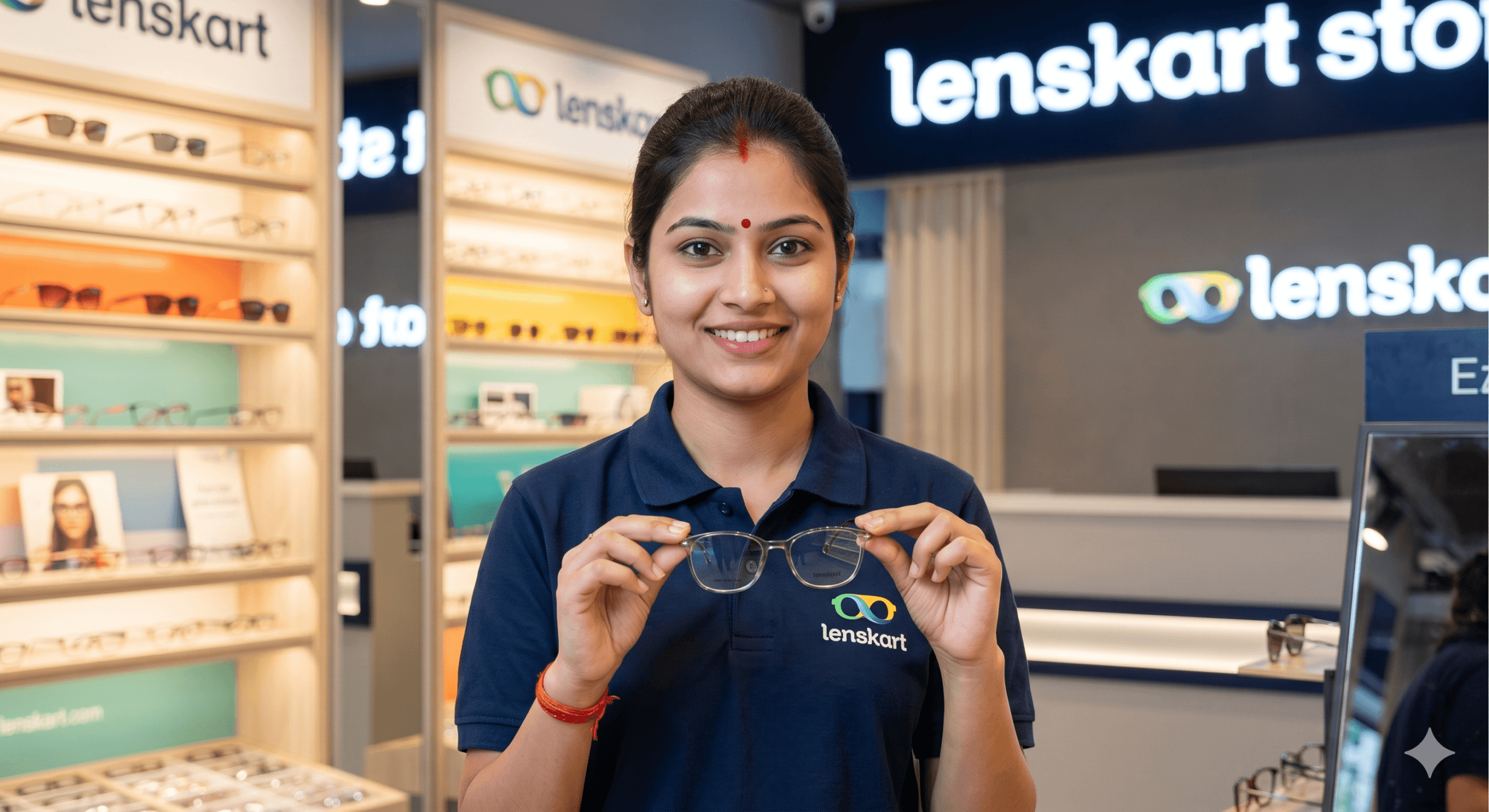
"A small red dot. A streak of vermillion on a forehead. Objects so familiar, so woven into the fabric of everyday Indian life, that most people don't think twice about them. Until, apparently, they walk through the doors of a corporate workplace — and suddenly, that tiny dot becomes a policy problem."
— The collision of aesthetic preferences and constitutional freedomsThat is the story behind the Lenskart grooming controversy that exploded across India in April 2026. But to call it merely a PR crisis for one eyewear brand is to miss the point entirely. It was a collision between corporate housekeeping and constitutional rights — between a company's aesthetic preferences and a citizen's fundamental freedoms. And it is a story this country has lived before, in courtrooms, in classrooms, in airports, and in boardrooms.
What Actually Happened in the Lenskart Grooming Controversy
The Leak · The Confrontation · The ResponseThe controversy erupted when screenshots of what appeared to be an internal Lenskart employee grooming guideline began circulating on social media. The document reportedly suggested that certain visible religious symbols — specifically the bindi and tilak — were restricted under employee appearance standards, while other religious symbols were not subject to the same restriction.
The internet caught fire. Boycott calls spread rapidly. The situation soon escalated beyond digital outrage, with public frustration spilling over into physical spaces. Crowds gathered at a Mumbai showroom to protest the alleged guidelines, expressing their discontent directly to store management. The depth of the issue surfaced when one showroom employee claimed that during staff training, they were explicitly told not to wear a tilak or kalawa — and that married women were also not permitted to wear a mangalsutra.
- The Leak: Screenshots of an alleged grooming policy circulate online. Public scrutiny focuses on what appears to be selective treatment of religious symbols — some protected, others flagged.
- The Confrontation: Public frustration spills over into physical stores as crowds gather at a Mumbai showroom to protest the alleged guidelines and voice their concerns to floor management. Hashtags trend. Boycott calls reach a peak. The brand becomes a national talking point.
- The Response: CEO Peyush Bansal speaks on X, calling the viral document 'outdated' and 'inaccurate,' stating that Lenskart has no restrictions on religious expression of any kind, including bindi and tilak. A public apology follows.
- The New Policy: Lenskart publishes a new 'In-Store Style Guide' explicitly welcoming bindi, tilak, sindoor, mangalsutra, kalawa, hijab, turban, and kada by name. The statement reads: 'If any version of our workplace communication caused hurt… we are deeply sorry.'
- The Sequel: Days later, a January 2025 festive ad re-emerges on social media, criticised for depicting the harvest festival in a culturally disconnected manner — reopening questions about the brand's deeper relationship with indigenous Indian identity.
This is the point most often glossed over in the heat of social media controversy: a company's internal 'Style Guide' does not supersede the Constitution of India. The Lenskart policy, as it existed, clashed directly with fundamental rights that every Indian citizen carries into every room — including a retail store on a high street.
Guarantees every citizen the right to freely profess, practice, and propagate religion. Wearing a bindi, tilak, hijab, or cross is not a style preference — it falls squarely under this constitutional protection.
Demands equality before the law. A policy that permits one faith's symbols while penalising another's is legally indefensible — it applies different rules to employees based solely on their religious identity. This is where the policy driving the Lenskart grooming controversy legally failed.
Discriminatory practices in conditions of service — including penalising staff during audits for wearing religious markers like a kalawa — violate workplace equity provisions under various State Shops and Establishments Acts. These laws govern the daily realities of employment across India, and appearance-based religious discrimination falls directly within their scope.
The crucial legal failure lies in Article 14. True equality does not mean identical treatment in every detail — it means applying the same standard evenhandedly across all comparable situations. A policy that shields certain religious symbols from restriction while flagging others as 'unprofessional' fails this test immediately and completely. The law is not subtle on this point.
This Has Happened Before
Global Parallels · Institutional Uniformity · Identity FrictionsThe Lenskart grooming controversy did not emerge in a vacuum. The friction between institutional dress codes and individual religious identity has played out across India and the world — in courtrooms, airline handbooks, ad campaigns, and educational institutions. Each episode adds a layer to the same unresolved question.
Educational institutions imposed strict dress codes that effectively banned the hijab. The resulting constitutional battle centred on whether the hijab constitutes an 'essential religious practice' under Article 25 — and whether institutional uniformity demands can override that protection. It was the structural inverse of Lenskart: institutional authority used to restrict one symbol in the name of a 'neutral' standard. The Supreme Court deadlocked. Both cases expose the same gap in how Indian institutions think about religious identity.
For years, cabin crew members across Indian carriers fought for the right to wear a bindi or mangalsutra — symbols that airlines initially banned in an effort to project a globalised aesthetic. Air India overhauled its guidelines but had to explicitly specify the permissible size of a bindi. Then, within days of the Lenskart story, Air India was engulfed in an almost identical controversy when a leaked cabin crew handbook appeared to restrict sindoor and bindi depending on uniform type. Two companies. The same week. The same policy failure.
Abercrombie & Fitch refused to hire a Muslim woman because her hijab conflicted with their 'Look Policy.' The U.S. Supreme Court ruled against the company, establishing that an employer cannot make appearance-based decisions that discriminate against religious practice. The principle: a uniform standard is not neutral if it disproportionately excludes those whose faith requires specific dress. The same logic applies to a policy that flags tilak and bindi while protecting other religious symbols.
A British Airways employee was prohibited from wearing a visible Christian cross while Sikh and Muslim colleagues were permitted their respective religious attire. The European Court of Human Rights ruled in her favour. The precedent is foundational in European employment law: you cannot allow the visible religious expression of some faiths while prohibiting others — even under the banner of brand uniformity. This is precisely the asymmetry that made the Lenskart document legally indefensible.
Neither involved a workplace policy. But both brands faced intense backlash for campaigns that stripped Hindu festivals of their traditional, religious core — FabIndia marketing a Diwali collection as 'Jashn-e-Riwaaz,' Tanishq depicting a narrative many found tonally disconnected. The Pongal ad that resurfaced in Lenskart's case sits in the same category. These tap the same psychological nerve: the perception that Indian corporations routinely sand down indigenous identity in the name of modernity. That accumulated perception is the emotional backdrop against which the Lenskart document detonated.
The Psychology of Selective Inclusion
Systemic Blind Spots · DEI Imports · Corporate NeutralityWhen a corporate HR department drafts a policy that protects some religious symbols while restricting others, it is rarely the product of deliberate malice. That, in some ways, makes it harder to fix. It is almost always the result of systemic blind spots — frameworks borrowed uncritically from elsewhere and applied to a context they were never designed for.
Four Institutional Blind Spots
The Western DEI Import: Many Indian startups build their Diversity, Equity, and Inclusion frameworks by directly importing Western corporate templates. In the West, accommodating specific religious attire is a heavily litigated civil rights issue. Indian HR departments hardcode those specific protections — without adding equivalent protections for majority-faith symbols that Western frameworks never needed to consider.
The Majority Blindspot: Because majority-faith markers are everywhere in India, corporate policymakers often unconsciously categorise them as 'casual cultural habits' rather than protected religious expressions. In the pursuit of a globalised aesthetic, a bindi gets quietly flagged as 'unprofessional' — while symbols perceived as minority-rights issues are actively shielded from any restriction.
The Paradox of Corporate Secularism: Corporations try to enforce visual 'neutrality' on the shop floor. But true neutrality in a religiously plural society means either banning all visible religious symbols equally (the French model) or allowing all of them equally (the Indian constitutional model). Selective accommodation creates a hierarchy of faith — and hierarchies produce exactly the kind of resentment that triggered the Lenskart grooming controversy.
Identity Threat at Work: When a policy signals that a core marker of identity is 'not the right look,' the message employees receive is not about aesthetics. It is about belonging. The psychological cost of suppressing an identity marker — even voluntarily, under quiet institutional pressure — is real: reduced engagement, lowered trust, and a persistent sense of not being fully welcome as a whole person.
The Paradox of Corporate Secularism is perhaps the most instructive of the three blind spots. A policy that restricts some religious symbols while protecting others is not neutral — it is discriminatory, regardless of intent. And in a country with India's constitutional architecture, it is not just ethically indefensible. It is legally vulnerable in precisely the ways Articles 14 and 25 were designed to address.
↑ Back to topWhat the Correction Looked Like
The Public Guide · Explicit Specificity · Institutional InstinctLenskart's response, once it arrived, is worth examining honestly — because it modelled something that most brands in similar situations fail to do. CEO Peyush Bansal did not issue a vague statement about valuing diversity. He acknowledged the specific document, called it 'inaccurate,' and stated plainly that there are no restrictions on bindi, tilak, or any other form of religious expression.
More importantly, the company published a new In-Store Style Guide and made it entirely public. The guide named every symbol explicitly — bindi, tilak, sindoor, mangalsutra, kalawa, hijab, turban, kada. That specificity is not cosmetic. A policy that lists symbols by name closes the interpretive gap that creates these controversies in the first place. No store manager can misread a document that leaves nothing open to interpretation.
The resurfaced Pongal advertisement offered a sobering coda: the explicit policy had been fixed, but the deeper question — how Indian brands represent indigenous cultural identity in their communication — remained very much open. Fixing a document is one step. Changing an institutional instinct takes considerably longer.
↑ Back to topWhat Corporate India Must Learn
Framework for Equitable Workplace PolicyThe Lenskart grooming controversy — and the near-simultaneous Air India episode — should function as a mandatory case study for every HR department operating in India. The lesson is not 'don't get caught with a bad policy.' The lesson is structural, constitutional, and long overdue.
- Test for symmetry: If any symbol of faith is protected in your policy, all comparable symbols must be equally protected. A policy that fails this test fails under Article 14 — full stop.
- Audit imported DEI frameworks: Western templates were built for Western contexts. Overlay them onto India's religious landscape before adoption. What is a minority-rights protection in one context may function as a majority-erasure instrument in another.
- Publish everything proactively: In an era when any internal document can reach social media within hours, the only defensible policy is one a company is comfortable making entirely public — before a controversy forces the issue.
- Name the symbols explicitly: Ambiguity is never neutral. A policy that does not explicitly protect bindi and tilak will be read, by someone, as implicitly restricting them. Specificity is the only reliable protection against misinterpretation.
- Ask the right question: Not 'does this policy technically discriminate?' Ask: 'Would every employee reading this feel that their identity is fully welcome here?' If the answer is uncertain, the policy needs rewriting.
The most fundamental shift required is a reframe that has been overdue for a long time. The right to wear a bindi, a tilak, a mangalsutra, or a kalawa is not a benefit that an employer graciously extends. It is a right — guaranteed by the Constitution of India — that an employee carries into every room, including the sales floor of a retail store. Corporate India is still learning to fully internalise that distinction. The cost of not learning it is paid, quietly, every single day, by employees who decide it is easier to leave part of themselves at the door.
↑ Back to topThe conversation sparked by Lenskart matters not because one brand got a policy wrong, but because it forced a reckoning with a question every Indian workplace must eventually answer honestly — and answer in constitutional terms.