Supreme Court Second Class Passenger Observation: Why Indian Railways May Have to Change Its Language
A full breakdown of the Lata v. Union of India ruling — the case facts, the Court's constitutional reasoning, what it means for Indian Railways, and how this analysis goes further than the rest of the coverage.
Court
Observation
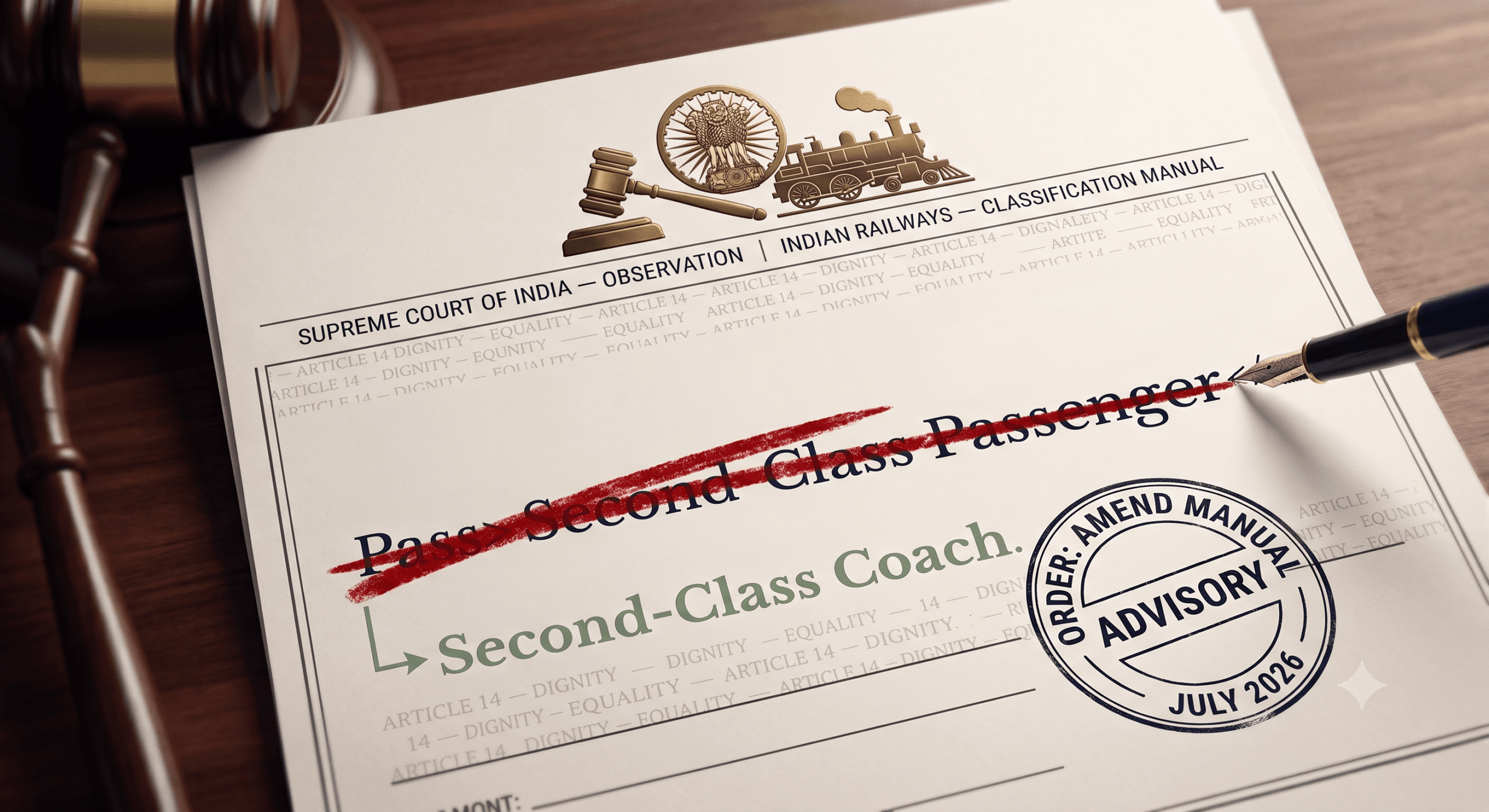
In Lata v. Union of India, the Supreme Court (Justices Sanjay Karol and N. Kotiswar Singh) suggested that Indian Railways stop calling people "second-class passengers," saying class labels should describe the coach, not the traveller, since the phrase carries forward India's colonial-era class hierarchy. The remark came while the Court awarded ₹8 lakh compensation to the widow of a man who died falling from a train in 2015.
- Bench
- Justices Sanjay Karol & N. Kotiswar Singh
- Nature
- Compensation claim over death of a passenger who fell from a moving train (2015)
- Outcome
- ₹8 lakh compensation awarded; Railway Claims Tribunal and Madhya Pradesh High Court orders set aside
- Key Observation
- "Second-class passenger" should be replaced — class labels should attach to the coach, not the traveller
The recent Supreme Court second class passenger observation has sparked a major conversation about language and dignity. It began as a compensation dispute over a tragic railway accident, ending with the Court asking Indian Railways to retire a phrase that has appeared on tickets and official documents for over a century.
01The Facts of the Case
Chandrakant Thakkar died in November 2015 after falling from the Ahmedabad–Howrah Mail. His widow sought compensation, but the Railway Claims Tribunal, Bhopal, rejected her claim — holding that although his death qualified as an "untoward incident" under Section 123(c)(2) of the Railways Act, 1989, he had not been proved to be a bona fide, ticketed passenger, since no ticket was recovered from his body. Before the Supreme Court second class passenger remarks were made, the Madhya Pradesh High Court upheld that finding in January 2024, citing inconsistencies in the widow's account of the journey date.
The Supreme Court disagreed with both courts below. It held that mere non-recovery of a ticket does not, by itself, prove a person was travelling without one — an affidavit setting out the relevant facts can discharge the claimant's initial burden, after which the onus shifts to the Railways. The Court awarded ₹8 lakh in compensation to the widow. (Full report via Bar & Bench →)
02The Supreme Court Second Class Passenger Observation Explained
Tucked inside its 19-page verdict was an observation that has drawn far more attention than the compensation order itself. While reviewing the Railways' manual and related documents, the Bench flagged its repeated use of the phrase "second class passenger."
While it is ostensibly linked to the expenditure incurred by the passenger to travel, we may suggest that the class connotation be attached to the coach and not to the passenger, in recognition of the history of class divisions in our country and the same being offensive to the spirit of the Constitution of India.
— Justices Sanjay Karol & N. Kotiswar Singh, Supreme Court of India
The Court's reasoning was precise: fares and coach categories can legitimately differ, but a person is not the coach they sit in. Labelling human beings by fare class, the Bench suggested, revives a colonial-era hierarchy that the Constitution was written to dismantle.
03The Legal Reasoning
| Equality & Dignity | Rooted in Article 14 (equality before law) and the constitutional value of dignity the Supreme Court has repeatedly read into Article 21. |
| Colonial Origins | India's railway class system traces back to British-era stratification, when the lowest tier was explicitly branded "third class." The remark treats this legacy as incompatible with equal citizenship. |
| Advisory, Not Binding | The Court did not issue a mandatory direction — this is a judicial suggestion, significant in weight but not an enforceable order compelling immediate change. |
| Shared Responsibility | In the same judgment, the Bench noted that passenger safety is a joint responsibility of the Railways and passengers, flagging overcrowding as a governance concern. |
04Why the Distinction Matters
- Language shapes perception — labelling a coach is neutral; labelling a person by fare paid implies social ranking.
- India already renamed its old caste-linked "first/second/third class" system once before; this closes a leftover gap in official language.
- Costs little to implement — a wording change in manuals, tickets, and reservation systems, not a service overhaul.
- Aligns official language with the Constitution's promise of equal dignity, regardless of fare paid.
- Some see it as largely symbolic — it doesn't fix overcrowding, safety, or real disparities in travel conditions.
- Reprinting tickets, signage, manuals, and IT systems across Indian Railways involves genuine administrative cost and time.
- Being advisory rather than binding, there's no enforcement timeline — change depends on the Railways' own initiative.
- Decades of public familiarity with "second class" as shorthand means new terminology will take time to stick.
Not Just About Labels
The Bench paired its remark on language with a sharper point on safety — noting that overcrowding compromises passenger safety, and that responsibility for accidents like Thakkar's is shared between the Railways and passengers themselves. The case is as much about accountability for unsafe travel conditions as it is about the words used to describe those who endure them.
05How This Coverage Goes Deeper
Most reports on this ruling — from wire-style news sites to aggregator blogs — stop at the headline observation. Here's what tends to get left out, and what we've added:
| Coverage Element | Typical News Coverage | This Analysis |
|---|---|---|
| Case facts & procedural history | Usually included | Included, with tribunal-to-Supreme-Court trail |
| Constitutional basis (Art. 14 & 21) | Rarely explained | Explained in context |
| Colonial history of railway classes | Mentioned in passing, if at all | Traced explicitly |
| Arguments for and against the change | Absent | Balanced pros and cons |
| Advisory vs. binding status clarified | Often blurred | Explicitly clarified |
| FAQs for quick reference | Absent | Included below |
06The Broader Stakes
Indian Railways carries over two crore passengers a day, making it one of the largest daily touchpoints between the Indian state and its citizens. A phrase repeated across that many tickets and interactions carries more weight than its two words suggest. If acted upon, the Supreme Court second class passenger suggestion would join a broader pattern of Indian public institutions revisiting inherited colonial terminology — from renamed criminal laws to reworded government forms — in favour of language that better reflects a constitutional, rather than a class-based, relationship between the state and the individual.
Whether or not Indian Railways amends its manuals, the Court's message is clear: a ticket may describe the seat. It should never describe the person sitting in it.
07Frequently Asked Questions
What did the Supreme Court actually rule on "second-class passenger"?
It was an observation, not a binding order — the Court suggested Indian Railways stop calling travellers "second-class passengers" and instead attach class labels only to coaches.
Which case led to this observation?
Lata v. Union of India and Another, a compensation case over the death of Chandrakant Thakkar, who fell from a moving train in 2015.
Is Indian Railways legally required to change the term?
No. The Court's remark is advisory, not a mandatory direction, though it carries significant persuasive weight and could shape future policy.
Who were the judges on the Bench?
Justices Sanjay Karol and N. Kotiswar Singh of the Supreme Court of India.
How much compensation was awarded in the case?
₹8 lakh was awarded to the widow of the deceased passenger, overturning the findings of the Railway Claims Tribunal and the Madhya Pradesh High Court.
Related on Vijay Foundations
- Article 21 and the Evolving Right to Dignity in India
- How the Railway Claims Tribunal Decides Compensation Cases
- India's Ongoing Effort to Retire Colonial-Era Legal Language