
Zip Code Life Expectancy: 5 Shocking Ways It Dictates Your Lifespan
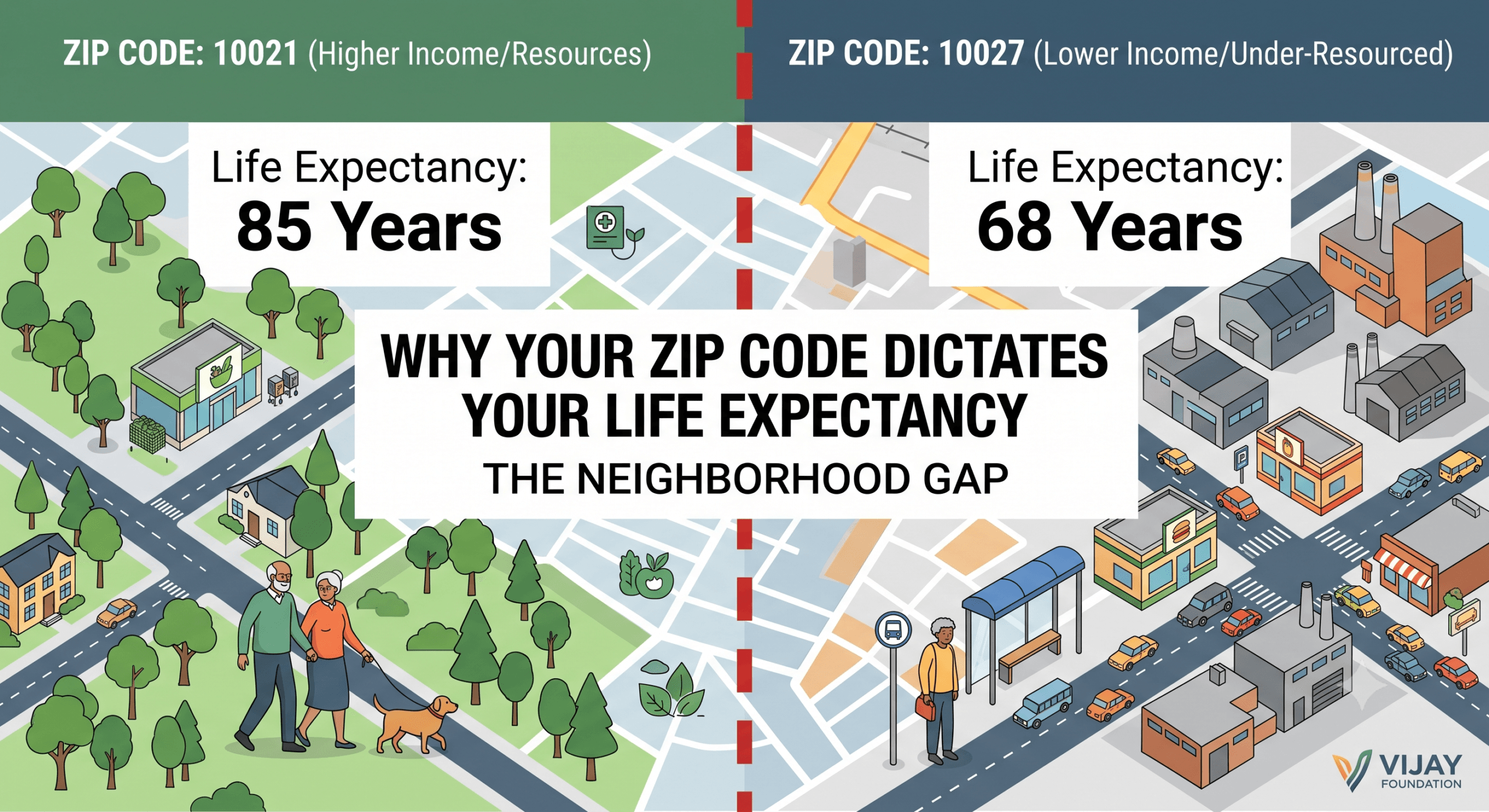
Ask a doctor what determines how long you'll live, and you might expect to hear about genetics or diet. But public health researchers increasingly point to a different, shocking metric: your zip code life expectancy. Across major cities, average lifespans can swing by decades between neighborhoods just a few miles apart — and the reasons trace back to healthcare access, environment, and policy, not personal choice alone.
The Zip Code Life Expectancy Gap Explained
Studies from major U.S. cities have found that lifespan can vary by 10, 15, even 20-plus years between neighborhoods separated by only a short commute. In Chicago, researchers have documented a gap of roughly three decades between residents of one affluent lakefront neighborhood and a historically under-resourced South Side community — despite the two being only a short train ride apart.
This isn't an isolated data point. Similar patterns repeat in New Orleans, Baltimore, Washington D.C., and dozens of other cities. The pattern is consistent enough that experts now treat zip code life expectancy as a stronger, more reliable predictor of your health outcomes than your genetic code.
5 Structural Factors Driving the Gap
It's tempting to assume this comes down to individual habits — diet, smoking, exercise. However, when analyzing zip code life expectancy, research points to something deeper: the structural conditions that shape those choices in the first place, aligning with data from major organizations like the World Health Organization (WHO).
- Access to healthcare. Some neighborhoods have hospitals and specialists within walking distance. Others are healthcare deserts, where the nearest emergency room is 30-plus minutes away.
- Food environment. "Food deserts" concentrate in low-income areas, where the nearest grocery store may be a long bus ride away and nutrition becomes a logistics problem, not just a willpower problem.
- Environmental exposure. Historically under-invested neighborhoods often sit closer to highways and industrial sites, leading to higher rates of asthma, heart disease, and certain cancers.
- Economic stability. Income affects housing quality, job safety, insurance coverage, and the ability to take time off for medical care — and chronic financial stress carries its own physiological toll.
- Safety and stress. Neighborhoods with fewer safe outdoor spaces see lower physical activity and higher chronic stress, both linked to long-term disease risk.
The Legacy of Historic Housing Policy
Many of today's health disparities trace back to policies from nearly a century ago. In the 1930s, federal lending maps graded neighborhoods for mortgage risk, often marking Black and immigrant communities as undesirable — a practice known as redlining. These neighborhoods were denied investment for decades while others received infrastructure and economic development.
The effects didn't disappear when the practice was formally outlawed in 1968. Formerly redlined neighborhoods today still show higher rates of heat exposure, air pollution, and chronic disease — a striking example of how policy decisions echo through generations as measurable health outcomes.
"Where you're born, and where you happen to live, can add or subtract years from your life before you've made a single personal health decision."
Why This Matters Beyond Statistics
If lifespan were purely a matter of personal choice, health interventions could focus solely on individual behavior change. But if geography and structural conditions are the dominant factors, the solutions have to be structural too: investing in healthcare infrastructure in underserved areas, expanding access to affordable food, addressing environmental hazards, building safe public spaces, and tackling the root economic inequities that shape everything else.
The Bigger Picture
Your neighborhood isn't destiny in a deterministic sense — plenty of individuals defy the odds of their local statistics. But at a population level, the data is hard to ignore. Understanding this doesn't mean giving up on personal responsibility for health. It means recognizing that responsibility operates within a landscape that isn't equally built for everyone — and improving zip code life expectancy requires fixing the landscape, not just individual behavior.
Frequently Asked Questions
Why does zip code life expectancy vary so much?
Zip code acts as a proxy for a bundle of structural factors — healthcare access, food environment, environmental exposure, income, and neighborhood safety — that accumulate over a lifetime and shape health outcomes more than individual behavior alone.
How big is the life expectancy gap between neighborhoods?
Research in major U.S. cities has documented gaps of 10 to 20-plus years in life expectancy between neighborhoods located just a few miles apart, even within the same city.
What role did redlining play in today's health disparities?
Discriminatory 1930s lending maps denied investment to many Black and immigrant neighborhoods for decades. Formerly redlined areas still show higher rates of pollution, heat exposure, and chronic disease today, showing how historical policy echoes into present-day health outcomes.
Can individual lifestyle choices overcome a zip code's health disadvantages?
Individual choices matter, and many people defy neighborhood-level odds. But at a population level, structural conditions — not willpower — account for most of the measurable gap, which is why public health experts push for community-level solutions alongside personal health efforts.
What can be done to close the neighborhood life expectancy gap?
Closing the gap requires structural investment: expanding healthcare infrastructure in underserved areas, improving access to affordable food, reducing environmental hazards, creating safe public spaces, and addressing the economic inequities that underlie the rest.
Support Health Equity in Your Community
Vijay Foundation provides free legal aid, healthcare access support, and community empowerment programs to underserved neighborhoods across Delhi-NCR.
Learn More at Vijay FoundationThis article is for general informational and educational purposes and does not constitute medical or legal advice. Readers should consult qualified professionals for guidance specific to their situation.