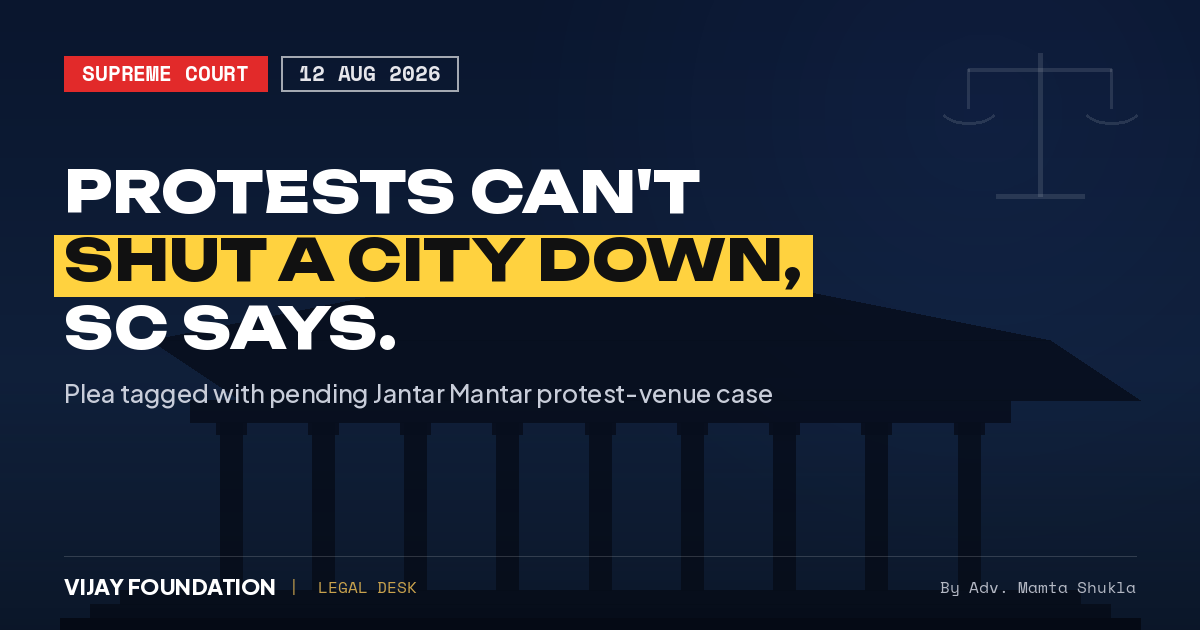
Protests can't shut a city down, SC says.
The Court has agreed to hear a plea on disruption of essential services during protests — and tagged it with a pending case on whether Jantar Mantar should remain Delhi's designated protest site.
On August 12, 2026, the Supreme Court of India agreed to hear a plea raising a question that sits at the uncomfortable intersection of two constitutional rights: the balance of the right to protest vs essential services, and the right of everyone else to get on with their day. A bench of Chief Justice of India Surya Kant, along with Justices Joymalya Bagchi and V Mohana, was told that when demonstrations are underway, hospitals, commuters, and critical infrastructure often get caught in the crossfire.
The Court did not brush the concern aside, but it didn't rush to grant relief either. Instead, it did something procedurally significant: it tagged the new plea with an already-pending case on where protests should be allowed to happen at all — a case centred on Delhi's Jantar Mantar. If you've been searching for clarity on the debate of right to protest vs essential services, here's what actually happened and why it matters.
"We do not know who is a protester and who is not"
Appearing for the petitioner, counsel told the bench that essential services are disrupted whenever protests are underway, and that ingress and egress — the ability to enter and leave an area — are completely disturbed. The submission was blunt: there is often no way of distinguishing a protester from a member of the general public caught in the same crowd, and this problem is not confined to Delhi — it is arising across the country.
The Chief Justice did not dismiss the concern, but he was candid about the difficulty ahead. The bench asked, in effect, how a court could realistically frame a direction broad enough to address disruption and balance the right to protest vs essential services without also curbing a constitutionally protected right. Even so, the Court agreed to hear the matter — a first step, not a final word.
"There is already a case pending before us concerning venues for protests, rallies and similar gatherings. Let this petition be tagged with that matter. But tell us, how can we issue a direction of this nature? We will hear the matter."
CJI Surya Kant, Supreme Court of IndiaWhy this got tagged with the Jantar Mantar case
The Court's decision to link this plea with the Jantar Mantar matter is the most consequential part of this update. That pending case argues that Jantar Mantar — Delhi's traditional, court-sanctioned protest site since a 2018 ruling — is no longer a suitable venue, citing safety and logistical concerns for local residents and disruption to the movement of essential goods and medical services. It has asked the Court to consider an alternative, larger venue such as Ramlila Maidan.
By tagging the two pleas together, the Supreme Court has effectively decided to examine the "where" and the "how much disruption is acceptable" questions of protest law in one breath, rather than as two separate disputes.
The context: Right to protest vs essential services
This case doesn't exist in a vacuum. The renewed scrutiny of protest venues comes in the backdrop of student-led demonstrations that began in June 2026, after the online collective Cockroach Janta Party (CJP) called for the resignation of the then Union Education Minister over repeated question paper leaks. Those protests built up to a large "Sansad Chalo" march towards Parliament on July 20, 2026 — the kind of large-scale, fast-moving demonstration that raises exactly the access and movement concerns now before the Court.
CJP call for resignation
Student-led protests begin after the Cockroach Janta Party demands the Education Minister's resignation over paper leaks.
"Sansad Chalo" march
Protests culminate in a large march towards Parliament, intensifying concerns about crowd control and essential-service access.
Supreme Court hearing
SC agrees to hear the essential-services plea and tags it with the pending Jantar Mantar venue case.
A question every citizen has a stake in
Protest is a constitutionally protected right in India, grounded in the freedom of speech and the freedom to assemble peaceably under Article 19 of the Constitution. But that right has never been treated as absolute — courts have long held that it can be regulated in the interest of public order, and that no one has an unqualified right to protest at a particular place.
For ordinary citizens, patients trying to reach a hospital, and protest organisers alike, the eventual outcome could reshape how demonstrations are planned, policed, and permitted across Indian cities — not just in Delhi. This is exactly the kind of constitutional question where legal awareness matters.
Nothing decided yet — but a marker has been laid down
It's worth being precise about what actually happened: the Supreme Court has not issued any direction restricting protests, nor has it ruled on the future of Jantar Mantar as a protest site. It has simply agreed to hear both matters together. The Chief Justice's own words — questioning how such a direction could even be framed — suggest the Court is alive to the difficulty of balancing two legitimate rights rather than favouring one over the other. The next hearing date will determine how quickly this moves forward.
Frequently asked questions
01What did the Supreme Court actually decide on 12 August 2026?
02What does it mean when the Supreme Court "tags" a petition with another case?
03What is the Jantar Mantar case about?
04Is the right to protest a fundamental right in India?
05Who is on the Supreme Court bench hearing this matter?
06Where can I get legal guidance on protest-related rights or complaints?
Need legal guidance on a civil rights matter?
Vijay Foundation's legal desk offers free, no-pressure guidance on constitutional, civil, and criminal law questions.
© 2026 Vijay Foundation · Registered Charitable Trust · This article is for general legal awareness and is not legal advice.