When Platforms Look Away: The Plea to Criminalise Silence on Child Sexual Exploitation and Abuse Material
A fresh petition before the Supreme Court says India's 2024 directions on CSEAM reporting social media mandates are being followed selectively. Now, the demand is clear: a single, non-negotiable rulebook for every digital intermediary operating in India.
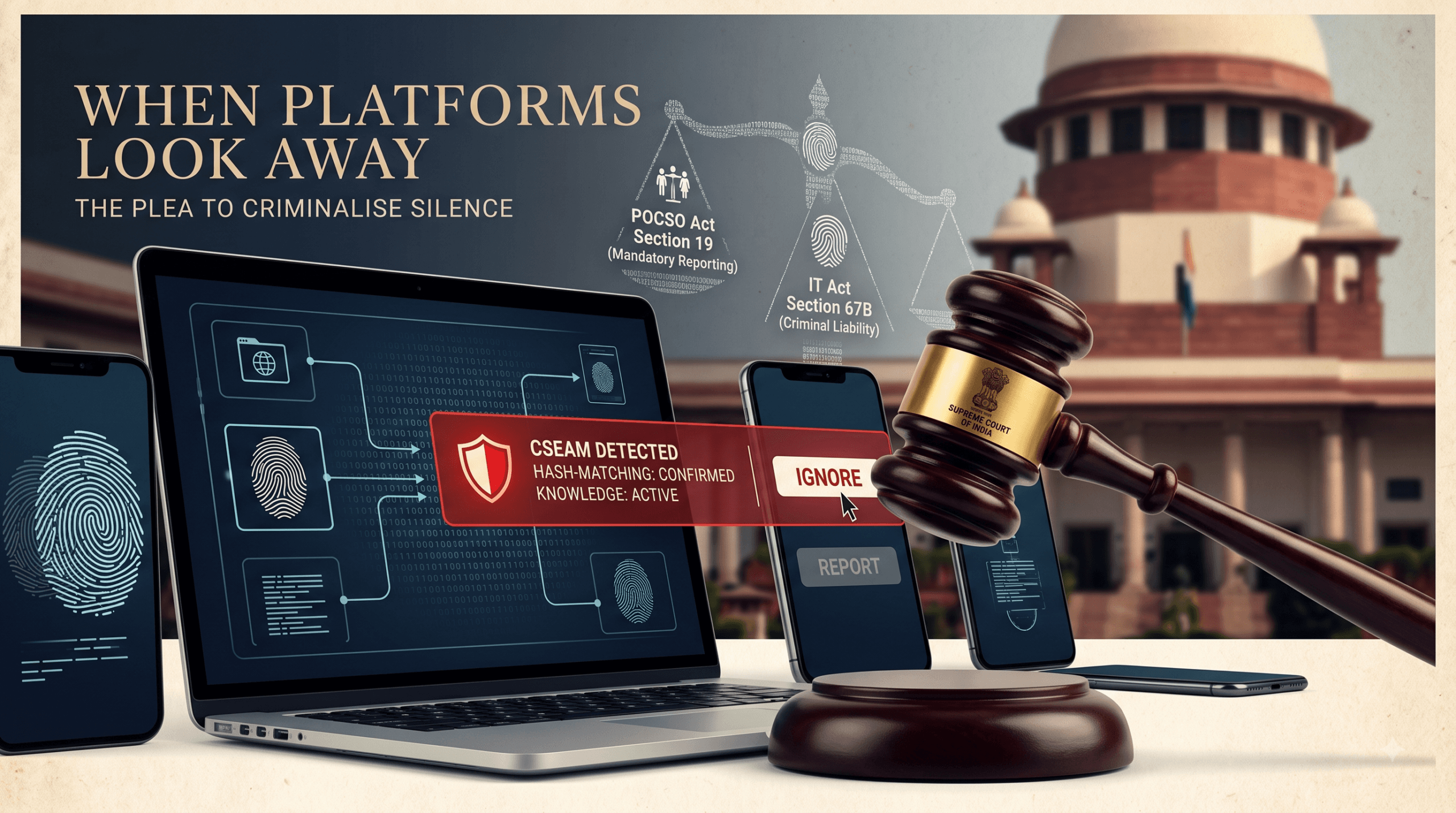
A new petition filed in the Supreme Court has reopened one of the most uncomfortable questions in India's digital-safety debate: what happens when a tech platform knows illegal material is circulating, but the CSEAM reporting social media protocol is completely ignored?
Key Highlights for Law Aspirants & Citizens
- A plea seeks criminal liability for social platforms failing to report CSEAM to law enforcement.
- Focuses on the intersection of POCSO Act (Sec 19) and IT Act (Sec 67B & 79).
- Exposes the technological reality: Platforms use 'Hash-Matching' to identify CSEAM, proving they possess "knowledge" of the crime.
- Demands a mandatory, uniform Standard Operating Procedure (SOP) across all intermediaries to replace selective corporate policies.
The petition asks the Court to do two things at once. First, to hold platforms accountable—including through criminal action—where they fail to report CSEAM discovered or flagged on their services. Second, to replace the current patchwork of corporate internal policies with a single, court-mandated Standard Operating Procedure (SOP) that every intermediary, regardless of size or origin, would be bound to follow.
The Technological Reality: How Do Platforms "Know"?
A common defense used by tech giants is the sheer volume of data: "We cannot monitor every post." However, the technological reality of CSEAM detection is entirely different. Tech platforms do not rely on humans looking at every image. They use automated tools like PhotoDNA and advanced Hash-Matching technology.
When an illegal image is identified anywhere in the world by organizations like NCMEC, it is assigned a unique digital fingerprint (a "hash"). When that exact file is uploaded to a platform like Facebook, X (formerly Twitter), or Telegram, the system automatically flags it. This means the platform doesn't just suspect a crime; their system mathematically knows it is CSEAM. The legal argument being raised is that ignoring an automated algorithmic flag is not just an oversight—it is criminal negligence.
The 2024 Directions That Started This CSEAM Reporting Social Media Debate
The backdrop to this plea is a landmark 2024 Supreme Court ruling that reshaped how Indian law treats online CSEAM. In Just Rights for Children Alliance v. S. Harish, the Court broadened the reading of Section 67B of the Information Technology Act. The Court made it clear that even viewing, storing, or exercising control over an account containing such material—without necessarily distributing it—can attract criminal liability.
This judgment effectively closed a loophole platforms and individuals had long leaned on: the argument that "mere possession," absent proof of onward transmission, was not punishable. Since then, Sessions courts have relied on CyberTipline reports from the US-based NCMEC to frame criminal charges, applying the doctrine of "constructive possession" (meaning control over an account is enough, even without the original physical device in hand).
The POCSO Overlap: The End of Safe Harbour?
While the IT Act governs the digital medium, the true teeth of India's child protection framework lie in the Protection of Children from Sexual Offences (POCSO) Act, 2012. For years, tech platforms navigated a grey area, citing 'intermediary safe harbour' under Section 79 of the IT Act, which protects them from liability for third-party content.
However, the new petition highlights a critical legal friction point: Section 19 of the POCSO Act makes it mandatory for any person (which includes corporate entities) who has an apprehension that an offense has been committed against a child to report it. The argument is simple—safe harbour cannot shield platforms from POCSO's mandatory reporting mandate when their algorithms or moderators explicitly detect CSEAM.
The Legal Framework Explained
Deals with the punishment for publishing, transmitting, or browsing/downloading material depicting children in sexually explicit acts. The 2024 SC ruling confirmed that digital "possession" falls under this section.
Specifically penalizes the storage of pornographic material involving a child. It imposes strict liability on anyone holding such content for commercial purposes or failure to destroy/report it.
Mandatory Reporting: Any person who has knowledge that a child has been sexually abused, or material is being circulated, must report it to the Special Juvenile Police Unit or local police. Failure to do so is a punishable offense under Section 21.
The Privacy vs. Protection Dilemma: The E2EE Debate
No discussion on CSEAM is complete without addressing End-to-End Encryption (E2EE) platforms like WhatsApp and Signal. These platforms argue that they cannot scan user messages without breaking encryption, thereby compromising the privacy of millions of law-abiding citizens.
This "Privacy vs. Safety" debate has reached a boiling point in Indian courts. While the right to privacy was upheld in the landmark Puttaswamy judgment, the Supreme Court has repeatedly noted that fundamental rights are not absolute. Advocates argue that platforms must either employ client-side scanning (where the device checks for hashes before sending) or be held liable for the metadata (group names, reporting history) they choose to ignore. This specific plea focuses heavily on demanding accountability in spaces where encryption is not an excuse—like public groups, open timelines, and unencrypted platforms.
Looking Outward: The Global Standard
India is not fighting this battle in isolation. Globally, the leash on tech giants is being tightened. The UK recently passed the Online Safety Act, which threatens top executives with actual jail time if they fail to protect children from CSEAM. The European Union’s Digital Services Act (DSA) imposes massive financial penalties on platforms failing to audit and mitigate systemic risks to minors.
The petitioners argue that if global tech platforms can comply with the rigorous demands of the UK and EU, there is no justifiable reason they should operate with lax standards in India. A uniform SOP would bring India's regulatory framework at par with the strictest global standards.
On paper, India now has one of the more assertive judicial postures on platform accountability for CSEAM in the world. In practice, enforcement still depends heavily on which platform you're dealing with—and how seriously its compliance team takes POCSO mandates. — Legal Desk Analysis
Why "Uniform" Is the Word Doing All the Work
The core grievance in the new plea isn't that the law is silent—it's that CSEAM reporting social media compliance is being read differently by different platforms. Some intermediaries report proactively; others respond only after a court order lands on their desk. Without one binding SOP, each company effectively writes its own definition of "reasonable effort."
What a Uniform SOP Would Likely Cover
- A fixed, court-defined timeline for reporting flagged CSEAM to Indian law enforcement and NCMEC.
- Mandatory preservation of metadata, IP logs, and account details the moment content is flagged, preventing evidence destruction.
- A named, accountable resident grievance officer in India who can be legally summoned, rather than an automated support ticket system.
- Standardised hash-matching and proactive detection tools to ensure smaller platforms maintain the same safety standards as tech giants.
- Clear escalation to criminal proceedings under the POCSO Act when a platform is shown to have known about the content and failed to report it.
A rule followed by some platforms is not a rule. It's a suggestion with a corporate lawyer attached.
What's Actually at Stake?
If the Supreme Court accepts the plea's framing, the practical consequences for intermediaries will be massive. A binding SOP would give trial courts and police a concrete legal checklist. For a company found to have detected CSEAM and simply not reported it, the exposure would no longer be limited to a mere IT Act compliance notice; it could mean direct criminal prosecution of the platform's responsible officers under POCSO and the Bharatiya Nyaya Sanhita (BNS).
For victims, the stakes are deeply human. Every hour a report sits unfiled in a tech company's queue is an hour a piece of abuse material keeps circulating, re-victimizing a child. The Supreme Court's decision on this plea will decide whether India finally enforces one mandatory standard for digital child safety, or continues to rely on corporate goodwill.
Frequently Asked Questions (FAQs)
Is simply viewing or downloading CSEAM a crime in India?
Yes. Following the landmark 2024 Supreme Court judgment (Just Rights for Children Alliance v. S. Harish), viewing, downloading, or exercising control over an account containing CSEAM constitutes "possession." This is a punishable criminal offense under Section 67B of the IT Act and Section 15 of the POCSO Act.
What is the liability of Social Media Platforms?
Platforms generally claim 'Safe Harbour' under Section 79 of the IT Act. However, under Section 19 of the POCSO Act, mandatory reporting is required if they detect child abuse material. The current Supreme Court plea argues that failing to report should strip platforms of safe harbour immunity and attract criminal charges.
How do platforms bypass end-to-end encryption to detect CSEAM?
For fully encrypted platforms (like WhatsApp), content cannot be scanned in transit. However, advocates argue that platforms must still act upon metadata, user reports, and group names. On unencrypted platforms, systems like 'PhotoDNA' automatically match uploaded files against a global database of known illegal material.
What does the new plea in the Supreme Court demand?
The plea demands a uniform, court-mandated Standard Operating Procedure (SOP) for all tech intermediaries. It asks for strict timelines for reporting CSEAM, mandatory preservation of digital evidence (like IP addresses), and criminal action against platforms that stay silent.
Where can a citizen report online child abuse material?
Citizens can report illegal content anonymously on the Government of India's National Cyber Crime Reporting Portal. Internationally, reports can also be made to the NCMEC CyberTipline.
Need Confidential Legal Assistance?
Vijay Foundation's legal aid team assists families navigating POCSO complaints, cybercrime reporting, and child-safety cases free of cost.
References & Legal Citations
- Supreme Court Judgment (2024): Just Rights for Children Alliance v. S. Harish
- The Information Technology Act, 2000 (Section 67B & 79) - India Code
- The Protection of Children from Sexual Offences (POCSO) Act, 2012
- The Week — Centre's CSEAM crackdown gets judicial backing
- Deccan Herald — Supreme Court on social media regulation for minors