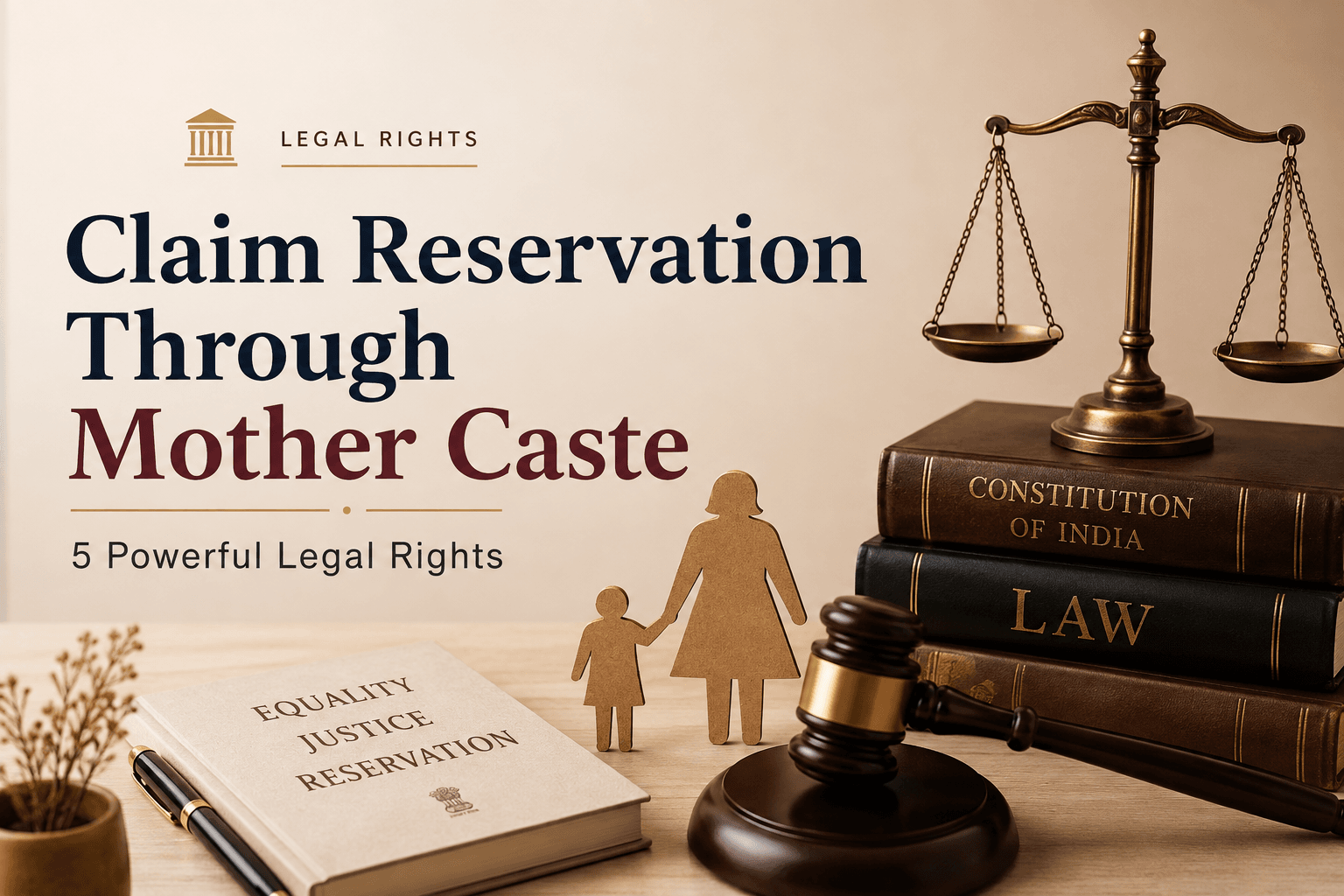
Claim Reservation Through Mother Caste: 5 Powerful Legal Rights
India's social fabric is rapidly evolving. With the rise of inter-caste marriages and the increasing empowerment of single mothers, a recurring and deeply personal legal question frequently arrives at my desk: "How can a child legally claim reservation through mother caste, rather than being forced to use the father's?"
Yes — you can claim reservation through mother caste, but only if you can show you were raised within her community and shared its social disadvantages. Courts test lived reality, not lineage on paper.
Historically, Indian society — and by extension, the administrative machinery — has operated on deeply entrenched patriarchal norms. Government authorities have often rigidly maintained that a child automatically inherits the caste, domicile, and communal status of the father by birth. But does the Constitution of India support this archaic view?
As an Advocate at the Supreme Court of India and the Founder Trustee of Vijay Foundation, I have guided numerous citizens, law students, and marginalized families through the labyrinth of reservation laws. The legal answer to this question is a resounding yes — but it is subject to specific legal tests based on the child's upbringing and social reality. In this comprehensive guide, we will break down the constitutional rights, landmark Supreme Court judgments, and the practical implementation of claiming reservation benefits through a mother's lineage.
I. The Constitutional Framework
To understand the judiciary's stance, we must first understand the fundamental purpose of the reservation system in India.
Reservation under Articles 15(4) and 16(4) of the Constitution is not a hereditary title; it is an affirmative action tool designed to uplift communities that have historically faced severe social, educational, and economic deprivation. The primary trigger for conferring Scheduled Caste (SC), Scheduled Tribe (ST), or Other Backward Class (OBC) benefits is the social disadvantage, stigma, and handicap a person suffers.
Therefore, denying a child the right to claim their mother's marginalized community status merely because society is patriarchal violates the fundamental right to equality (Article 14) and the right against discrimination (Article 15). The law cannot ignore a child's actual suffering just because of their father's higher caste or different native origin.
II. Breaking the Patriarchal Mold
The journey of maternal caste inheritance in Indian courts is a fascinating evolution from rigid customary law to progressive, reality-based jurisprudence.
For decades, the standard presumption was that a child born of an inter-caste marriage inherits the father's caste. This judgment clarified that while a general presumption favours the father's caste, it is neither conclusive nor unchallengeable. A child can rebut it by proving they were brought up in the mother's community and suffered the same deprivations, indignities, and handicaps as other members of that SC/ST community.
The Court struck down the Puducherry administration's refusal to grant MBC/SC/OBC certificates to children whose mothers were natives of Puducherry but whose fathers were migrants from other states — rejecting the government's patrilineal argument outright.
The basis of reservation is only social disadvantage and the sufferings and stigma attached to the child. Whether it is patrilineal or matrilineal makes no difference. — Madras High Court, Thelagam v. UT of Puducherry
The judgment cemented the rule that if a child is born and raised in the mother's caste surroundings, they cannot be denied reservation benefits merely because the father belongs to a different state or forward caste.
For more insights into constitutional rights and high court rulings, explore the extensive legal resources on the Vijay Foundation Blog.
III. Core Tests to Claim Reservation Through Mother Caste
While the courts allow a child to adopt the mother's social status, it is not an automatic administrative process. You cannot simply attach the mother's caste certificate and expect an immediate approval. The law requires you to pass the Test of Social Upbringing. Authorities and Scrutiny Committees will evaluate three factors:
- Environment and upbringingWas the child raised within the fold of the mother's community? If the father is from a forward caste but abandoned the family, and the child grew up entirely in the mother's SC/ST household, the child clearly shares the mother's social status.
- Community acceptanceHas the mother's community accepted the child as one of their own? This can be proven through community participation, marriage customs, and social integration.
- Experience of disabilitiesDid the child face the same societal barriers, prejudices, and backwardness associated with the mother's caste during their schooling and developmental years?
IV. A Real-Life Case Study
Let us consider a practical scenario to make this easier to understand.
The situation
Anita, an SC woman from Uttar Pradesh, marries Rahul, a General Category man. A few years after their son, Rohan, is born, the couple separates. Rahul moves away and ceases all contact. Anita raises Rohan single-handedly in her ancestral village, amidst her SC community.
The dispute
When Rohan applies for college, he applies for an SC certificate to claim reservation. The local Tehsildar rejects the application, stating that Rohan is a General Category candidate by birth because of his father.
The legal remedy
Applying the Supreme Court's rationale, the Tehsildar's rejection is legally flawed. Rohan's lived reality is that of his mother's community — he has not enjoyed any of the social or economic privileges of his father's forward caste. Anita can file an appeal or a Writ Petition in the High Court, showcasing school records, panchayat testimonies, and affidavits proving that Rohan was brought up completely within the SC community. The court will mandate the issuance of the SC certificate to Rohan.
V. The Road Ahead
Despite crystal-clear directives from the Supreme Court and various High Courts, grassroots revenue authorities — Tehsildars and Sub-Divisional Magistrates — often continue to harass single mothers and children of inter-caste marriages, demanding the father's caste proof.
This forces marginalized citizens into exhausting legal battles. What India urgently needs is a sweeping administrative reform — a uniform statutory guideline issued by the Ministry of Social Justice and Empowerment, directing all state authorities to assess caste claims based on upbringing and social reality, rather than blind patriarchy.
If you or someone you know is facing unlawful rejection of a caste certificate despite fulfilling the legal criteria, do not hesitate to seek legal recourse. Organizations like ours are dedicated to fighting for your constitutional rights.
Reach out to Vijay Foundation Legal Services for guidance and support. To read the official Supreme Court judgments on social justice and reservation, visit the Supreme Court of India Official Portal.
Frequently Asked Questions
Can a child automatically get the mother's caste certificate if the parents had an inter-caste marriage?
No, it is not automatic. To successfully claim reservation through mother caste, the child must prove that they were brought up in the mother's community and suffered the same social disadvantages. If the child was raised in a privileged environment afforded by a forward-caste father, the claim may be rejected.
My ex-husband is General category and I am OBC. Can my daughter claim OBC reservation?
Yes. If you have raised your daughter independently within your community surroundings and she has not benefited from her father's social status, you can apply for an OBC certificate for her by providing evidence of her upbringing and community acceptance.
The Tehsildar rejected my child's SC application, saying caste is only derived from the father. What should I do?
This administrative stance is legally outdated and contradicts Supreme Court judgments. You have the right to file an appeal before the District Scrutiny Committee or the District Collector. If the administrative appeal fails, you can file a Writ Petition in your State's High Court citing the Rameshbhai Dabhai Naika (2012) judgment.
Does this rule apply to adopted children?
The law regarding adopted children is slightly different. Generally, a child born in a forward caste cannot claim SC/ST reservation merely by being adopted into an SC/ST family, as they did not suffer the historical stigma from birth. However, each case is evaluated on its unique facts regarding how early the adoption took place and the child's integration into the community.
Are the rules the same across all Indian states?
The fundamental constitutional principles laid down by the Supreme Court apply pan-India. However, the procedural rules for issuing certificates, and specific state government orders, can vary slightly from state to state. It is always advised to consult local state guidelines alongside Supreme Court precedents.