
Movie Delayed by Ads? Understanding Your Legal Rights & Consumer Court Remedies
Your ticket says 10:35 PM, but the film starts at 10:52 PM. A consumer court has now recognised this practice as an actionable legal injury. Learn your rights and how to file a complaint.
Introduction
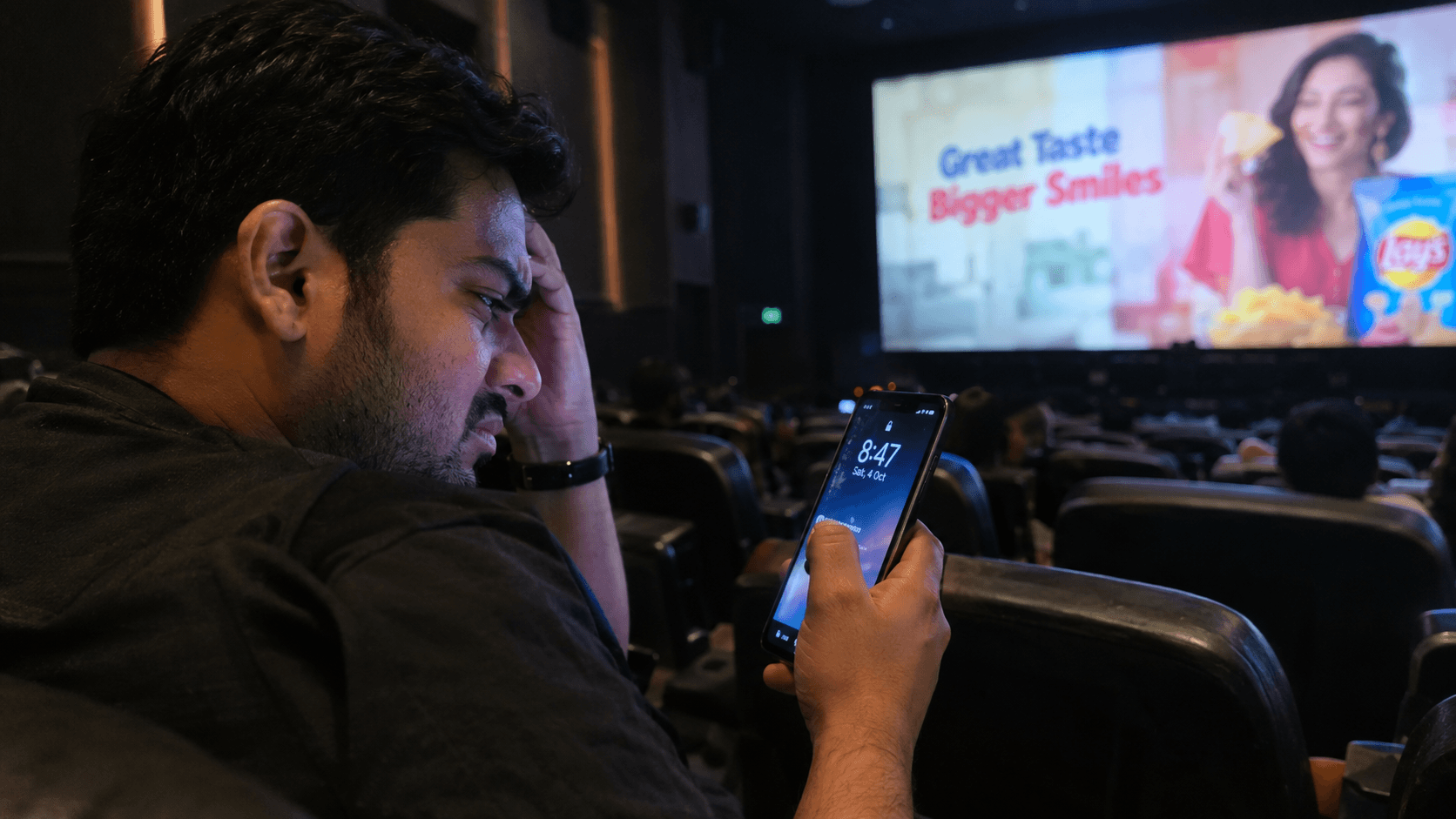
If you want to take action against a movie delayed by ads, consumer court rulings in India now provide a clear and powerful path for compensation. You purchase a premium multiplex ticket for a highly anticipated film. The ticket clearly states the showtime is 10:35 PM. You rush through traffic, grab your popcorn, and take your seat on time. However, instead of the feature film, you are subjected to an endless loop of commercial advertisements, automobile commercials, and promotional trailers. The actual movie does not begin until 10:52 PM.
This 15 to 25-minute delay has become a frustrating, unspoken norm across Indian multiplexes. Theatres effectively use paying consumers as a "captive audience" to generate massive advertising revenue, completely disregarding the consumer's time and schedule.
But does this widespread industry practice constitute a legal wrong?
Recently, an aggrieved moviegoer in Hyderabad decided he had endured enough. He took a leading multiplex chain to the consumer forum, resulting in a landmark 2026 ruling that officially recognised this practice as an actionable legal injury. This article explores the legislative framework, the crucial legal counter-arguments to multiplex defenses, and the practical steps you can take if you face a similar situation. To understand your wider protections, you can also read our guides on consumer rights awareness at Vijay Foundation.
Key Takeaway
Screening commercial advertisements beyond the scheduled showtime, leading to an unreasonable delay in a movie's commencement, constitutes a "deficiency in service" and an "unfair trade practice" under the Consumer Protection Act, 2019. Furthermore, fine-print disclaimers validating these delays are deemed "unfair contracts." Aggrieved viewers possess the legal right to approach Consumer Dispute Redressal Commissions or the CCPA to claim compensation and punitive damages.
The Legislative & Regulatory Backbone
To understand why a delayed movie screening violates the law, we must examine the intersection of consumer protection laws, broadcasting guidelines, and state regulations.
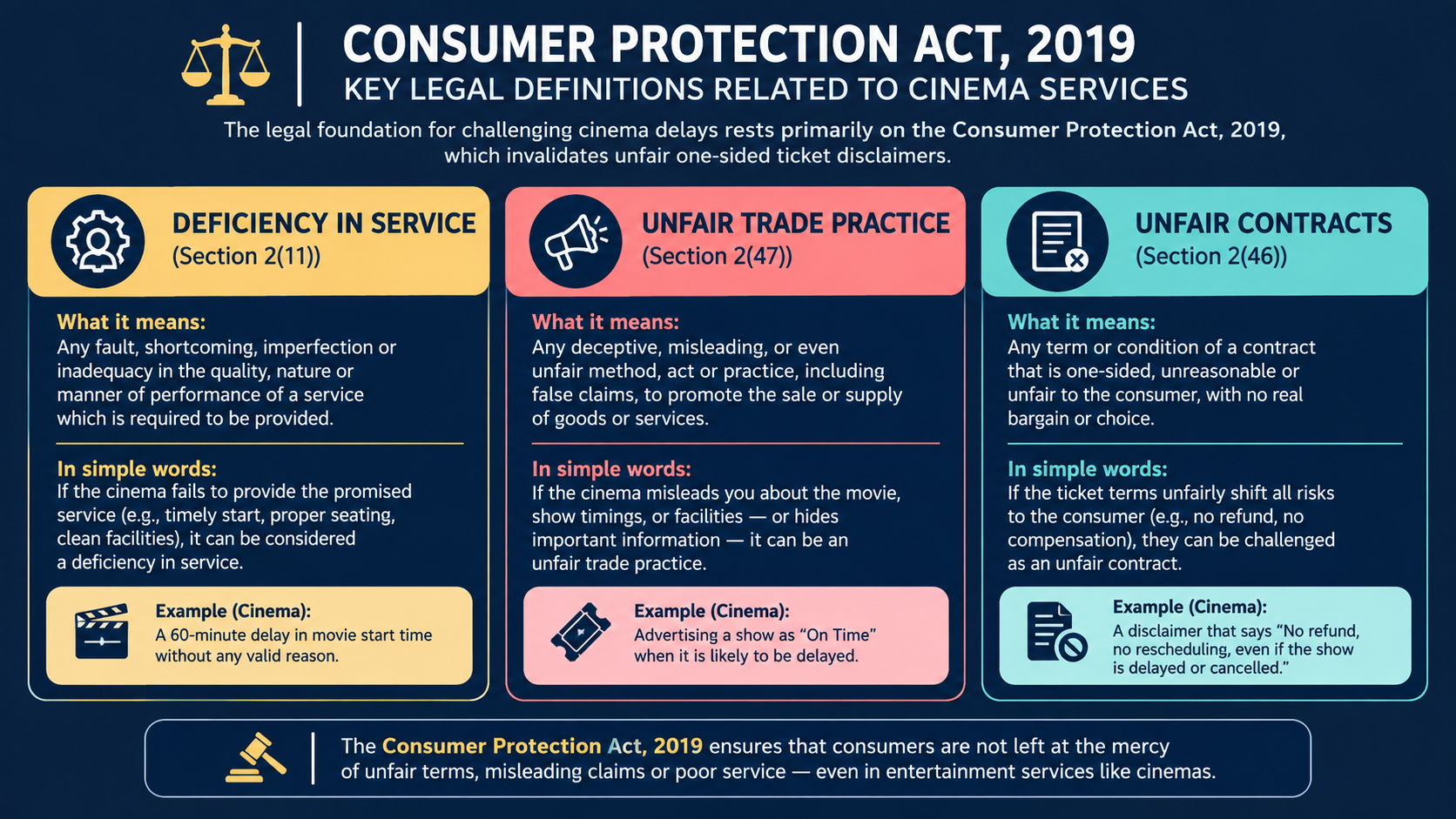
The Consumer Protection Act, 2019
When you purchase a movie ticket, you enter into a contract for a specific service at a specific time.
Section 2(11) – Deficiency in Service
This defines a deficiency as any fault, imperfection, shortcoming, or inadequacy in the quality, nature, or manner of performance required by law. Delaying a scheduled service to play third-party commercials falls squarely under this definition.
Section 2(47) – Unfair Trade Practice
This covers practices adopted for promoting the sale or supply of any goods or services by adopting an unfair or deceptive method. Luring consumers for a 10:35 PM showtime while internally planning to start the film at 10:52 PM is highly deceptive.
The Multiplex Defense: "It's in the Terms and Conditions"
When taken to court, multiplexes routinely argue that their physical tickets and online booking platforms carry a disclaimer stating:
However, under Section 2(46) and Section 47 of the Consumer Protection Act, 2019, courts can strike down "Unfair Contracts." A unilateral, one-sided disclaimer printed in tiny font, which leaves the consumer with zero bargaining power, cannot override the consumer's fundamental right to fair service. A ticket disclaimer is not a blank cheque to hijack 22 minutes of a consumer's paid time.
State Cinemas (Regulation) Acts
Every state has local municipal laws governing cinema licensing (e.g., the UP Cinemas Regulation Act, Delhi Cinematograph Rules). Under these licensing conditions, District Magistrates (DMs) have the authority to regulate exhibition times. If a theatre habitually violates these scheduled exhibition times to maximise commercial ad revenue, consumers have the concurrent right to file a grievance directly with the DM or the local licensing authority, potentially risking the theatre's operating license.
Ministry of Information and Broadcasting (I&B) Guidelines
Theatres often defend long ad breaks by claiming they are fulfilling their statutory duty to show Public Service Awareness (PSA) films (such as health advisories or anti-tobacco warnings). However, the Ministry of Information and Broadcasting has issued clear guidelines restricting the duration of such approved PSA films to a maximum of 2 minutes. Any commercial advertising played beyond this statutory requirement to derive corporate profit crosses the line into commercial exploitation.
Judicial Interpretation & Landmark Precedents
Consumer Commissions across India have repeatedly frowned upon the practice of forced advertisements. A highly notable 2026 order brings fresh, concrete clarity to this issue.
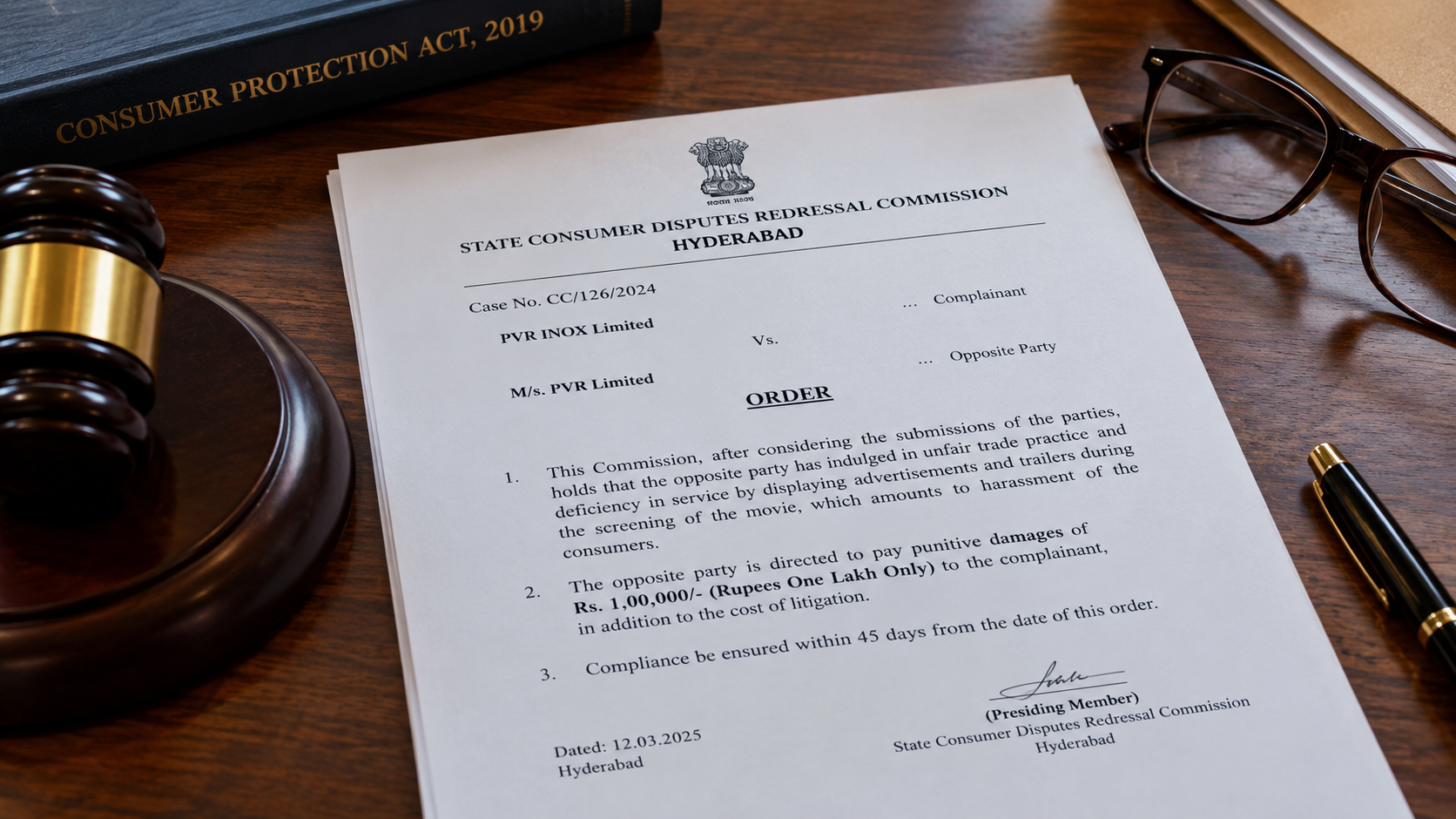
Chanda Athish Kumar v. PVR Cinemas and Another
Order dated September 11, 2026- Court
- District Consumer Disputes Redressal Commission-II, Hyderabad
- Year
- 2026 (Order dated September 11, 2026)
- Facts
- An advocate booked a ticket for the Telugu film Kubera, scheduled for a 10:35 PM showtime. After enduring a barrage of commercial ads and trailers, the feature film finally started at 10:52 PM, a delay of nearly 22 minutes. Because of this, the consumer reached home at 3:00 AM instead of 2:00 AM, exposing him to late-night travel hazards and disrupting his rest.
- Legal Issue
- Does a 22-minute delay in screening a film due to commercial advertisements constitute an actionable deficiency in service, despite multiplex defenses?
- Court's Reasoning
- The Commission observed that the theatre intentionally played commercial advertisements to generate revenue from a seated, captive audience, effectively hijacking the consumer's paid time. Relying on the I&B Ministry guidelines that limit public service films to two minutes, the Commission rejected the theatre's defense that the ads served a public interest.
- Principle Established
- Time is a valuable commodity. Screening commercial advertisements beyond the scheduled showtime, leading to substantial delays, is both an unfair trade practice and a deficiency in service.
- Practical Significance
- The Commission ordered the multiplex to pay:₹20,000Compensation for inconvenience₹5,000Litigation costs₹50,000Punitive damages to the District Consumer Welfare Fund, to deter repetition of such exploitative practices
Note: While District Commission orders are subject to appellate challenge, this ruling serves as a highly persuasive precedent for consumers nationwide.
Rights, Liabilities & Consumer Protection
To navigate this issue effectively, consumers must understand the boundaries of their rights and the liabilities of the cinema management.
Your Rights
- Right to Accurate Information: You have the fundamental right to know the exact time the feature film commences.
- Right to Reject Forced Commercials: While you cannot avoid the 2-minute mandatory public service announcements, you are not contractually bound to consume 20 minutes of corporate advertising on paid time.
Institutional Liability
Multiplex chains are liable if they intentionally print misleading showtimes. If a ticket states 10:35 PM, the core service (the movie) must reasonably begin at 10:35 PM, making allowances only for statutorily mandated PSA films. Earning advertising revenue by deliberately delaying the main service constitutes unjust enrichment.
Available Remedies
If you face this issue, you can approach the District Consumer Disputes Redressal Commission where you reside or where the cinema is located. You can also learn how the National Consumer Disputes Redressal Commission (NCDRC) sits at the top of the three-tier system.
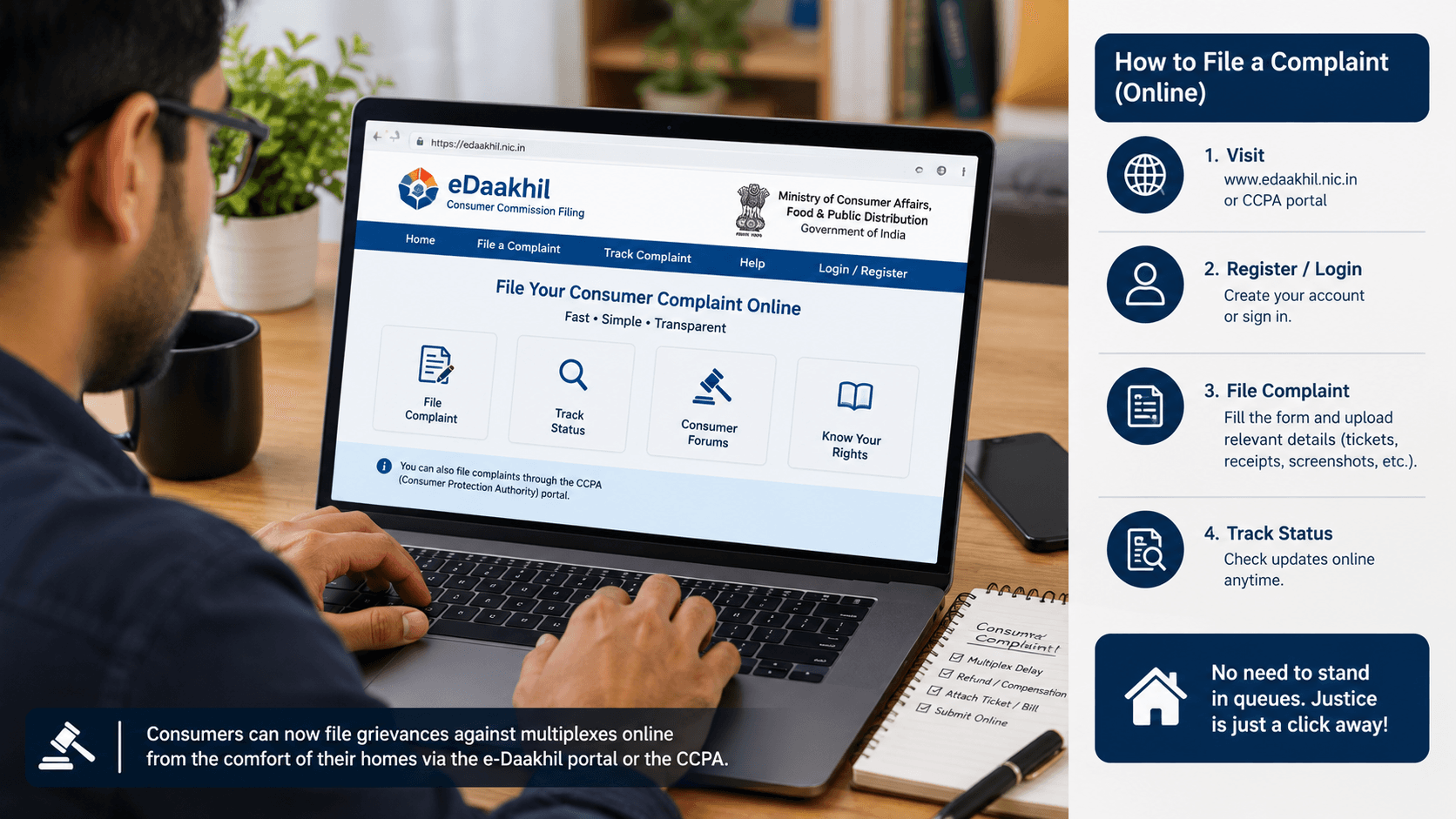
Complaint to the CCPA for Class Action
Because delayed movie screenings affect millions of citizens daily, this is not merely an individual grievance. It is a class-wide injury. Consumers can file a complaint directly with the Central Consumer Protection Authority (CCPA). The CCPA has the statutory power to take suo moto cognizance, conduct investigations, issue nationwide directives banning the practice, and levy massive fines on multiplex chains, bypassing the need for a lengthy individual trial. You can also raise your grievance through the National Consumer Helpline.
Practical Scenario: What Should You Do?
Imagine you go to a theatre with your family for a 6:00 PM show. By 6:25 PM, you are still watching car and real estate commercials. You want to take legal action. How do you build your case?
- Preserve the Evidence: Retain your physical ticket or PDF e-ticket showing the scheduled 6:00 PM start time.
- Record the Delay: Take a quick, timestamped photograph or video inside the hall at 6:25 PM showing the ads playing. Take another timestamped photo the exact moment the Censor Board Certificate (the start of the film) appears on the screen.
- Establish Contact: Write an email to the cinema's customer grievance officer immediately after the movie, officially placing the exact minutes of delay on record.
Common Mistakes People Make
What You Should Do & What You Should Avoid
What You Should Do
- Send a Formal Legal Notice: Before approaching the consumer forum, send a written legal notice to the cinema's registered corporate office, demanding compensation for the deficiency in service.
- Use e-Daakhil: If they ignore the notice, utilise the Government of India's e-Daakhil portal to file your consumer complaint online easily.
- Claim Specific Damages: Quantify your loss. Did the delay cause you to pay extra for a late-night cab? Did it cause mental harassment? Document it clearly.
What You Should Avoid
- Creating a Disturbance: Do not engage in physical altercations or shouting matches with the ground staff or theatre manager. They do not control the centrally programmed advertising servers.
- Exaggerating Claims: Asking for ₹10 Lakhs in compensation for a 20-minute delay will result in your case being dismissed as frivolous. Keep compensation demands proportionate and reasonable.
Critical Analysis & The Road Ahead
While the Hyderabad Commission's 2026 ruling is a massive victory, the systemic issue remains unsolved. Multiplexes heavily rely on advertising revenue to maintain profitability, and until the cost of judicial penalties outweighs the ad revenue generated during those 22 minutes, the practice will likely continue.
The Constitutional Lens: The "Captive Audience" Doctrine
From a jurisprudential perspective, this issue touches upon the "Captive Audience Doctrine," which intersects with Article 21 of the Constitution (Right to Life and Personal Liberty, which includes the right to be let alone). When a consumer purchases a ticket, enters a dark auditorium, and takes a seat, they cannot easily leave without losing their spot or missing the start of the film. Forcing commercial messaging upon a captive audience that has explicitly paid for entertainment is fundamentally exploitative.
The Transparency Solution
The Ministry of Information and Broadcasting, in conjunction with the CCPA, should mandate a simple ticketing reform. Tickets should explicitly state two distinct times:
This simple regulatory fix would entirely cure the "deficiency in service" because consumers would have transparent information and the freedom to choose whether to sit through the ads or arrive exactly when the movie begins. Until such regulations are enforced, empowered citizens filing consumer complaints, and class action petitions via the CCPA, remain the strongest deterrents.
Conclusion
Your time has value. When multiplex chains unilaterally delay a scheduled screening by 20 to 30 minutes to maximise their advertising revenues, they are violating the fundamental tenets of the Consumer Protection Act. The law does not permit them to hide behind unfair "terms and conditions," nor can they artificially prolong intervals to trap a captive audience. The recent judicial precedents clearly indicate that courts are losing patience with this unfair trade practice. By preserving your evidence and utilising modern, accessible forums like the CCPA and e-Daakhil, you can hold these entities accountable and secure the compensation you rightfully deserve.
Frequently Asked Questions
1. Can multiplexes legally show advertisements before a movie?
Yes, theatres are legally permitted to show advertisements. However, they cannot do so by delaying the scheduled start time of the feature film printed on your ticket. Mandatory Public Service Awareness (PSA) films are restricted to a maximum of 2 minutes.
2. Can the theatre defend itself by saying the ticket says "showtime includes ads"?
No. Under Sections 2(46) and 47 of the Consumer Protection Act, 2019, one-sided terms printed in fine print that leave the consumer with no bargaining power are classified as "Unfair Contracts" and can be struck down by the consumer court.
3. What if the cinema makes the interval (intermission) unreasonably long for ads?
Indian law does not mandate long intermissions. If a theatre artificially stretches an interval to 20 minutes specifically to play commercial advertisements and sell food, this also constitutes an unfair trade practice and a deficiency in service.
4. Do I need to hire a lawyer to file a case against a cinema hall?
No. The Consumer Protection Act is designed to be citizen-friendly. You can file and argue the complaint yourself, either in person or virtually through the e-Daakhil portal. However, consulting a lawyer for drafting the initial legal notice is highly recommended.
5. What evidence do I need to prove the movie was delayed?
You will need your original movie ticket (or digital invoice), the exact scheduled showtime, timestamped photographs or videos taken inside the theatre showing advertisements playing past the showtime, followed by a timestamped photo of the Censor Board certificate when the movie finally begins.
Useful Official Resources
Visit Vijay Foundation to read more on consumer rights and legal awareness.
Explore Vijay Foundation