
Jantar Mantar De-Notified as Protest Venue: What the Delhi Police Order Means
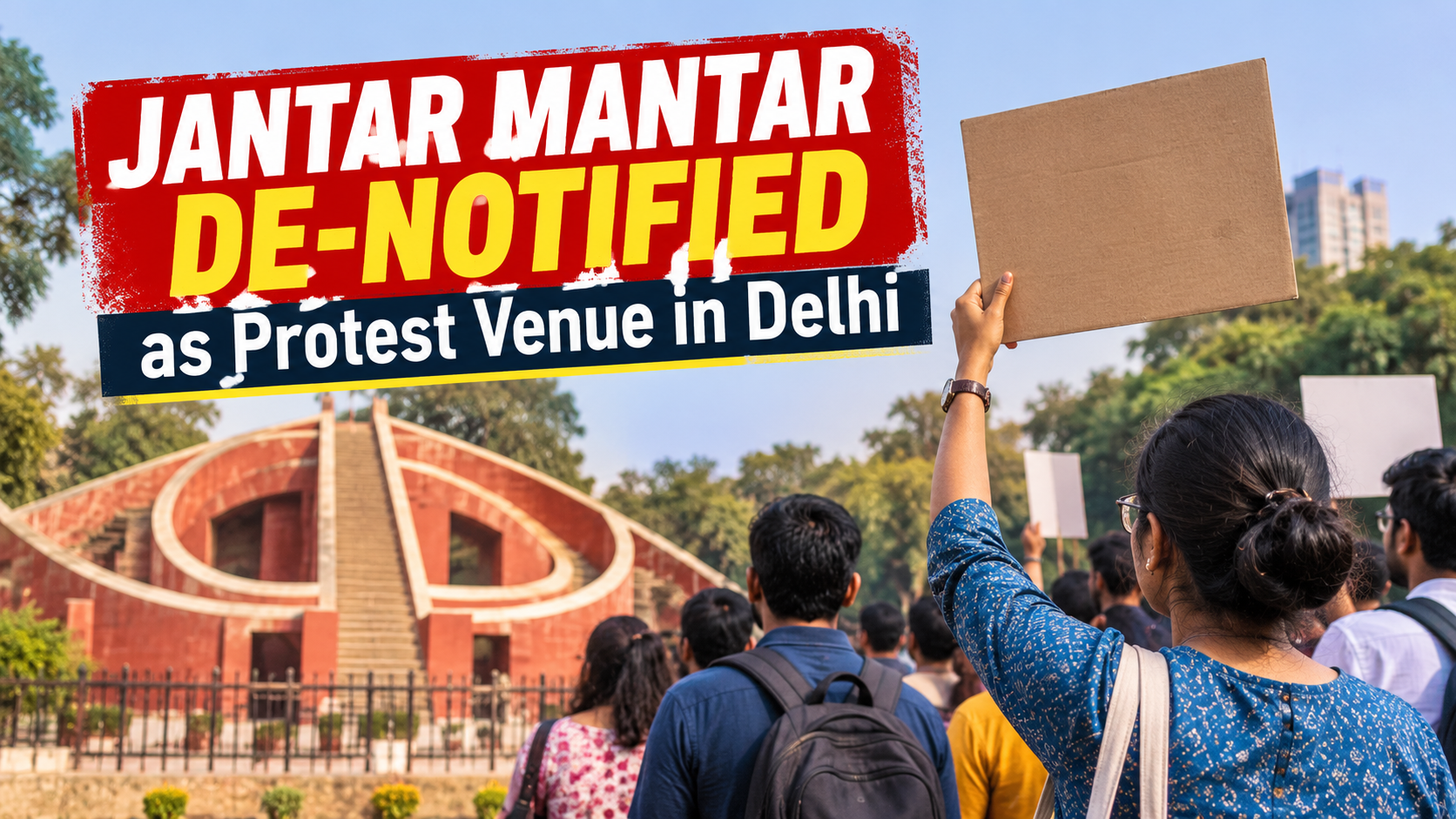
Delhi Police has withdrawn Jantar Mantar as a designated venue for protests and demonstrations and named Ramlila Ground, Burari Ground and CBD Ground in East Delhi as the new venues. The change follows a Home Ministry committee's recommendations, and a revised procedure is yet to be issued.
Introduction
For decades, Jantar Mantar has been the place where Delhi's protesters came to be heard. Its proximity to Parliament and the central government offices made it the natural stage for demonstrations on causes ranging from labour rights to electoral reform. On 11 October 2026, the Delhi Police Commissioner, Anurag Kumar, issued a standing order that removed Jantar Mantar as a designated protest venue. The order was publicised the next day.
The order names three replacements: Ramlila Ground, Burari Ground and CBD Ground in East Delhi. It states that the change is based on the recommendations of a committee constituted by the Union Ministry of Home Affairs to examine alternative venues. The order also says that a detailed and revised procedure for protests at the three new venues will be issued separately. This article explains what the order says, the constitutional framework that applies to it, and the questions it raises.
- Delhi Police has removed Jantar Mantar as a designated protest venue under a standing order dated 11 October 2026, which partially modifies an earlier standing order of 28 April 2022.
- Ramlila Ground, Burari Ground and CBD Ground in East Delhi are the three new designated venues, and a detailed procedure for them is to follow.
- The right to peaceful protest is constitutionally protected, but the State may regulate the time, place and manner of protests. The question is whether these new venues are reasonable and accessible.
The Legislative and Regulatory Backbone
Article 19(1)(a) of the Constitution guarantees freedom of speech and expression. Article 19(1)(b) guarantees the right of citizens to assemble peacefully and without arms. Together, these provisions form the basis of the constitutional right to protest, which the Supreme Court has recognised as part of the freedoms guaranteed by Article 19.
Article 19(3) allows the State to impose reasonable restrictions on the right to assemble in the interest of public order, along with sovereignty and integrity of India. Any restriction must be reasonable, and it must relate to one of the grounds listed in the Article.
The standing orders issued by the Delhi Police are administrative instruments. They are not statutes passed by Parliament. The earlier standing order of 28 April 2022 set out the procedure for protests in Delhi, and the 2026 order partially modifies it. Readers should distinguish between this administrative order and the statutory framework that governs public order, including the power to prohibit assemblies under the Bharatiya Nagarik Suraksha Sanhita, 2023 (BNSS), which replaced Section 144 of the Code of Criminal Procedure, 1973.
Who Is Affected?
- Individuals and citizen groups who plan demonstrations, sit-ins or peaceful assemblies in Delhi.
- Political parties, trade unions and civil society organisations, which have historically used Jantar Mantar for protests.
- Residents of the areas where the new venues are located, who may see changes in traffic and public use of these grounds.
- Police and administration, who must enforce the new procedure and keep public order.
Judicial Interpretation and Precedents
The Ramlila Maidan Incident (2012)
In Ramlila Maidan Incident v. Home Secretary, Union of India, (2012) 5 SCC 1, the Supreme Court dealt with police action against a peaceful gathering. The Court held that citizens have a fundamental right to peaceful assembly and protest, which cannot be removed by arbitrary executive or legislative action. It also held that preventive orders under Section 144 of the CrPC must be founded on actual and reasonably apprehended threats to public order, and not on general or speculative grounds.
The Ban on Protests at Jantar Mantar (2017)
On 5 October 2017, the National Green Tribunal ordered a ban on protests at Jantar Mantar and directed that demonstrators be shifted to Ramlila Maidan. The order was challenged before the Supreme Court.
Mazdoor Kisan Shakti Sangathan v. Union of India (2018)
In its judgment of 23 July 2018, a bench of Justices A.K. Sikri and Ashok Bhushan set aside the blanket prohibition. The Court held that there cannot be a complete ban on protests in central Delhi, including at Jantar Mantar. At the same time, it recognised that the authorities may regulate the time, place and manner of demonstrations to balance the rights of protesters with public order and the rights of others. The Court directed that a suitable mechanism be established for this purpose.
Following that judgment, Delhi Police issued guidelines that allowed protests at Jantar Mantar subject to restrictions. Gatherings were limited in size, with larger demonstrations directed to Ramlila Maidan. The 2026 order is the most recent change to that framework.
Constitutional Lens
The matter engages Article 19(1)(a) and 19(1)(b), and the reasonableness standard under Article 19(3). It also engages Article 14, because a change in venue must be applied in a non-arbitrary manner. The key question is not whether the State may regulate protest, which the Supreme Court has accepted, but whether the regulation is proportionate, transparent, and leaves citizens with a real and accessible opportunity to be heard.
Rights, Liabilities and Practical Steps
Your rights as a citizen. You have a constitutional right to assemble peacefully and without arms, and to express your views in public. A designated venue is one of the means by which that right is exercised in Delhi. The order does not, on its face, prohibit peaceful protest elsewhere in the city. Whether it does so in practice depends on the rules that apply to any particular gathering.
Your duties as a protester. Protesters must follow lawful directions from the police, respect public order, and avoid violence. A peaceful gathering loses its protection if it becomes unlawful.
Institutional responsibilities. The Delhi Police must apply the new procedure fairly and make it public in clear terms. The authorities must also ensure that the new venues can be reached by public transport and can accommodate the expected numbers of participants.
Exceptions and limits. The Supreme Court has said that restrictions on protest must be reasonable and related to public order. A restriction that is not reasonable can be challenged before a court. As of the date of this article, we have not seen a reported legal challenge to the 2026 order, and readers should check for any development.
Practical Scenario: What Should You Do?
This scenario is hypothetical and included for explanation only.
A group of residents in South Delhi plans a peaceful demonstration about a local civic issue. They have usually protested at Jantar Mantar and now want to know where they can hold the demonstration lawfully.
- Read the current order: obtain the standing order of 11 October 2026 and any revised procedure from the Delhi Police website or the relevant police station.
- Identify the correct venue: check which of the three designated venues is suitable for the expected number of participants and reachable by public transport.
- Find the permission requirement: check whether prior permission is needed and how far in advance it must be sought. Reports on the earlier procedure referred to advance permission, so confirm the current requirement.
- Keep the protest peaceful: stay within the approved time and size, and follow police directions.
- Document the process: keep copies of the application, the permission letter and any communication from the police.
- Consult an advocate if refused: if permission is refused or conditions appear unreasonable, seek legal advice before deciding on the next step.
Common Mistakes People Make
- Assuming the old venue still applies. The order has removed Jantar Mantar from the list of designated venues, so organisers should check the current position before planning.
- Gathering without permission. Even a peaceful gathering can become unlawful if it does not follow the applicable procedure.
- Relying on social media posts. Information about venues and procedures should come from the official notice, not from forwarded messages.
- Ignoring the timeline. Revised procedures are to be issued separately, so an older procedure may no longer be accurate.
- Overlooking local conditions. A venue that is lawful may still be unsuitable because of traffic, weather or access arrangements.
What You Should Do
- Read the standing order dated 11 October 2026 and check for the revised procedure.
- Plan the venue, route and timing with the expected numbers in mind.
- Keep the protest peaceful and follow police instructions at all times.
- Seek legal advice early if permission is refused.
What You Should Avoid
- Do not assume that a protest is lawful merely because it is peaceful.
- Do not share unverified claims about the orders or the venues.
- Do not block roads, public transport or access to essential services.
Critical Analysis and the Road Ahead
The order raises a legitimate question about how a democracy balances the right to protest with the needs of public order and the city's daily life. Its strength is that it provides a clear list of designated venues. Its weakness is that the reasons for the change have not been made public in detail, and the revised procedure has yet to be issued.
Three points deserve attention. First, the new venues are located in different parts of the city, and the central venue, Ramlila Ground, is the only one that is close to the principal centres of government. Second, the Supreme Court in 2018 required a balanced framework, not a shift of protest sites that makes participation harder. Third, a transparent process requires that reasons, consultation and the revised procedure are made available to the public.
Constructive steps the authorities could consider:
- Publish the committee's recommendations and the reasons for the change, consistent with the transparency that the 2018 judgment expects.
- Issue the revised procedure promptly, with clear rules on permission, size limits and timing.
- Ensure that each new venue has adequate public transport, facilities and safety arrangements.
- Provide a grievance mechanism for organisers who face refusal or unreasonable conditions.
- Review the arrangement periodically, so that it continues to meet the test of reasonableness.
Conclusion
The de-notification of Jantar Mantar and the designation of three new venues is an administrative decision, but it touches a fundamental constitutional right. The Supreme Court has held that protest cannot be banned outright, and that the State may regulate it only through reasonable measures. Whether the new arrangement meets that standard will depend on the revised procedure and on how it works in practice. Readers should check the official orders before planning any protest.
Read more on Vijay Foundation: Vijay Foundation's legal awareness resources
Frequently Asked Questions
1. Is protest banned at Jantar Mantar now?
Jantar Mantar is no longer a designated protest venue under the 11 October 2026 standing order. The order does not, on its face, ban peaceful protest, but organisers should check the current procedure before planning any gathering there.
2. Which are the new protest venues in Delhi?
The Delhi Police has designated Ramlila Ground, Burari Ground and CBD Ground in East Delhi as the new venues for protests and demonstrations.
3. Does the Constitution protect the right to protest?
Yes, the right to assemble peacefully and without arms under Article 19(1)(b) and the freedom of speech and expression under Article 19(1)(a) have been held to support peaceful protest. The State may impose reasonable restrictions under Article 19(3).
4. What did the Supreme Court say in the 2018 Jantar Mantar case?
In Mazdoor Kisan Shakti Sangathan v. Union of India (2018), the Supreme Court set aside a blanket ban on protests in central Delhi and held that authorities may regulate the time, place and manner of demonstrations to balance competing rights.
5. What should an organiser do before a protest?
Check the current standing order and any revised procedure, choose a suitable venue, apply for any required permission in time, keep the protest peaceful, and seek legal advice if permission is refused.
Disclaimer: This article is intended for general legal awareness and informational purposes only. It does not constitute case-specific legal advice. The applicable legal position may depend on the facts and circumstances of each matter.
Sources and Authoritative References
- India Code (Constitution, BNSS 2023 and related statutes)
- Supreme Court of India (Mazdoor Kisan Shakti Sangathan v. Union of India, judgment of 23 July 2018)
- Reports consulted: ANI, Bar & Bench, LiveLaw, Business Today, The Weekend Leader, India TV News, The Tribune