
Transgender Persons Amendment Bill 2026: Legal Analysis by Mamta Shukla
The Transgender Persons (Protection of Rights) Amendment Bill, 2026 — passed by both Houses of Parliament in March 2026 — does not merely amend a statute. It dismantles the foundational right of every transgender person to define their own gender identity. In doing so, it reverses over a decade of progressive constitutional jurisprudence rooted in dignity, autonomy, and equality.
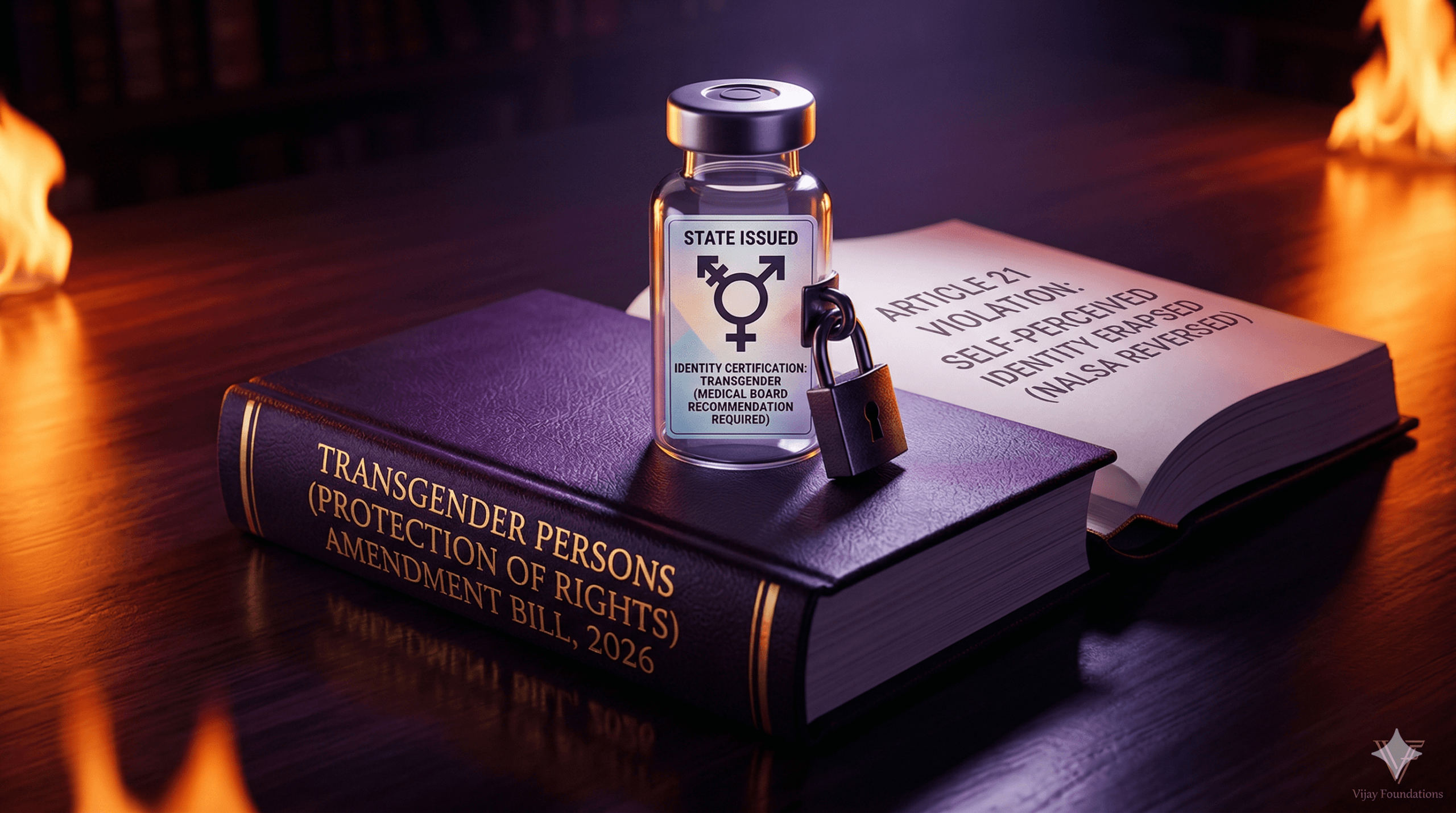
Introduction: How the Transgender Persons (Protection of Rights) Amendment Bill, 2026 Erases Identities
On 25–26 March 2026, both Houses of Parliament passed the Transgender Persons (Protection of Rights) Amendment Bill, 2026. Despite its protective name, this legislation strikes at the very heart of what it means to be a transgender person in India. As an advocate who has argued for the fundamental rights of marginalised communities before the courts of this country, I write this analysis with deep concern and a sense of urgent responsibility.
The Transgender Persons (Protection of Rights) Amendment Bill, 2026 replaces the foundational principle of self-determination — the right of every individual to define their own gender identity — with state-mandated medical adjudication. In doing so, it reverses more than a decade of progressive jurisprudence built on the constitutional values of dignity, autonomy, and equality.
This article places the Amendment in its proper legal context: examining how it contradicts the Supreme Court's landmark ruling in NALSA v. Union of India (2014), how it violates fundamental rights under Articles 14, 19, and 21 of the Constitution, and what legal recourse remains available to those who will be most harmed. You may also read our earlier analysis on the NALSA judgment and its significance for a fuller constitutional picture.
Background: The Transgender Persons (Protection of Rights) Act, 2019
To fully appreciate the gravity of the Transgender Persons (Protection of Rights) Amendment Bill, 2026, one must first understand what the parent legislation sought to achieve. The Transgender Persons (Protection of Rights) Act, 2019 was India's first comprehensive legislative framework for transgender persons, enacted after years of advocacy, protests, and judicial interventions.
Section 2(k) of the 2019 Act defined a transgender person broadly as "a person whose gender does not match with the gender assigned at birth." This inclusive definition encompassed trans men, trans women, non-binary persons, intersex individuals, and those with diverse socio-cultural identities. Crucially, Section 4(2) recognised that a transgender person had the right to a self-perceived gender identity — no medical procedure, no surgery, and no bureaucratic certification was required.
While the 2019 Act was itself imperfect and drew criticism from the transgender community — particularly for complicated certification procedures — it preserved the foundational right to self-identification. The Transgender Persons (Protection of Rights) Amendment Bill, 2026 strips away even that floor of protection.
"Under Sections 5 and 6 of the 2019 Act, a transgender person could submit an affidavit declaring their gender identity, and the District Magistrate was responsible for issuing a certificate of identity. No medical or physical examination was required." — Legal commentary on the 2019 Act provisions
The NALSA Judgment (2014): The Constitutional Foundation of Self-Determination
No analysis of transgender rights in India can proceed without reference to National Legal Services Authority v. Union of India & Others, (2014) 5 SCC 438 — popularly known as the NALSA judgment. Delivered by Justices K.S. Radhakrishnan and A.K. Sikri, this ruling is widely regarded as one of the most progressive pronouncements on gender rights by any court in the world.
The Supreme Court held that gender identity lies at the core of personal identity and is integral to personal autonomy, dignity, and freedom guaranteed under Article 21 of the Constitution. The Court rejected biological determinism — the notion that gender must align with chromosomal or anatomical sex — and embraced the psychological and self-perceived understanding of gender.
The judgment explicitly held that requiring medical or surgical intervention as a prerequisite for legal gender recognition violates the fundamental rights of transgender persons. The Court directed that transgender persons be recognised as a "third gender," entitled to all rights guaranteed to citizens of India.
The Supreme Court held that self-identification of gender is an integral part of personal autonomy and self-determination, rooted in the right to life and personal liberty under Article 21 of the Constitution. A person's gender identity, the Court ruled, does not require medical validation or state approval to be constitutionally recognised.
The Transgender Persons (Protection of Rights) Amendment Bill, 2026 provision explicitly excluding "self-perceived sexual identities" is therefore not merely a policy reversal — it is a direct subversion of binding Supreme Court precedent. For a deeper understanding of how courts have interpreted Article 21 in related matters, see our post on Article 21 and the Right to Dignity for Marginalised Communities.
Key Changes Under the 2026 Amendment Bill
The Transgender Persons (Protection of Rights) Amendment Bill, 2026 introduces several transformative changes to the existing legal framework. The comparison below maps the critical provisions of the 2019 Act against what the Amendment substitutes:
| Aspect | Transgender Persons Act, 2019 | Amendment Bill, 2026 |
|---|---|---|
| Definition | Broad: includes trans men, trans women, non-binary, gender-fluid persons | Narrowed: Only specific socio-cultural groups (kinner, hijra, aravani, jogta) and intersex persons |
| Self-identification | Section 4(2) recognised self-perceived gender identity without medical test | Removed: Explicit exclusion of "persons with self-perceived sexual identities" |
| Certificate of Identity | Issued by District Magistrate on self-declaration affidavit | Changed: DM issues certificate only after Medical Board recommendation |
| Medical Board | Not required for identity recognition | Added: Mandatory Medical Board headed by Chief Medical Officer or Dy. CMO |
| Gender change | Optional revised certificate if surgery undertaken | Mandatory: Revised certificate required after surgery |
| Penalties | 6 months–2 years imprisonment for forced labour, displacement etc. | Enhanced: 10 years to life for kidnapping/grievous hurt; fine up to ₹5 lakh |
| Name change | Through revised certificate of identity | Only first name change permissible in birth certificate |
The Right to Self-Determination: A Constitutional Imperative
The concept of self-determination in the context of gender identity flows organically from the Constitution's guarantee of the right to life and personal liberty (Article 21), the right to equality (Article 14), and the right to freedom of expression (Article 19(1)(a)).
Gender identity is perhaps the most intimate dimension of one's personhood. It speaks to how one experiences oneself in relation to the world — not merely in terms of appearance or behaviour, but at the deepest level of self-understanding. To require that this inner truth be verified and validated by a Medical Board and a District Magistrate is to treat self-knowledge as inherently suspect and to subordinate personal dignity to bureaucratic authority.
"The moment you take away the right to self-identify, you give that power to the state. A medical board will examine you, and a district magistrate will decide who you are. It strikes at dignity and autonomy at their deepest root." — Transgender rights lawyer, commenting on the Amendment Bill
Self-Determination Under International Law
India is a signatory to the International Covenant on Civil and Political Rights (ICCPR) and the Universal Declaration of Human Rights (UDHR), both of which protect personal autonomy, privacy, and dignity. The Yogyakarta Principles — internationally recognised guidelines on the application of human rights law to gender identity — explicitly state that each person's self-defined gender identity is one of the most basic aspects of self-determination, dignity, and freedom.
The UN Human Rights Council has repeatedly called upon member states to recognise self-declared gender identity as the basis for legal gender recognition. The Transgender Persons (Protection of Rights) Amendment Bill, 2026 moves India in precisely the opposite direction — towards state-controlled identity verification that the international community has repeatedly condemned.
Medical Gatekeeping: Treating Identity as a Pathology
The revival of the medical gatekeeping model in the 2026 Amendment rests on a deeply flawed premise: that gender identity requires clinical verification before it can receive legal recognition — essentially treating being transgender as a medical condition to be diagnosed rather than a natural variation of human experience to be respected.
The World Health Organisation (WHO) declassified gender incongruence as a mental disorder in ICD-11 (effective 2022). The American Psychiatric Association's DSM-5 similarly shifted away from classifying transgender identity as a disorder. The global consensus in medical science is clear: being transgender is not a pathology.
Yet the Amendment Bill mandates that a Medical Board must examine and recommend certification before a person can receive legal recognition of their gender identity. This creates multiple layers of structural harm:
Furthermore, the Bill's framework implies a pathological understanding of transgender identity — that a person identifies as transgender due to biological "anomalies" or external coercion. This negates individual agency and is inconsistent with contemporary medical science, constitutional values, and the NALSA judgment.
Who Gets Left Behind: The Exclusion Crisis
The Amendment Bill's narrowed definition is not merely a semantic change — it is an act of legal erasure for vast sections of India's transgender community. By limiting recognition to traditional socio-cultural categories, the Bill excludes:
- Trans men — individuals assigned female at birth who identify as men
- Trans women — individuals assigned male at birth who identify as women
- Non-binary persons — individuals who identify outside the male/female binary
- Gender-fluid persons — those whose gender identity shifts across time
- Genderqueer individuals — those who reject conventional gender categories
- Persons on hormone therapy without surgery — who cannot satisfy the Bill's medical requirements
India's 2011 census recorded 487,803 transgender persons, though activists argue the true figure is far higher given widespread stigma and underreporting. Of these, as of 2026, only approximately 32,500 have received identity cards under the existing system. The Amendment Bill risks throwing even this small recognised group into legal uncertainty.
The exclusion of trans men is particularly alarming, as the retained definition historically applies to persons assigned male at birth living in feminine roles within traditional hijra communities. A trans man on hormone therapy — visible, facing discrimination, needing health and welfare protections — receives zero legal recognition under the new framework.
Constitutional Challenges: Articles 14, 19, and 21
From a constitutional law perspective, the Transgender Persons (Protection of Rights) Amendment Bill, 2026 raises profound questions of validity that are virtually certain to be litigated before the Supreme Court of India. At Vijay Foundations, we believe there are strong grounds to challenge the law on three constitutional fronts.
Article 21 — Right to Life, Dignity, and Personal Liberty
The Supreme Court has interpreted Article 21 expansively to include the right to live with dignity, the right to privacy, and the right to personal autonomy. In K.S. Puttaswamy v. Union of India (2017), the nine-judge bench held unanimously that privacy — including privacy over one's identity and bodily autonomy — is a fundamental right. The Bill's mandatory medical examination to certify gender identity constitutes a direct intrusion into this privacy, antithetical to the dignity-based constitutional framework.
Article 14 and the Transgender Persons (Protection of Rights) Amendment Bill, 2026
The Bill creates an arbitrary classification: it recognises individuals with certain socio-cultural identities as legally transgender while denying equal recognition to trans men, trans women, and non-binary persons who may face identical or greater discrimination. This classification has no intelligible differentia linked to a legitimate state objective — a requirement for any classification to survive Article 14 scrutiny.
Article 19(1)(a) — Freedom of Expression
Courts in India and across jurisdictions have recognised that gender expression — how one presents oneself in alignment with one's identity — constitutes a form of protected expression. Requiring state certification before a person can legally express their gender identity imposes an unjustifiable prior restraint on protected expression under Article 19(1)(a).
"The bill's proviso — explicitly excluding persons with self-perceived sexual identities — could invite constitutional scrutiny on the ground that it is inconsistent with NALSA and the broader protection of personal autonomy the Court had articulated." — Constitutional law expert, quoted in legal commentary on the Amendment Bill
Global Standards: How the World Is Moving Forward
While India's 2026 Amendment moves toward greater state control over gender identity, the global trend is clearly and decisively in the opposite direction. Nations that once required medical intervention for legal gender recognition are now adopting simpler, dignity-affirming processes based on self-declaration:
- Nepal — recognises a third gender category; allows self-declaration for legal recognition
- Pakistan — the Transgender Persons (Protection of Rights) Act, 2018 allows self-perceived identity as the basis for certification
- Germany — enacted self-identification laws in 2024, removing medical and judicial requirements
- Canada — allows gender-neutral and self-declared markers on federal identity documents
- Australia — most states permit self-identification for gender marker changes on birth certificates
- Argentina — pioneered self-determination law in 2012, without requiring surgery or psychiatric assessment
As documented by Human Rights Watch and Amnesty International, international human rights standards universally require self-declared identity to be the basis for accessing all social security measures and entitlements. India has, through this Amendment, retreated from that global standard.
Legal Recourse and the Road Ahead
The passage of the Bill does not end the struggle — it begins a new chapter. Transgender persons and human rights advocates have pledged to mount legal challenges, and multiple avenues remain available under India's constitutional framework.
Writ Petitions Before the Supreme Court
Given the Bill's direct conflict with binding precedent in NALSA (2014) and Puttaswamy (2017), a challenge by way of writ petition under Article 32 of the Constitution is the most immediate remedy. At Vijay Foundations, we are actively consulting with members of the transgender community and allied organisations to explore intervention in such proceedings.
Public Interest Litigation
NGOs, legal aid societies, and concerned citizens may approach the Supreme Court by way of Public Interest Litigation (PIL) challenging the constitutional validity of the Amendment. The Court has consistently shown receptiveness to PILs concerning the rights of vulnerable and marginalised communities.
Parliamentary and Policy Advocacy
The Amendment Bill was passed without reference to a Parliamentary Standing Committee and without adequate consultation with the transgender community — a process widely condemned as procedurally deficient. Engagement with the Ministry of Social Justice and Empowerment, opposition parliamentarians, and sustained civil society pressure remain important tools for policy reform.
International Human Rights Mechanisms
Civil society organisations can submit shadow reports to the UN Human Rights Committee and other treaty bodies, placing India's compliance with the ICCPR and related instruments under international scrutiny and creating diplomatic pressure for reform.
Conclusion: Dignity Cannot Be Certified by a Medical Board
The Transgender Persons (Protection of Rights) Amendment Bill, 2026 is, in my considered legal opinion, a constitutionally flawed and humanly devastating piece of legislation. It does not protect transgender persons — it polices them. It does not streamline identity recognition — it erects new walls of exclusion. And it does not advance the rule of law — it retreats from the most progressive constitutional jurisprudence our Supreme Court has produced.
The right to self-determination of gender identity is not a privilege. It is a constitutional entitlement, flowing from the dignity and liberty guaranteed to every person under Article 21 of the Constitution of India. It was affirmed by the Supreme Court in 2014. It was incorporated, however imperfectly, in the 2019 Act. To strip it away in 2026 — in the name of protection — is a profound contradiction that our legal system must not allow to stand.
As advocates, as citizens, and as a society, we have an obligation to resist this regression — in the courts, in Parliament, and in the public conversation. The transgender community has borne enough. It is time for the law to stand on the right side of dignity.
At Vijay Foundations, we remain committed to fighting for the constitutional rights of every person, regardless of gender identity. Read also: Gender Justice and the Legal Landscape in India and The Right to Privacy for Marginalised Communities.
Frequently Asked Questions
It is a parliamentary amendment to the 2019 Act, passed by both Houses of Parliament in March 2026. The Bill narrows the legal definition of transgender persons to specific socio-cultural groups and intersex individuals, removes the right to self-perceived gender identity, and mandates certification through a Medical Board and District Magistrate.
The Bill removes Section 4(2) of the 2019 Act, which recognised self-perceived gender identity, and replaces it with mandatory medical board certification. This makes the state the arbiter of a person's gender identity, contradicting the Supreme Court's ruling in NALSA v. Union of India (2014).
Trans men, trans women, non-binary persons, gender-fluid individuals, and genderqueer people are excluded from legal recognition. The new definition retains only certain socio-cultural categories (kinner, hijra, aravani, jogta) and intersex individuals.
Yes. Legal experts and organisations plan to challenge the Bill before the Supreme Court of India under Article 32 of the Constitution, on grounds including inconsistency with the NALSA judgment (2014) and violation of Articles 14, 19, and 21.
The Amendment runs counter to global trends. Nations including Nepal, Germany, and Argentina have moved toward self-declaration-based recognition. India's 2026 Amendment places it at odds with these international human rights norms.
Need Legal Assistance?
Vijay Foundations provides free legal consultations for transgender persons and marginalised communities. Reach out to Advocate Mamta Shukla and our team today.
📞 Contact Us for Free Legal Aid →