The Elastic Republic: Balancing Stability with Constitutional Boundaries
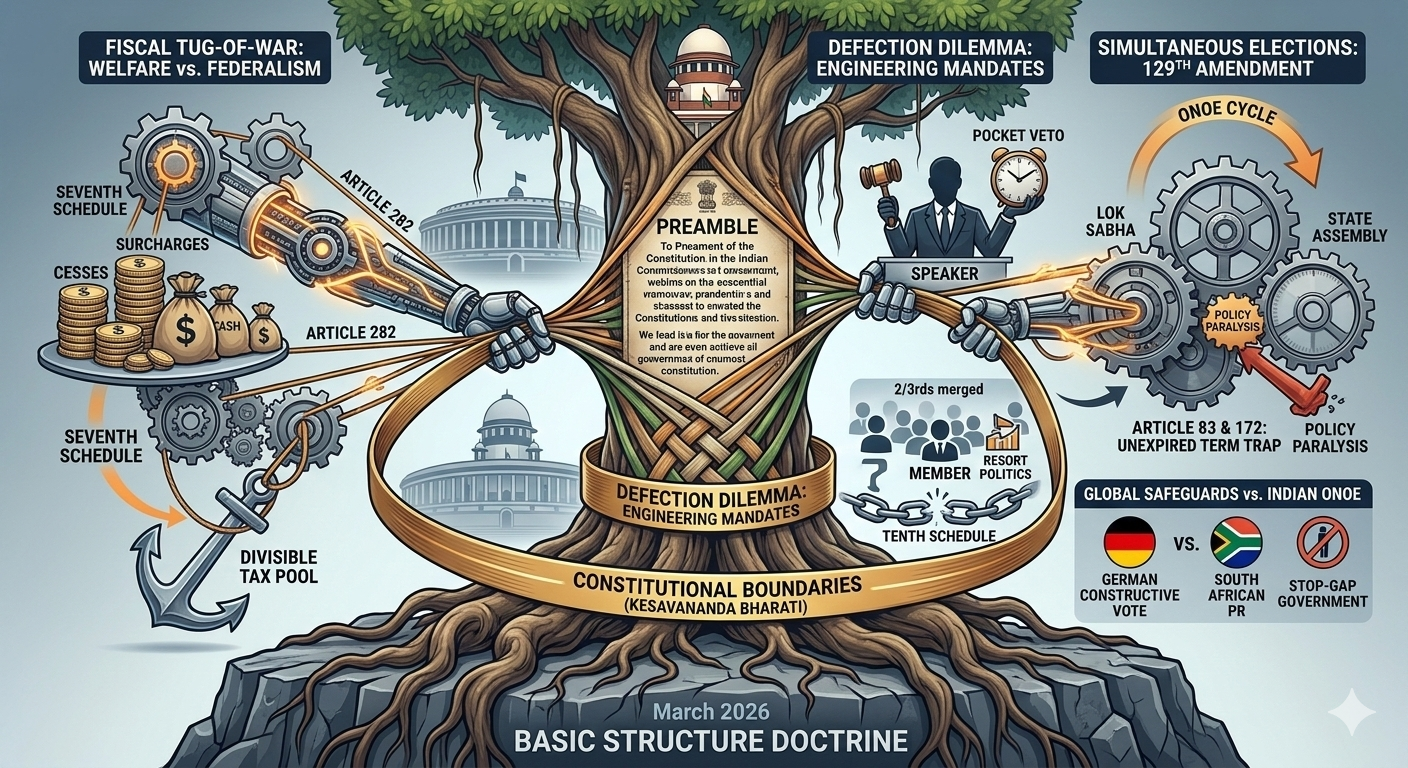
As we analyze the 129th Amendment Bill ONOE, we see how the Indian Constitution is often described as a “living document,” designed with an inherent elasticity to adapt to the needs of a burgeoning republic. However, as we navigate 2026, there is a growing concern that this elasticity is being stretched to a snapping point. The delicate balance between executive efficiency, federal autonomy, and legislative accountability is under immense pressure from three distinct but converging forces: populist welfare spending, political defections, and the 129th Amendment Bill ONOE push for simultaneous elections.
1. The Fiscal Tug-of-War: Welfare vs. Federalism
Welfare-driven public spending has become the primary currency of Indian electoral politics. We have entered an era of “competitive clientelism,” where the line between distributive justice and electoral inducement is blurring. The legal crux lies in Article 282, which allows the Union to make grants for “any public purpose.”
By increasing reliance on cesses and surcharges—which are not shared with the states—the Union restricts the “divisible tax pool.” This forces regional governments to either cut local priorities or increase debt to match central welfare branding, effectively eroding the spirit of the Seventh Schedule. This fiscal strain is a key backdrop to the current discussions surrounding the 129th Amendment Bill ONOE.
2. The Defection Dilemma: Engineering Mandates
The Tenth Schedule (Anti-Defection Law) was conceived to ensure political stability, yet today it is increasingly viewed as a paper tiger. We have moved from individual desertions to “wholesale defections,” where two-thirds of a legislative party merge with another to bypass disqualification. This instability is often cited by proponents of the 129th Amendment Bill ONOE as a reason for reform.
The role of the Speaker remains a significant point of strain. By utilizing a “pocket veto”—delaying disqualification petitions—the office has often shifted from a neutral arbiter to a tool for the executive. Recent judicial directives in 2025 have begun setting strict timelines, signaling that the judiciary may no longer tolerate the strategic stalling of democratic mandates.
3. Simultaneous Elections: Understanding the 129th Amendment Bill ONOE
The push for “One Nation, One Election” (ONOE) via the 129th Amendment Bill ONOE seeks to prevent “policy paralysis” caused by frequent elections. However, the proposed overhaul is unprecedented in its impact on our democratic structure.
| Article | Proposed Change | Practical Impact |
|---|---|---|
| 82A | Appointed Date | President fixes a date to start the first simultaneous cycle. |
| 83 & 172 | Unexpired Term | Early dissolved Houses serve only the remainder of the 5-year cycle. |
| 327 | Power Expansion | Parliament gains explicit power to legislate on simultaneous polls. |
4. Global Comparisons: Stability vs. Accountability
While India draws inspiration from Germany and South Africa for the 129th Amendment Bill ONOE, those nations possess safeguards we currently lack. Germany utilizes a “Constructive Vote of No Confidence,” ensuring a successor is elected before a government falls. South Africa relies on Proportional Representation, where individual defections don’t threaten the entire cycle. Without these, the 129th Amendment Bill ONOE model risks creating “stop-gap” governments that devalue the voter’s franchise.
5. The Basic Structure Challenge for the 129th Amendment Bill ONOE
Any move toward the 129th Amendment Bill ONOE faces the Basic Structure Doctrine. Key challenges include:
- Federalism: Truncating State terms may violate regional autonomy (S.R. Bommai case).
- Accountability: Moving to a fixed calendar may weaken the executive’s daily accountability to the legislature.
- Ratification: Amendments affecting state powers require ratification by half of the State Legislatures under Article 368(2).
Conclusion: Protecting the Elastic
The convergence of these trends points toward a “presidentialization” of the Indian parliamentary system through the 129th Amendment Bill ONOE. While “efficiency” is a seductive goal, it cannot come at the expense of the Basic Structure. The elasticity of our Constitution was meant to allow for growth, not to facilitate the bypass of democratic checks and balances. We must ensure the elastic remains strong enough to snap back into its original, democratic shape.
Dive deeper into our mission on our About Us page. Or view the full text at the Constitution of India Archive.