
 When Power Escapes Accountability: Why “Public Servant” Under POCSO Must Include Elected Representatives
 When Power Escapes Accountability: Why “Public Servant” Under POCSO Must Include Elected Representatives
Lessons from the Unnao Rape Case
By Adv. Mamta Shukla
The Unnao rape case is not merely a criminal appeal—it is a constitutional test of India’s commitment to child protection and accountability of power. At its core lies a deceptively technical question with profound moral and legal consequences:
Can an elected MLA escape the aggravated offence provisions of the POCSO Act merely because he is not formally labelled a “public servant” under the Indian Penal Code?
The Delhi High Court’s December 2025 order, which temporarily suspended the life sentence of former MLA Kuldeep Singh Sengar, answered this question in the affirmative. The Supreme Court’s swift intervention signals that such an answer may be legally untenable—and morally indefensible.
The Dangerous Consequence of Literalism
The Protection of Children from Sexual Offences (POCSO) Act is a protective welfare statute, enacted to shield children from sexual exploitation—particularly by those who occupy positions of authority and dominance.
Yet, the Delhi High Court adopted a mechanical literalism, holding that:
POCSO does not define the term “public servant”
Section 2(2) of POCSO imports definitions from the IPC
IPC Section 21 does not include MLAs
Therefore, an MLA cannot commit “aggravated penetrative sexual assault” under Section 5(c) of POCSO
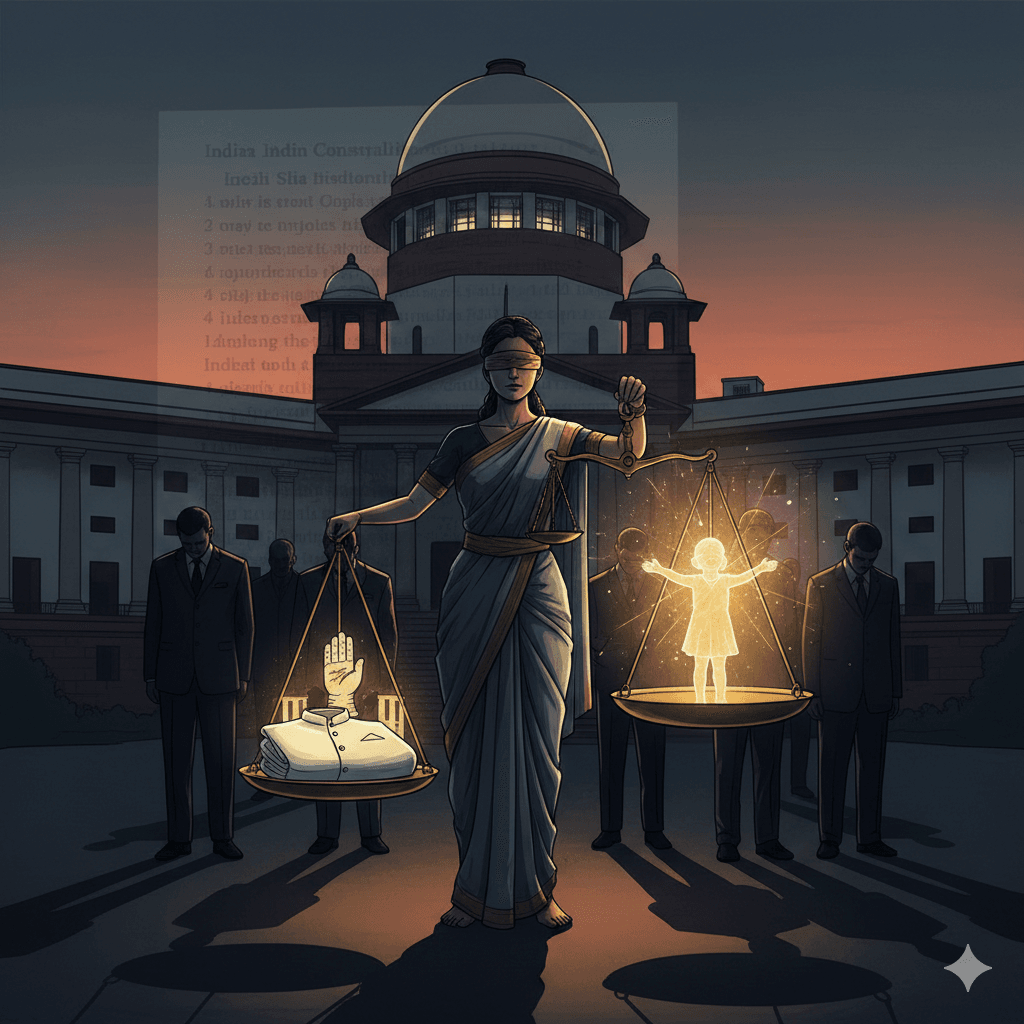
This interpretation leads to a startling anomaly:
A constable or a patwari is treated as a “public servant” for aggravated sexual assault,
but an elected MLA—wielding far greater power—stands exempt.
As Chief Justice Surya Kant rightly observed, this is a result the law cannot logically or constitutionally sustain.
Power, Not Designation, Is the Real Misuse
POCSO’s aggravated offence provisions are triggered not by job titles, but by abuse of power, trust, and dominance.
An MLA:
Represents tens of thousands of citizens
Exercises influence over police, administration, and local institutions
Is routinely approached by vulnerable persons—including minors—for help, employment, or protection
Commands fear, obedience, and silence, especially in rural and semi-urban India
To argue that such a person does not occupy a position warranting enhanced liability under child protection law is to ignore social reality.
Purposive Interpretation Is Not Judicial Overreach
The Supreme Court has repeatedly held that POCSO must be interpreted purposively, not pedantically.
In Attorney General of India v. Satish (2021), the Court rejected a narrow interpretation requiring “skin-to-skin contact”, holding that such literalism would defeat the very purpose of the Act.
The same principle applies here:
A narrow definition of “public servant” excluding elected representatives
Creates a loophole for the most powerful offenders
Undermines the statute’s deterrent effect
Welfare legislation—especially child protection law—cannot be allowed to collapse under technical formalism.
Section 5(p): The Overlooked Safeguard
Even assuming arguendo that “public servant” under Section 5(c) is read narrowly, Section 5(p) of POCSO independently covers persons in a “position of trust or authority.”
An MLA clearly satisfies this standard.
The Delhi High Court’s failure to meaningfully engage with Section 5(p) reflects a troubling oversight—one that the Supreme Court has rightly flagged.
Accountability Cannot Shrink With Power
India’s legal framework already recognises elected representatives as “public servants” under the Prevention of Corruption Act, because they:
Discharge public duties
Wield public power
Are entrusted with public resources
It would be a constitutional paradox if:
An MLA can be prosecuted as a public servant for corruption
But is not held to higher accountability for sexually assaulting a child
Such an outcome would invert the hierarchy of values, placing procedural purity above child safety.
What Is at Stake
The Supreme Court’s final ruling will determine whether:
POCSO remains a living, protective statute, or
Becomes vulnerable to technical evasions by the powerful
A ruling affirming that elected representatives fall within POCSO’s aggravated offence framework would:
Reinforce victim-centric jurisprudence
Close a dangerous accountability gap
Affirm that no public power comes with private immunity
Conclusion
The Unnao case reminds us that sexual violence is not only a crime of the body—it is a crime of power.
If the law punishes a constable more harshly than a legislator for abusing a child, it sends a chilling message: that power dilutes responsibility.
POCSO was enacted to say the opposite.
The Supreme Court now has the opportunity—and the constitutional duty—to ensure that those who wield the greatest power are held to the highest standard of accountability, especially when the victim is a child.
Key Sources
Indian Express, “Kuldeep Singh Sengar’s brief relief ends as SC stays Delhi HC’s bail order” — discusses SC stay and the legal issue on public servant interpretation. The Indian Express
LiveLaw, “’Constable is public servant, but not MLA?’ Supreme Court questions plea” — detailed account of SC’s observations on statutory interpretation. Live Law
The Indian Express, opinion piece on why POCSO must recognise legislators as public servants under the Act. The Indian Express
Times of India, coverage of SC’s concern over public servant classification and stay of HC order. The Times of India