
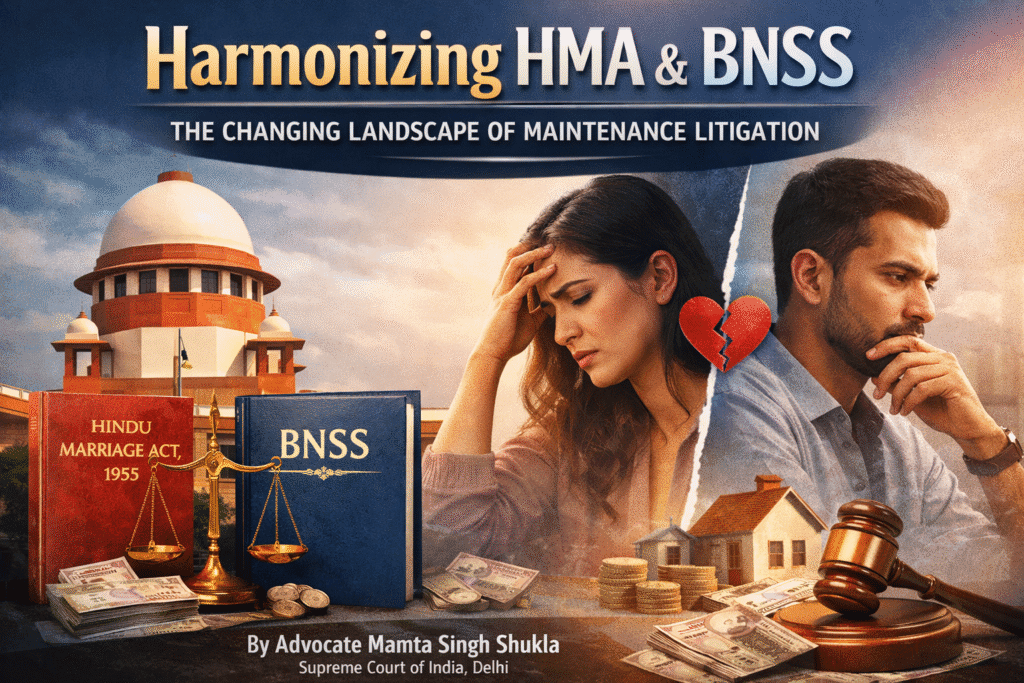
HARMONIZING HMA & BNSS:
The Changing Landscape of Maintenance Litigation
By – Advocate Mamta Singh Shukla, Supreme Court of India, Delhi
INTRODUCTION
In the intricate tapestry of matrimonial litigation, few threads are as contentious—or as consequential—as the determination of maintenance and alimony. It is the financial heartbeat of a separation, often dictating the difference between dignity and destitution for spouses and children.
For decades, the quantification of maintenance was often reduced to rigid arithmetic or subjective guesswork. However, the legal landscape has shifted seismically. Over the last few years, and specifically through a series of landmark rulings in 2025, the Supreme Court of India has moved beyond mere sustenance to embrace a philosophy of “Fairness, Dignity, and Realistic Quantum.”
The Apex Court has made it unequivocally clear: maintenance is not charity, nor is it a tool for punishment. It is a fundamental right designed to bridge the financial disparity caused by marital breakdown. Whether invoking the Hindu Marriage Act, 1955 (HMA) or the newly implemented Bharatiya Nagarik Suraksha Sanhita (BNSS) (formerly CrPC), the judiciary is now harmonizing statutes to balance the payer’s capacity with the recipient’s rightful claim to a comparable social status.
- THE LEGAL FRAMEWORK: BALANCING CAPACITY AND NEED
To understand the shift, one must first understand the statutory pillars that support maintenance claims. The Court has clarified that these provisions are not mutually exclusive but cumulative:
- Interim Maintenance (Section 24 HMA): Designed to provide immediate relief during the pendency of litigation. It covers the costs of proceedings and monthly expenses to ensure the weaker spouse is not starved out of justice.
- Permanent Alimony (Section 25 HMA): Awarded at the time of passing the decree (divorce or judicial separation). This looks at the “big picture”—often resulting in a lump sum or secured monthly payments for life.
- Secular Support (Section 144 BNSS / Section 125 CrPC): A distinct remedy focused on preventing destitution. It is secular, applies to all religions, and emphasizes speedy relief for wives, children, and parents.
The Core Principle: The quantum (amount) must balance the payer’s financial capacity with the recipient’s reasonable needs, standard of living, and conduct.
- THE GAME CHANGER: RAJNESH V. NEHA (2020)
No discussion on maintenance is complete without citing Rajnesh v. Neha (2020). This judgment cured the greatest plague of matrimonial cases: the concealment of income.
The Supreme Court mandated the filing of a comprehensive Affidavit of Assets and Liabilities by both parties.
- Impact: Courts no longer have to rely on guesswork.
- The “Date of Filing” Rule: Crucially, the Court held that maintenance must be awarded from the date the application was filed, not the date of the order, preventing payers from benefiting by delaying the trial.
- THE 2025 WAVE: HIGHER QUANTUMS & STRICTER PENALTIES
The year 2025 has been pivotal, with the Supreme Court issuing judgments that reflect current economic realities, including inflation and high-net-worth lifestyles.
- The “Lifestyle & Inflation” Approach in Rakhi Sadhukhan v. Raja Sadhukhan (2025), the Court recognized that a maintenance order passed years ago becomes redundant due to inflation. The Court enhanced monthly alimony from Rs. 20,000 to Rs. 50,000, explicitly citing the rising cost of living and the wife’s dependence.
- Permanent Alimony & Cruelty in M.V. Leelavathi v. Dr. C.R. Swamy (2025), the Court dealt with a case involving cruelty. While granting divorce, the Court ensured the wife’s financial security was not compromised, awarding a permanent alimony of Rs. 50 Lakhs. The Court balanced the husband’s professional capacity with the need to secure the wife’s future.
- Cracking Down on Concealment Perhaps the sternest warning came in Parvin Kumar Jain v. Anju Jain (2025). The husband had concealed assets worth Rs. 300 Crores to plead poverty. The Court penalized the husband Rs. 5 Crores for the concealment and enhanced the alimony to reflect his true financial status.
- The Article 142 Power: The “Clean Break” In high-stakes cases like Rinku Baheti v. Sandesh Sharda (2025), the Supreme Court utilized its extraordinary powers under Article 142 to dissolve the marriage and settle finances instantly. Considering the husband’s substantial business income, the Court awarded a massive lump sum of Rs. 10 Crores.
- THE “WORKING WIFE” DILEMMA & GENDER NEUTRALITY
A common defence raised by husbands is, “She is qualified; she can earn.” The Courts have nuanced this argument significantly.
- Capability vs. Reality: In Shailja v. Khobanna (2018), the Court held that being “capable of earning” is not the same as actually earning.
- Income Disparity: Relying on the gold-standard Bhagwan Dutt v. Kamla Devi (1975), courts hold that even if a wife earns, she is entitled to maintenance if her income is insufficient to maintain the lifestyle she was accustomed to.
- Gender Neutrality: The law is not a one-way street. As seen in Anubha v. Vikas Aggarwal (2000) and Kalyan Dev Chowdhury v. Rita Dev Chowdhury (2017), husbands who are incapacitated or genuinely unable to earn can claim maintenance from wealthy wives.
- DETERMINING THE QUANTUM: THE “13 FACTORS”
So, how does the Judge arrive at a figure? Courts now evaluate 13+ factors outlined in Rajnesh and subsequent rulings, including:
- Status of the parties (Social standing).
- Reasonable wants of the claimant.
- Independent income and property of the claimant.
- Number of dependents (children, aged parents).
- Cost of living in the specific city (Metro vs. Tier-2).
- Unaccounted Income: Courts look beyond IT Returns, examining lifestyle indicators (credit card bills, luxury travel) to determine real income.
FINAL THOUGHTS
The message from the Supreme Court is clear: Maintenance is a matter of right, not charity. Whether it is a lump sum of Rs. 10 Crores or a monthly support of Rs. 50,000, the objective is to ensure that the weaker spouse does not suffer the indignity of destitution while the other lives in luxury.
For litigants, the key takeaway is transparency. Disclosure is the best policy; concealment is now a costly gamble.
SOURCES & REFERENCES
These establish legal authority and are essential for credibility.
- Hindu Marriage Act, 1955 – Sections 24 & 25
https://legislative.gov.in/sites/default/files/A1955-25.pdf - Bharatiya Nagarik Suraksha Sanhita, 2023 – Section 144
https://egazette.nic.in/WriteReadData/2023/249161.pdf
SUPREME COURT JUDGMENTS –
- Rajnesh v. Neha, (2021) 2 SCC 324
https://indiankanoon.org/doc/173960230/ - Bhagwan Dutt v. Kamla Devi, (1975) 2 SCC 386
https://indiankanoon.org/doc/1042337/ - Shailja v. Khobanna, (2018) 12 SCC 199
https://indiankanoon.org/doc/181544185/ - Kalyan Dev Chowdhury v. Rita Dev Chowdhury, (2017) 14 SCC 200
https://indiankanoon.org/doc/130507470/ - Anubha v. Vikas Aggarwal, (2000) 4 SCC 1
https://indiankanoon.org/doc/1792780/
✍️ Adv. Mamta Singh Shukla
Supreme Court of India | PoSH Trainer
Finally, the article was originally published by Vijay Foundation. For more legal and public-interest articles, readers may visit vijayfoundations.com.