
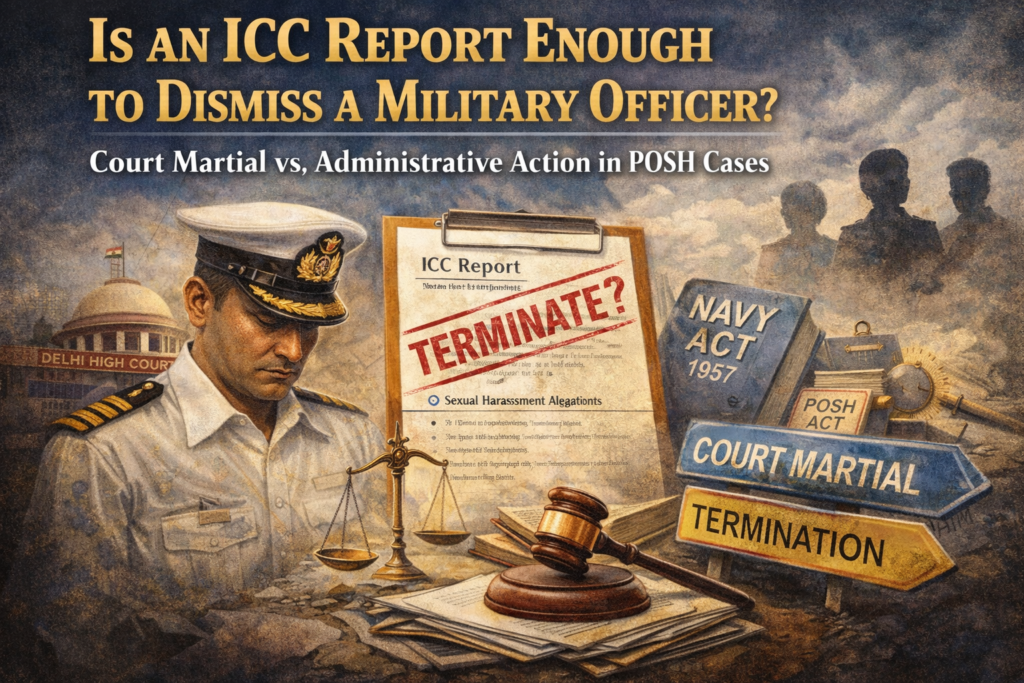
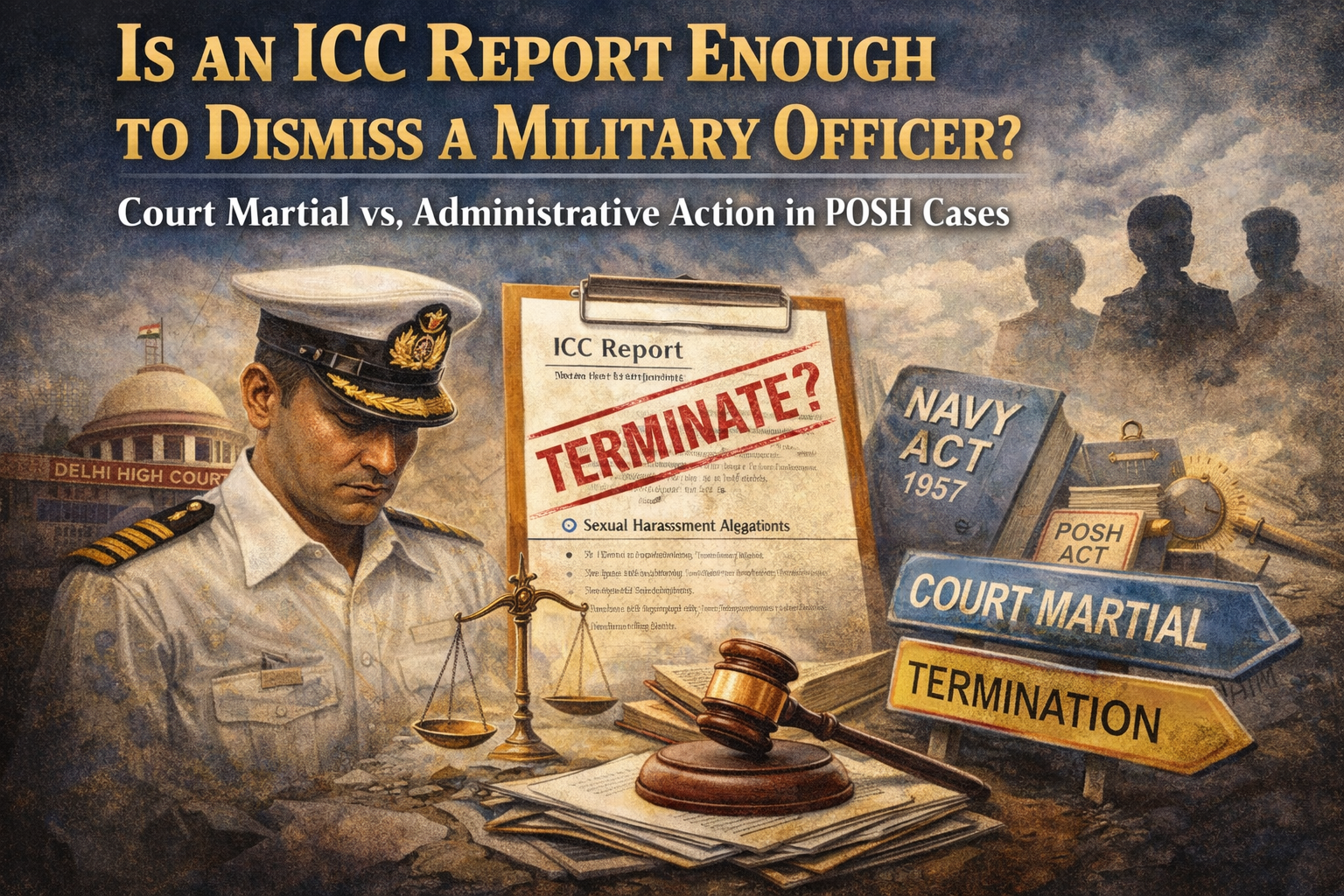
Is an ICC Report Enough to Dismiss a Military Officer?
When a naval officer faces allegations of sexual harassment, can he insist on a Court Martial? Or may the Navy terminate his services administratively based on an Internal Complaints Committee (ICC) report?
This tension between military due process and the urgent mandate of the POSH Act (Prevention of Sexual Harassment) lay at the heart of the Delhi High Court’s decision in Cdr. Yogesh Mahla v. Union of India & Ors.
In its judgment dated July 10, 2025, the Court refused to halt disciplinary proceedings against a Commander. In doing so, it sent a clear warning against delay tactics in sensitive workplace harassment cases.
This article analyses the ruling and explains its significance for military law.
The Facts: A Commander Under Scrutiny
The case arose from a complaint filed by a lady officer, referred to as “X.” She accused Commander Yogesh Mahla of sexual harassment during his posting at the Naval Dockyard, Visakhapatnam.
Following the complaint, the Navy initiated a structured response.
First, it constituted an Internal Complaints Committee (ICC) under the POSH Act and Navy Order 06/2024. After conducting the inquiry, the ICC found the allegations to be substantiated.
Next, in March 2025, the Chief of Naval Staff issued a Show Cause Notice (SCN). The notice proposed termination of service under Section 15(2) of the Navy Act, 1957. Importantly, it recorded that a Court Martial would be “inexpedient and impracticable.”
The Legal Battle: “I Want a Court Martial”
Commander Mahla challenged the Show Cause Notice before the Armed Forces Tribunal (AFT). He later approached the Delhi High Court.
His challenge focused on procedure rather than facts.
He argued that the Navy could not dismiss him through an administrative order. Instead, he claimed that only a Court Martial could lawfully adjudicate such serious allegations. According to him, a Court Martial provided stronger procedural safeguards and stricter evidentiary standards.
Additionally, he questioned the legality of the ICC process. He also asserted a right to challenge the ICC’s recommendations before facing any punitive action.
The Verdict: “Stop Stultifying the Process”
A Division Bench comprising Justice C. Hari Shankar and Justice Ajay Digpaul dismissed the petition. The Court refused to interfere with the Show Cause Notice at this stage.
The Bench based its reasoning on three clear principles.
1. No Premature Judicial Intervention
The Court held that a Show Cause Notice does not amount to a final order. Instead, it merely offers the officer an opportunity to respond. Therefore, judicial intervention at this stage would be premature.
By approaching multiple forums before submitting a reply, the petitioner attempted to block the disciplinary process before it could conclude.
2. Delay Undermines Justice
Moreover, the Bench criticised the repeated legal challenges. It observed that the petitioner had effectively “stultified” the proceedings by causing avoidable delay.
The Court stressed that sexual harassment cases demand speedy and effective action, as mandated by the Supreme Court in Vishaka and Medha Kotwal Lele. Consequently, courts must remain cautious about entertaining challenges that frustrate these objectives.
3. Administrative Action Is Lawful
Finally, the Court upheld Navy Order 06/2024, which integrates the POSH Act into naval regulations.
It clarified that the Navy need not conduct a Court Martial in every case. If the Chief of Naval Staff records valid reasons explaining why a Court Martial is inexpedient, administrative action remains legally permissible.
The Takeaway
This judgment sets an important precedent for the Armed Forces in the post-POSH Act era.
It makes one point clear: a demand for a Court Martial cannot serve as a shield to delay action recommended by an ICC. When an internal inquiry substantiates allegations of sexual harassment, authorities may proceed with administrative termination under the Navy Act.
Ultimately, the Delhi High Court reaffirmed that procedural technicalities cannot override the need for substantive justice in workplace harassment cases.
The matter remains sub-judice, and further clarity may emerge from the Supreme Court. Until then, this ruling stands as a strong endorsement of timely accountability within the Armed Forces.
Sources & Links
Armed Forces Tribunal order in Cdr. Yogesh Mahla v. Union of India & Ors – AFT principal bench order confirming the basis of the show cause notice and ICC findings.
Supreme Court POSH Act jurisdiction rulings – Recent clarifications that ICC findings form the first stage of inquiry and can be acted upon by employers across departments under the POSH Act.
Adv. Mamta Singh Shukla
Supreme Court of India | POSH Trainer
Originally published by Vijay Foundation. For more legal and public-interest articles, visit vijayfoundations.com.