
THE DEATH OF THE THICK SKIN: ARE WE FORGETTING HOW TO LAUGH?
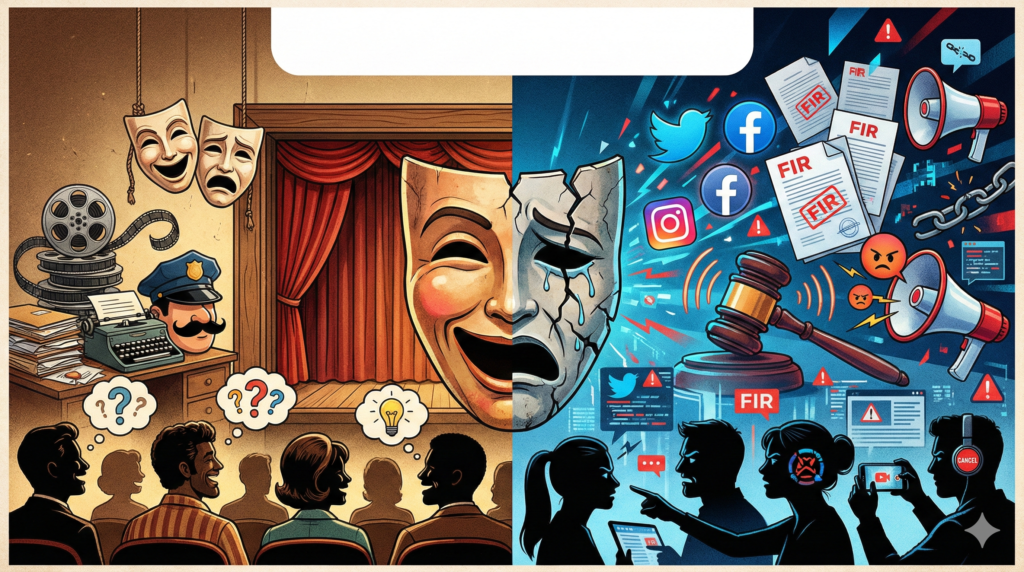
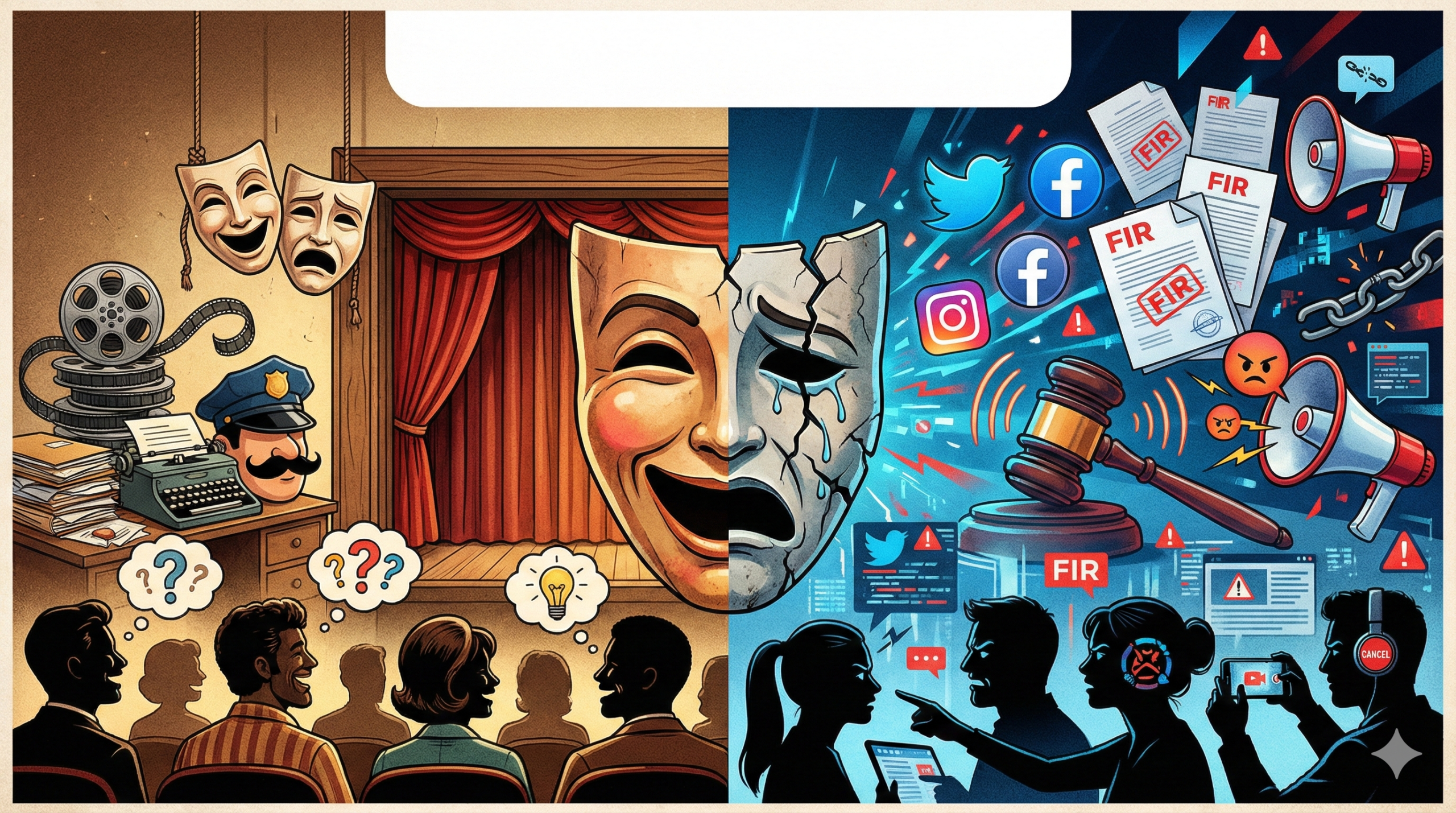
It has been frequently observed that if the iconic “Draupadi cheer-haran” climax from the 1983 classic Jaane Bhi Do Yaaro were to be released today, a very different reception would be anticipated. Instead of applause for its biting satire, immediate calls for bans and the filing of FIRs would likely be witnessed.
The question of whether society is becoming “more intolerant” is complex; however, when earlier films like Sholay and Jaane Bhi Do Yaaro are compared with the current climate, a significant transformation in how satire is processed can be discerned.
THE ERA OF CONTEXTUAL UNDERSTANDING (1970S–80S)
Previously, a distinction was generally made by audiences between the intent of the filmmaker and the content depicted on screen.
- Satire was accepted: In Jaane Bhi Do Yaaro, the chaos on the Mahabharata stage was not interpreted as an insult to the epic itself. Rather, it was understood that the corruption of modern institutions—builders, police, and bureaucrats—was being mocked through the mythological lens.
- Caricatures were permitted: Similarly, in Sholay, the character of the jailer was viewed as a harmless caricature of authority. It was not seen as an attack on the dignity of the uniformed forces, nor was the sovereignty of the state considered to be undermined.
- Context was preserved: During this period, films were consumed in their entirety. Consequently, the satirical message was understood within the broader narrative, rather than being judged by isolated fragments.
THE SHIFT TOWARD INTERPRETIVE LITERALISM (THE PRESENT)
Conversely, a shift toward “interpretive literalism” has been noted in recent years. This change is exemplified by the Karnataka High Court’s recent observation regarding the depiction of Hindu Gods in a Zee comedy show, where it was stated that “no indulgence” would be deserved by such portrayals.
- The “Single-Frame” Judgment: Today, scenes are often judged in isolation. If a character is dressed as a deity and a joke is cracked, offense is immediately taken, often without the scene’s larger message being considered.
- The Narrowing of Artistic License: It is argued by many that the benefit of the doubt—once granted to artists—is no longer being extended. Instead, an immediate interpretation of “insult” is often favored over “satire.”
FACTORS CONTRIBUTING TO THE PHENOMENON
Furthermore, several structural changes in society can be identified as drivers of this intolerance.
- Amplification by Social Media: Content is now stripped of its context and circulated globally within minutes. Consequently, outrage is manufactured among millions who may not have even viewed the original work.
- The Weaponization of Law: Legal provisions, such as Section 295A (hurting religious sentiments), are increasingly being invoked by private citizens. As a result, the legal process itself is often feared as the punishment, leading to self-censorship by creators.
- The Polarization of Discourse: In a polarized environment, comedy is frequently viewed through a partisan lens. It is often asked whether a specific religion or group is being targeted, rather than the humor being appreciated for its own sake.
CONCLUSION:
Ultimately, it can be concluded that a rigidity regarding sacred symbols has been adopted by society. The playful elasticity that was once enjoyed in films like Jaane Bhi Do Yaaro—where a mythological set could be dismantled to expose a corrupt system—has largely been lost.
It appears that the ability to separate the depiction from the divine has diminished. Consequently, the line between satire and sacrilege has been blurred, leaving little room for the nuance that was once celebrated in Indian cinema.
SOURCES:
- Karnataka HC on Zee Comedy Show (Jan 2026): Bar and Bench: “Anything under garb of free speech? Karnataka HC pulls up Zee over depiction of Hindu Gods”
- Original Jaane Bhi Do Yaaro Context: The Indian Express: Why Jaane Bhi Do Yaaro is a timeless classic
- Legal Context (Section 295A): Constitution of India: Article 19(2) and Reasonable Restrictions
 Adv. Mamta Singh Shukla
Supreme Court of India | PoSH Trainer
 Adv. Mamta Singh Shukla
Finally, the article was originally published by Vijay Foundation. For more legal and public-interest articles, readers may visit vijayfoundations.com.