
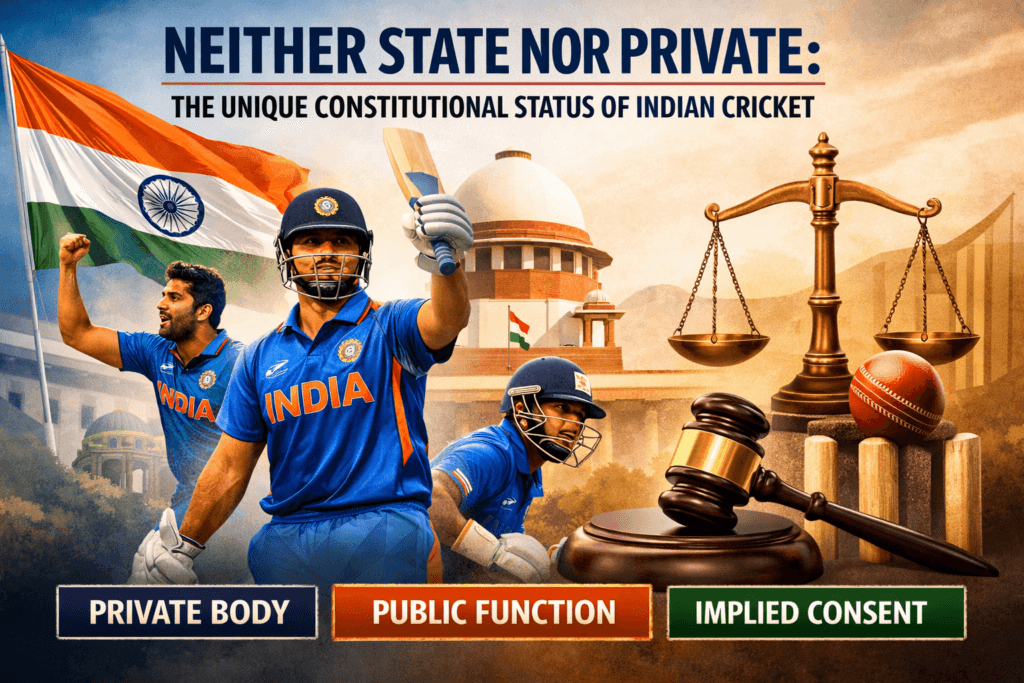
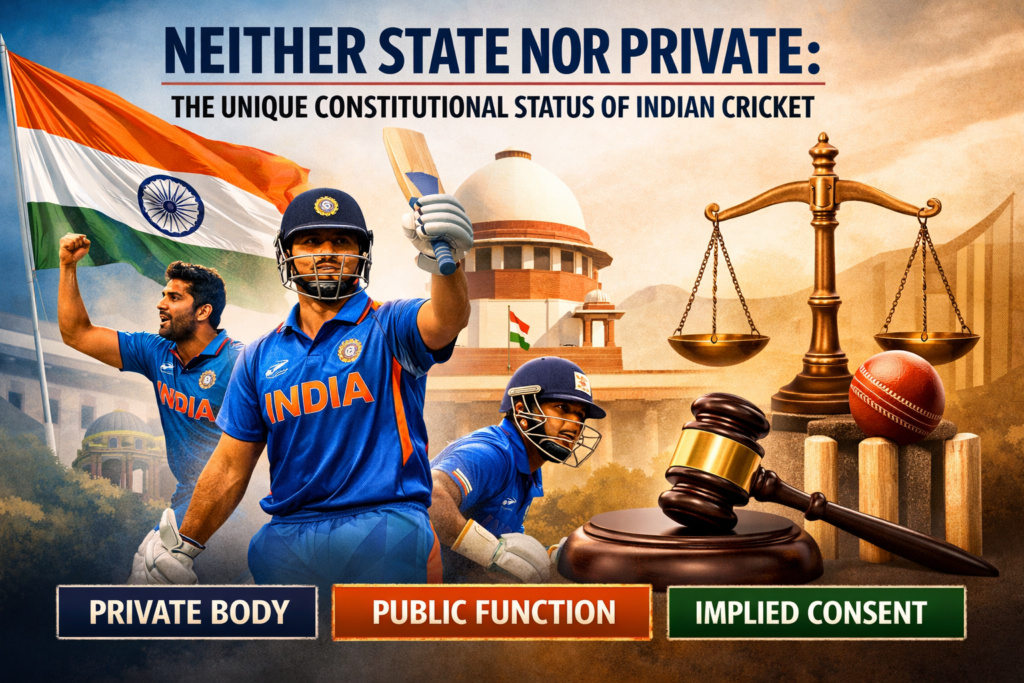
NEITHER STATE NOR PRIVATE: THE UNIQUE CONSTITUTIONAL STATUS OF INDIAN CRICKET
The Supreme Court of India dismissed a Public Interest Litigation (PIL) that sought to restrain the use of the name “Team India” for the national cricket team. The Court termed the plea frivolous. Yet, the case briefly spotlighted the unusual constitutional position of Indian cricket and the Board of Control for Cricket in India (BCCI).
THE TRIGGER: A “FRIVOLOUS” CHALLENGE:-
The petitioner argued that the BCCI is a private society, not a government body. On that basis, the plea claimed that a team selected by the BCCI should not use the name “Team India” or present itself as the national team.
The petitioner further alleged that the use of national symbols, including the Indian tricolour, by a private entity misleads the public into believing the team enjoys formal state sponsorship.
A Supreme Court bench comprising Chief Justice Surya Kant, Justice Joymalya Bagchi, and Justice Vipul M. Pancholi firmly rejected these arguments. The Court described the petition as an abuse of judicial process and warned the petitioner not to burden the Court with such claims.
The bench upheld the Delhi High Court’s earlier dismissal and reaffirmed the team’s universal recognition as India’s national representative.
THE LEGAL PARADOX: PRIVATE BODY, PUBLIC FUNCTION:-
To understand the Court’s response, one must examine the BCCI’s unique legal status.
In Zee Telefilms Ltd. v. Union of India (2005), the Supreme Court held that the BCCI does not qualify as “State” under Article 12 of the Constitution. The Court relied on three key factors:
- The BCCI receives no government funding.
- It operates as a society registered under the Tamil Nadu Societies Registration Act.
- The Government of India holds no ownership or shares in the Board.
However, the Court drew an important distinction. While the BCCI remains a private body, it performs a public function of national importance. As a result, courts can subject it to writ jurisdiction under Article 226.
The Court also recognised that the government has granted implied consent for the use of the name “India” and national symbols. The State routinely provides diplomatic, logistical, and security support to the team during international tours. This conduct confirms official approval.
THE ERA OF ACCOUNTABILITY: THE LODHA REFORMS:-
Although the BCCI’s private status protected it from the name-change challenge, it did not shield the Board from judicial scrutiny over governance.
After the 2013 IPL betting scandal, the Supreme Court appointed the Justice R.M. Lodha Committee to reform cricket administration. The Committee recommended sweeping changes to curb corruption and concentration of power.
Key reforms included:
- One State, One Vote: This rule ended the voting dominance of states with multiple associations, such as Maharashtra and Gujarat.
- CAG Nominee: The Court mandated the presence of a Comptroller and Auditor General nominee to enhance financial transparency.
- Cooling-Off Periods: Administrators must now take mandatory breaks between terms to prevent entrenched control.
THE “CONFLICT OF INTEREST” DILEMMA:-
The most debated reform remains Rule 38 of the BCCI Constitution, popularly known as the “One Person, One Post” rule. The rule prevents individuals from holding multiple positions of influence at the same time.
Under this framework, a person cannot simultaneously serve as a BCCI office-bearer and work as a selector, commentator, IPL mentor, or franchise official.
This rigidity has produced unintended consequences. Several former players and experts declined BCCI roles to protect their professional careers.
Rahul Dravid, for instance, had to step away from his corporate role to lead the National Cricket Academy. Sourav Ganguly openly criticised the rule and famously tweeted, “God help Indian cricket.”
While the rule reduced conflicts of interest, it also discouraged experienced professionals from entering cricket administration.
CONCLUSION:-
The Supreme Court’s dismissal of the PIL confirms the settled legal position. The BCCI occupies a rare constitutional space. It remains a private body, yet performs a public function of national significance.
Although it does not fall within the definition of “State” under Article 12, courts can still oversee its actions through judicial review. The name “Team India” stands on firm legal ground, backed by implied government consent and decades of public recognition.
In the end, legal labels matter less than reality. Indian cricket represents the nation, not because a statute says so, but because the country and the State both treat it that way.
SOURCE LINKS:-
- Zee Telefilms Ltd. v. Union of India (2005) – Supreme Court of India
- Board of Control for Cricket in India v. Cricket Association of Bihar (2015) – Lodha Committee case
- Justice R.M. Lodha Committee Report on BCCI Reforms
- Article 12 & Article 226 – Constitution of India
- Supreme Court observations on PIL abuse
 Adv. Mamta Singh Shukla
Supreme Court of India | Certified PoSH Trainer
 Adv. Mamta Singh Shukla
Finally, the article was originally published by Vijay Foundation. For more legal and public-interest articles, readers may visit vijayfoundations.com.