
Table of Contents
ToggleSovereignty in the Cloud: 7 Masterful Tips for Party Autonomy in Tech Transactions
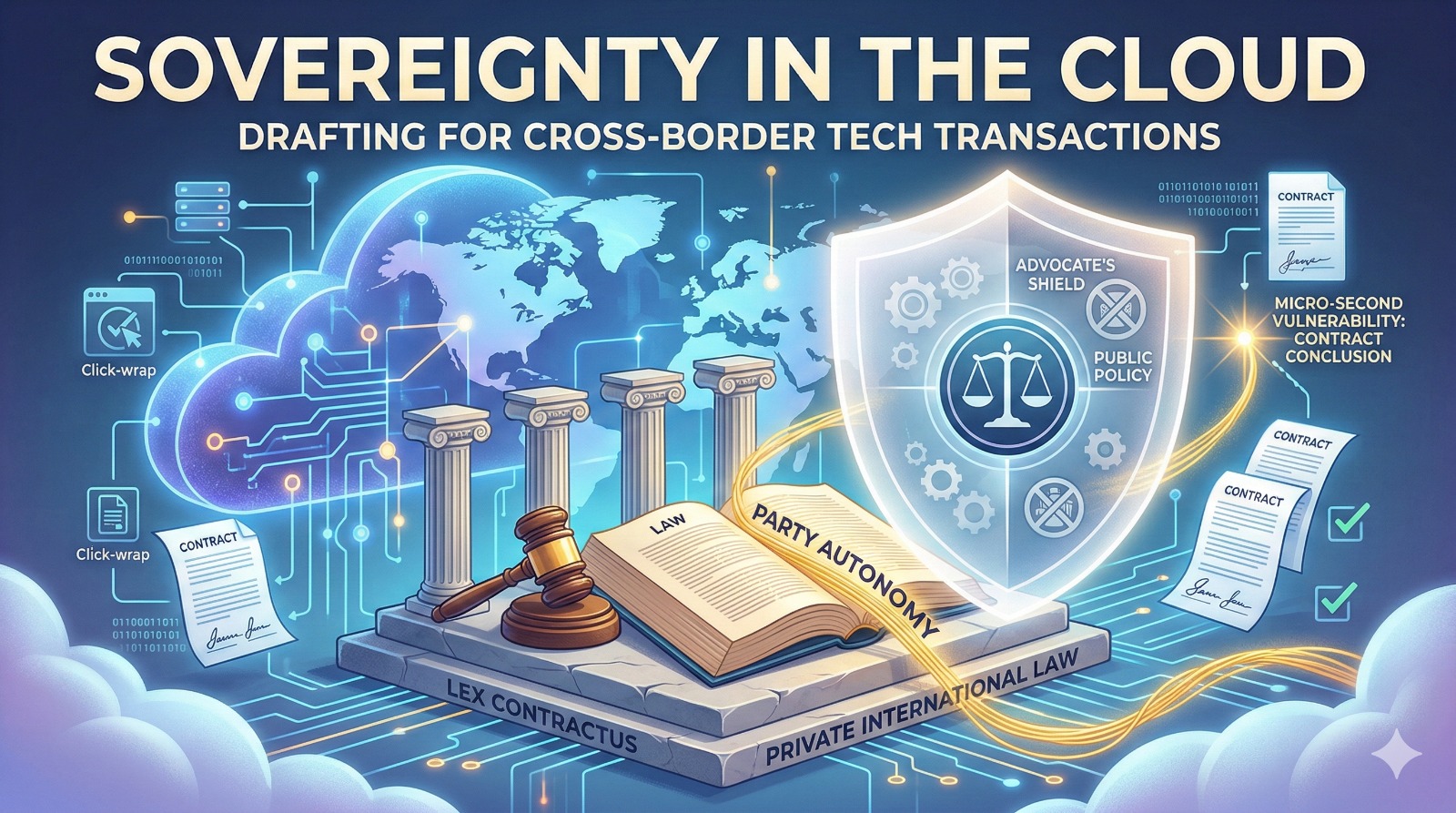
In an era of borderless data, achieving true Sovereignty in the Cloud is no longer a given—it must be strategically engineered through contract law. In the high-stakes theater of global commerce, the “meeting of the minds” occurs across fundamentally conflicting legal systems. For the modern Advocate, Party Autonomy is the “golden thread” of Private International Law—a surgical tool providing the predictability essential for digital-first transactions where Sovereignty in the Cloud is at risk.
However, the freedom to choose the law is not an absolute license. It is a strategic power bounded by mandatory rules and the technical mechanics of contract “conclusion.” To truly master this domain, one must understand how Party Autonomy functions at the very birth of a legal obligation to protect a firm’s Sovereignty in the Cloud.
1. The Anatomy of Choice: Substantive vs. Conflict-of-Laws Party Autonomy
To maintain Sovereignty in the Cloud, we must first distinguish between the two distinct layers of autonomy:
- Substantive Autonomy: The right to negotiate commercial obligations, price, and risk allocation.
- Conflict-of-Laws Autonomy: The power to select the lex contractus—the legal system that fills the gaps and determines the validity of the agreement itself.
Without an express choice of law, Sovereignty in the Cloud is compromised, as the contract becomes subject to default “connecting factors” which can render protective clauses unenforceable in foreign courts.
2. The Critical Junction: How Party Autonomy Influences Contract Conclusion
The “conclusion” phase is the most vulnerable state of any deal. Party Autonomy allows parties to preemptively decide which law governs this “birth.” This is vital because different systems follow conflicting rules—such as the “Mailbox Rule” in Common Law versus the “Receipt Rule” in Civil Law—to determine exactly when a deal becomes binding. Establishing these rules early is a cornerstone of maintaining Sovereignty in the Cloud.
3. Global Frameworks and External Legal Instruments
Navigating the global maze requires an understanding of regional instruments like the Hague Principles and the UNIDROIT Principles. These serve as a model for international contracts where national laws may be too rigid to support Sovereignty in the Cloud.
| Instrument | Legal Focus | Strategic Utility |
|---|---|---|
| Rome I Regulation | EU Courts | Article 3 provides near-absolute autonomy for contractual obligations. |
| Hague Principles | Global Soft Law | Promotes the widest possible use of Party Autonomy in commercial deals. |
| CISG | International Sales | Governs formation but allows for an “opt-out” via Art. 6. |
4. Resolving Conflicts with Strategic Party Autonomy
Utilizing Party Autonomy allows an Advocate to solve the “Battle of the Forms” before it happens. By ensuring the Governing Law Clause is embedded in the initial offer, you establish the rules for resolution methods like the “Last Shot Rule,” further securing your client’s Sovereignty in the Cloud.
5. The Advocates’ Shield: Limits of Party Autonomy
Freedom of contract is not absolute. In the context of Sovereignty in the Cloud, practitioners must account for the legal boundaries that cannot be contracted away:
- A. Overriding Mandatory Rules: Provisions like data residency requirements and GDPR apply regardless of the law chosen, directly impacting Sovereignty in the Cloud.
- B. Public Policy (Ordre Public): A judge may refuse foreign law if it is “manifestly incompatible” with local forum values.
- C. Formal Validity: Modern frameworks like Art. 11 of Rome I protect digital “Click-wrap” agreements in the tech sector.
6. The Future: De-nationalization and Smart Contracts
We are increasingly seeing a shift toward “non-state” rules. In blockchain-based deals, Party Autonomy is moving toward “de-nationalization.” This requires drafting “Hybrid Clauses” that combine traditional national law with digital-first arbitration rules to protect your Sovereignty in the Cloud during automated execution.
7. Practitioner’s Final Checklist for Party Autonomy
- Express Choice: Ensure the choice of law is explicit to safeguard Sovereignty in the Cloud.
- Scope: Does the clause cover both contractual and non-contractual (tort) disputes?
- Exclusivity: Clearly state if the jurisdiction is “Exclusive” to prevent forum shopping.
- Mandatory Review: Check for local data residency rules that might override your Sovereignty in the Cloud strategy.
Conclusion: Designing Legal Certainty
In Private International Law, silence is a liability. If the parties do not choose their law during the conclusion of their contract, the court will choose it for them. By masterfully exercising Party Autonomy, you build a robust bridge between two worlds and secure your Sovereignty in the Cloud for the long term.
Learn more about our legal advisory on our About Us page.