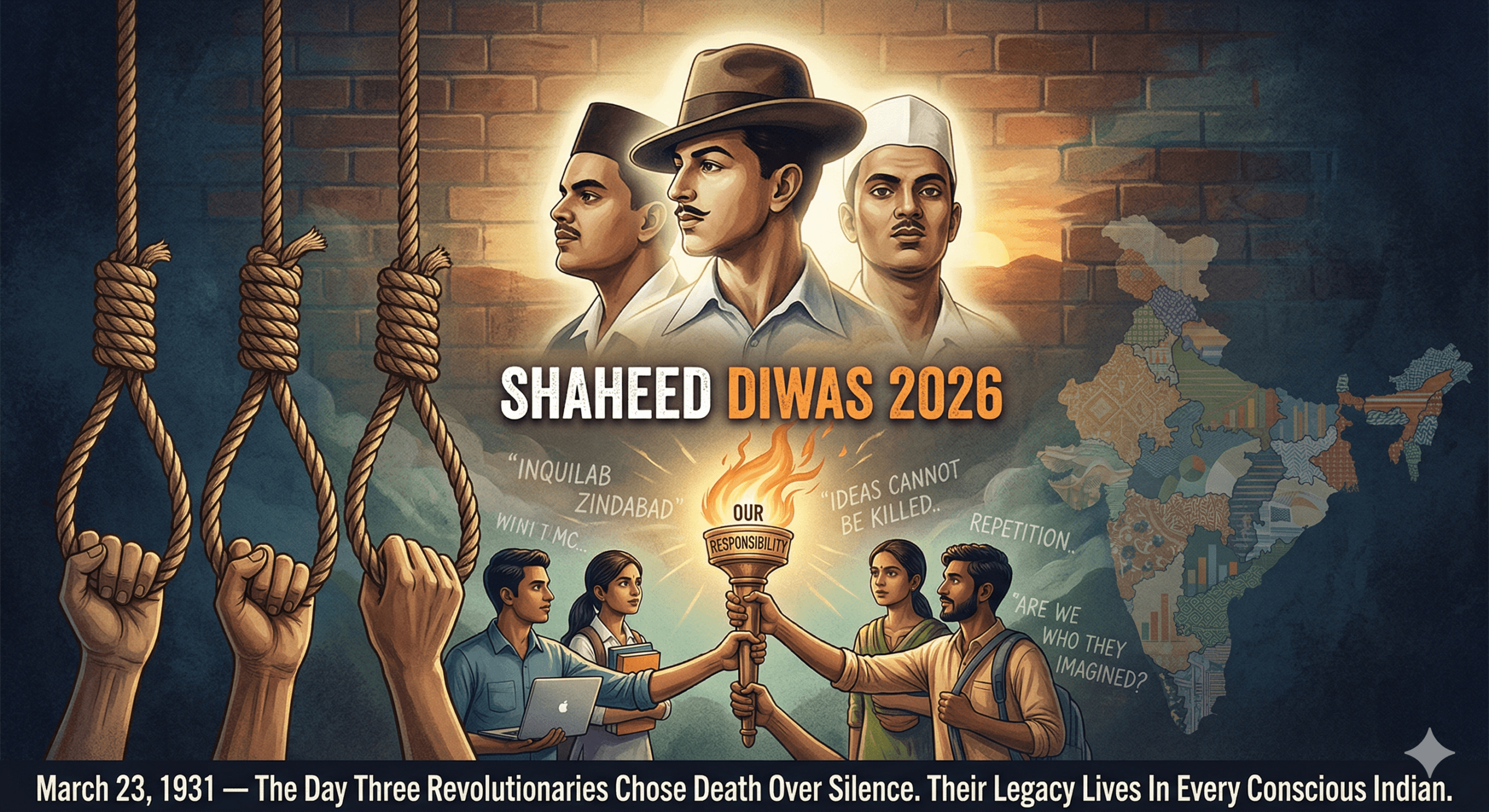
Their Noose. Our Responsibility.
Did We Live Up to
the Dreams of 1931?
Bhagat Singh, Rajguru, and Sukhdev were hanged on March 23, 1931. They didn't just die for independence — they died for a vision of youth. Ninety-five years later, this is the honest reckoning.
"They may kill me, but they cannot kill my ideas. They can crush my body, but they will not be able to crush my spirit."— Shaheed Bhagat Singh · Executed March 23, 1931 · Age 23
On March 23, 1931, three young men walked to the gallows in Lahore Central Jail. They were 23, 22, and 24 years old. They smiled. They sang. They chanted Inquilab Zindabad — Long Live the Revolution — as the ropes tightened. Bhagat Singh, Shivaram Rajguru, and Sukhdev Thapar gave their last breath not merely to end British rule, but to birth a certain kind of Indian — conscious, courageous, fearless, and ceaselessly curious. Every year on Shaheed Diwas 2026, we are called to remember not just their names, but the fire behind them.
Ninety-five years have passed. Shaheed Diwas 2026 — observed on March 23 — is marked with tributes that flood social media. Politicians lay wreaths. Schools hold assemblies. And then, by evening, it's back to scrolling reels.
The real question isn't whether we remember the martyrs. The real question is: did we become who they imagined we would be?
This blog does not offer easy comfort. It offers an honest mirror — reflecting both the vision of 1931 and the reality of 2026. On Shaheed Diwas 2026, we ask: if today's Indian youth has fallen short of that vision, what can we actually do about it?
Part I: The Vision of 1931 — What Did the Martyrs Dream For the Youth?
To understand whether today's youth lives up to the martyrs' expectations, we must first understand precisely what those expectations were. Bhagat Singh was not simply a militant. He was a voracious reader who consumed Marx, Lenin, Rousseau, and Victor Hugo in prison. His writings — especially Why I Am an Atheist and his prison notebooks — reveal a man who envisioned the Indian youth as the intellectual backbone of a transformed nation.
Their vision can be distilled into five powerful pillars:
Intellectual Depth
Youth who read, think critically, debate publicly, and understand both Indian and global political philosophy — not just follow slogans blindly.
Rejection of Exploitation
Inquilab Zindabad wasn't about just British rule. It was a war cry against every system where one human exploits another — economic, caste-based, or communal.
Collective Over Self
The martyrs belonged to different religions and regions but had one goal. They modeled the idea that community interest must rise above personal ambition.
Fearless Integrity
Bhagat Singh refused to apologize to the British even to save his life. He imagined a youth that chooses moral courage over personal comfort.
Scientific Temper
He was an atheist who based his worldview on reason and evidence. He wanted a youth that questions superstition, fights blind faith, and trusts science.
These were not lofty poetic hopes. These were the operational demands of a revolution. Bhagat Singh understood that political freedom without social transformation was meaningless — a change of masters, not a change of destiny. His vision demanded that each generation of youth carry the revolution forward within themselves.
Bhagat Singh founded the Naujawan Bharat Sabha (Youth Society of India) in 1926 — five years before his execution. Its purpose was to mobilize youth not just to fight colonialism, but to build a progressive, secular, egalitarian India from within. The word "Naujawan" (young person) was central to his identity. He didn't just want young people to fight — he wanted them to think.
Part II: The Mirror — Does Today's Youth Measure Up?
Holding today's generation up to the five pillars of the 1931 vision gives us a complicated, layered picture. It is neither a story of total failure nor of uncomplicated success. As we observe Shaheed Diwas 2026, the Indian youth of today stands as a generation of extraordinary contradictions.
| The 1931 Vision | Where We're Winning ✓ | Where We're Falling Short ✗ |
|---|---|---|
| Intellectual Depth | IIT, IIM graduates lead global companies. India produces 1.5M engineers/year. ✓ Growing | Only 28% of Indians read books regularly (NLM 2024). Critical thinking is rarely tested in school. ✗ Weak |
| Rejection of Exploitation | Youth-led movements against sexual harassment (#MeToo India), environment, and labor rights have grown. ✓ Emerging | Caste discrimination, communal violence, and economic inequality remain severe — and youth participation in addressing them is low. ✗ Urgent |
| Collective Over Self | Volunteer networks, NGOs, and community welfare startups are growing fast in Tier 2 & 3 cities. ✓ Promising | "Hustle culture" glorifies individualism. Young professionals often cite "my growth" over "community uplift." ✗ Shifting |
| Fearless Integrity | Young journalists, lawyers, activists risk careers to speak truth. India's whistleblower culture is rising. ✓ Brave minority | Most youth stay silent on local corruption, unfair systems, or social injustice to avoid career or social consequences. ✗ Common |
| Scientific Temper | India's space program, vaccine drive, and tech sector show scientific prowess. ✓ Strong | Misinformation spreads faster in India than any other country (Reuters Institute 2023). Superstition still shapes daily choices for millions. ✗ Paradox |
The Brilliance We Carry
Let's be honest about what today's youth has achieved. Indian-origin professionals lead Google, Microsoft, IBM, and dozens of global institutions. The startup ecosystem in India created over 100 unicorns by 2025. Indian-origin scientists contributed to discoveries in genomics, AI, and climate science. This is technological bravery — and the martyrs would have cheered for it. The "Atmanirbhar Bharat" spirit in innovation genuinely echoes the self-reliance the 1931 generation dreamed of.
The Fog We Have Drifted Into
And yet. While Bhagat Singh spent his prison years reading Trotsky and writing treatises on religion and state, a significant portion of today's youth spends comparable hours in dopamine loops — engineered by apps designed to keep eyes on screens and minds in a fog. This is not moral judgment. It is an honest systemic observation.
The martyrs spent their last days in libraries. A generation later, we spend our free time in algorithms. The revolution hasn't ended — it has merely been distracted.
The deeper gap is ideological. Bhagat Singh's generation had a coherent worldview — socialism, secularism, anti-imperialism — built through years of reading and debate. Today, we often see passion without philosophy. The "outrage culture" that dominates social media is not meaningless, but it frequently lacks the long-term vision and organized action that transforms anger into change.
Part III: Bridging the Gap — How Can Today's Youth Actually Align with the Vision?
If we have drifted from the 1931 vision — partially, structurally, not always deliberately — the path back is not guilt. It is not performative patriotism on Shaheed Diwas 2026 followed by indifference on March 24. The path back is through specific, real, daily choices that individually seem small but collectively constitute the revolution Bhagat Singh was actually talking about.
Here are seven concrete, actionable ways today's youth can begin to honor — genuinely, not ceremonially — the dream of the 1931 martyrs:
-
01
Cultivate Intentional Reading Habits
Bhagat Singh read everything from economics to theology even in prison. Start with one serious book per month — history, political philosophy, economics, science. Read Bhagat Singh's own writings. Understand the Constitution. Replace 30 minutes of scrolling with reading, and watch your intellectual horizon expand. Libraries, open-source archives, and free e-books make this more accessible than ever.
-
02
Stand Against Injustice — Starting in Your Own Neighborhood
You don't need to throw bombs to be revolutionary. Standing against the local municipal officer who demands a bribe, speaking up when a Dalit colleague is unfairly sidelined, or refusing to silently watch a woman being harassed on public transport — these micro-acts of courage are what Sukhdev and Rajguru imagined when they spoke of a fearless generation.
-
03
Verify Before You Share
Bhagat Singh was an anti-superstition rationalist who championed scientific temper. Every time you share unverified political content, communal misinformation, or pseudoscientific health claims, you work against his legacy. Use fact-checking tools. Pause before forwarding. The information revolution is powerful — it can be wielded for liberation or for fog.
-
04
Use Your Profession as Your Revolution
The martyrs fought through the tools available to them. Your tools are your skills — coding, law, design, teaching, medicine, communication. An engineer who builds accessible public transport infrastructure is revolutionary. A lawyer who takes up a pro bono case for a bonded laborer is revolutionary. Your career can be a weapon for the common good. Choose who you serve with your talent.
-
05
Actively Reject Communal and Caste Divisions
Bhagat Singh, Rajguru, and Sukhdev came from different castes and religions and died for one India. If their sacrifice means anything, it demands that we actively refuse to let religion, caste, region, or language be weaponized to divide us. This means speaking up in family WhatsApp groups, refusing to vote purely on identity lines, and building genuine cross-community friendships and alliances.
-
06
Invest in Service — Even Small Doses
Volunteering even two hours a week with a local NGO, tutoring an underprivileged child, contributing to community clean-up drives, or supporting mental health awareness campaigns — these are modern expressions of the collectivist ethos the martyrs embodied. Service is not sacrifice; it is civic oxygen.
-
07
Participate in Democracy — Beyond Just Voting
Voting is the floor, not the ceiling. Attend gram sabhas or ward meetings. File RTI requests. Engage with local civic issues. Follow and critique policy. The martyrs fought for political agency — using it fully is the least we can do. Democracy requires citizens who participate, not just spectators who occasionally ballot.
These seven actions are not a checklist to complete once. They are a shift in orientation — from passive patriotism (feeling proud) to active citizenship (doing something). Bhagat Singh wrote in a letter: "Every tiny molecule of ash, I am made of, is in love with you, O motherland. I am such a lunatic that I am free even in jail." Freedom, for him, was a state of engaged, purposeful living — not a destination reached and then forgotten.
Part IV: The Philosophical Reckoning — Are We Even Asking the Right Questions?
There is a deeper question beneath all of this: are we holding the right conversation about the martyrs, or have we reduced them to symbols to be worshipped rather than ideas to be lived?
There is a peculiar irony in the way Shaheed Diwas 2026 is observed in India. The same political establishments that crushed similar dissent in the decades after 1931 now organize official commemorations. Bhagat Singh — who was explicitly anti-establishment, anti-capitalist, and anti-religion — has been claimed by nearly every political party, religion, and ideology. His image adorns party banners across the political spectrum.
The greatest insult to a martyr is not forgetting them. It is using them — turning their fire into a logo and their sacrifice into a brand.
Today's youth must be wary of this appropriation. Honoring the 1931 martyrs is not about posting on Instagram or changing a display picture for a day. It is about asking hard questions about the systems we participate in and benefit from. It is about acknowledging that exploitation — which Bhagat Singh hated above all else — still exists in India's labor markets, its caste structures, its gender hierarchies, and its political economy.
The youth that Bhagat Singh imagined was not merely patriotic. It was just. There is a difference. Patriotism without justice is nationalism. Justice with patriotism is revolution. And that revolution — the interior one — is what March 23 actually asks of us each year.
"Lovers, Lunatics and poets are made of the same stuff."— Bhagat Singh · From his prison diary
The Torch Is in Your Hands
The martyrs of 1931 did their part — completely, selflessly, and at the age most of us are still figuring out our careers. They gave their today for our tomorrow. And their tomorrow has arrived. It is now.
Being a patriot in 2026 does not require us to die on the gallows. But it does require us to live with purpose. It requires us to choose ethics over easy money, knowledge over ignorance, truth over convenience, and solidarity over silence.
When we make those choices — in our offices, classrooms, homes, and neighborhoods — we do not just remember Bhagat Singh, Rajguru, and Sukhdev. We become who they imagined we would be.
Let us not just read their names in history books. Let us reflect their character in our lives. That is the only tribute that truly matters on Shaheed Diwas 2026 — and every day that follows.
Inquilab Zindabad — Share ThisFrequently Asked Questions
📚 Further Reading & Resources
Internal Reads
- The Role of NGOs in Modern India: A Look at Community Welfare Today
- How to Use RTI to Hold Local Government Accountable
- Youth Volunteerism in India: Stats, Stories, and Starting Points
- Digital Citizenship: Fighting Misinformation in the Age of WhatsApp
- The Indian Constitution Explained for Young Citizens