When the State's System Fails, Citizens Should Not Pay the Price
A landmark Bombay HC Aadhaar ruling has drawn a clear constitutional line: a citizen cannot be held hostage to a government database's technical glitch. The court's directives to UIDAI on 6 May 2026 mark a turning point in how India must treat its own people when the Aadhaar system misfires.
A Database That Governs Lives — and Sometimes Fails Them
Aadhaar — the world's largest biometric identity system — has become the backbone of welfare delivery, financial inclusion, and government service access in India. Over 1.4 billion residents are enrolled. With such scale comes an uncomfortable truth: even a fraction of a percent of errors translates into millions of lives disrupted.
Biometric mismatches, failed updation, deactivation, suspension, omission, cancellation — these are not abstract bureaucratic terms. They mean a student cannot secure a provisional college admission. A labourer loses access to welfare entitlements. A senior citizen is denied an insurance claim. And when the system offers no clear path to resolution, these individuals are left with a cruel choice: navigate an opaque bureaucracy alone, or pay a lawyer and knock on the doors of a constitutional court.
The Bombay High Court, in its order dated 6 May 2026 in Rohit Nikalje & Anr. v. Regional Officer, UIDAI & Ors. (Neutral Citation: 2026:BHC-AS:22042-DB), said this is simply not acceptable. In doing so, it has articulated a principle that goes far beyond the facts of one case.
The Nikalje Twins: A Story of Administrative Limbo
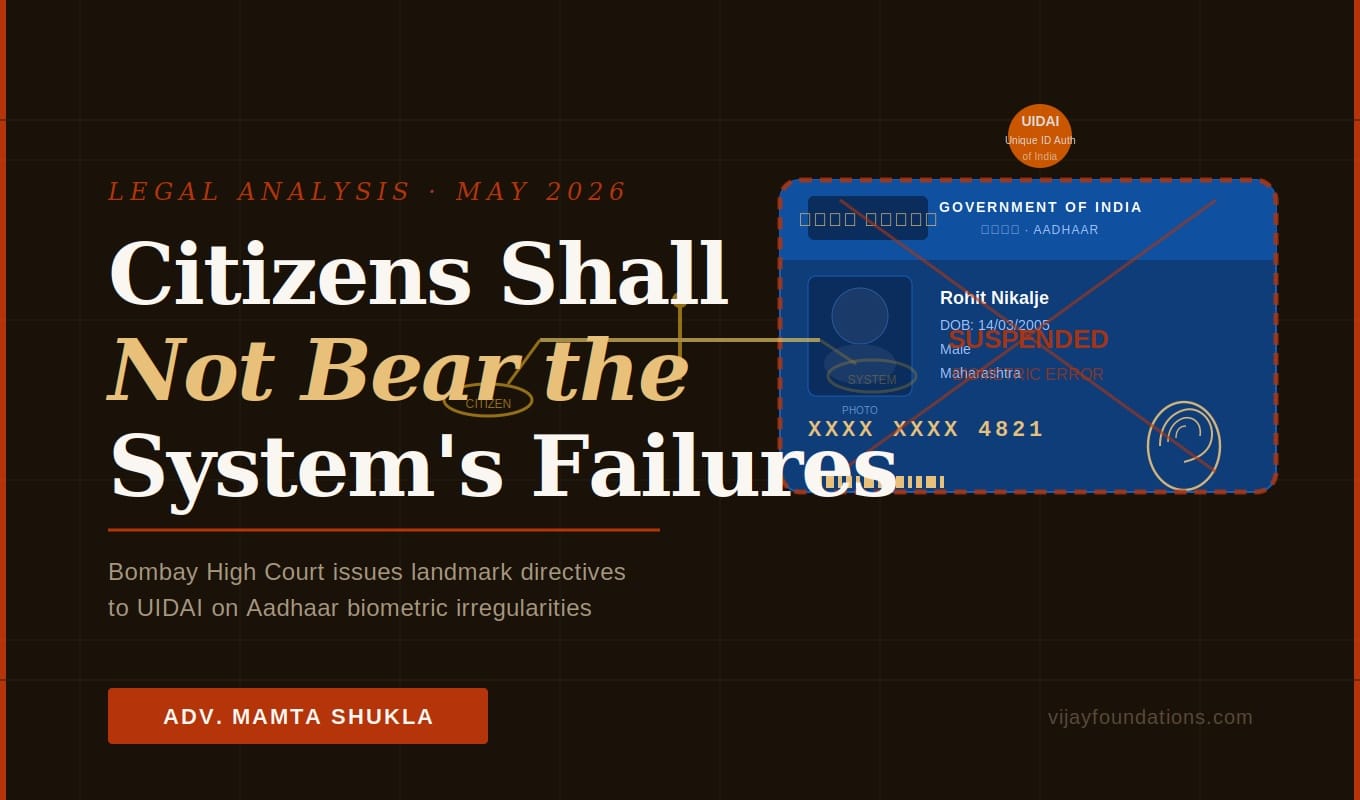
The petitioners were twin brothers who had been issued Aadhaar cards as minors in 2012. Ten years later, when they attempted to update their biometrics — a routine process — they were met with a bewildering series of contradictory official communications.
Rohit Nikalje & Anr. v. Regional Officer, UIDAI & Ors.
The brothers were first directed to update their biometrics. Then told to apply for cancellation. Then informed the cancellation process was revoked. And finally told their numbers had been suspended — with no explanation and no resolution. All while requiring valid Aadhaar for college admissions and insurance for sporting activities.
Order Date: 6 May 2026 | Bench: Justice Ravindra V. Ghuge & Justice Hiten S. Venegavkar | Writ Petition under Art. 226The court found the situation untenable. If childhood biometric data was incorrectly recorded, the fault cannot be fastened upon the children. It directed the twins to submit fresh enrolment applications within 15 days and ordered UIDAI to process these applications strictly within four weeks.
Crucially, the court clarified that while it would not direct the restoration of a record containing anomalous biometrics, it would compel authorities to exercise their statutory functions in a time-bound, humane, and constitutionally reasoned manner. The Aadhaar Act, 2016 and its Regulations, the bench held, do not sanction an "indefinite administrative limbo."
"An eligible resident cannot be left remediless merely because an earlier biometric record is defective, particularly where there is no allegation of fraud or impersonation."
— Division Bench, Bombay High Court, May 2026This Is Not an Isolated Incident — The Court Said So
What makes this ruling especially significant is the court's acknowledgement that it is increasingly noticing cases where citizens are compelled to approach constitutional courts due to biometric-related Aadhaar failures. The bench made explicit what lawyers and civil society have long observed: the problem is systemic.
The affected populations are not abstract — they include students, senior citizens, agricultural labourers, persons from rural areas, and those from economically weaker sections of society. These are precisely the groups for whom Aadhaar was meant to be a tool of empowerment, not a bureaucratic labyrinth.
Who Gets Left Behind by Biometric Failures?
- Students needing Aadhaar for college admission verification and scholarship disbursal
- Senior citizens requiring Aadhaar for pension transfers and healthcare benefits
- Labourers linked to MGNREGA and direct benefit transfers through Aadhaar-seeded bank accounts
- Rural residents far from Aadhaar Seva Kendras, who cannot afford repeated visits
- Economically weaker sections unable to bear the cost of legal recourse
The court did not dispute that protecting the integrity of the Aadhaar database is of national importance. UIDAI is fully justified in guarding against duplication, impersonation, and fraudulent enrolment. But there is a crucial distinction: when the system itself generates the anomaly — not the citizen — the constitutional obligation to provide a remedy remains firmly on the state.
What the Bombay High Court Has Ordered UIDAI to Do
The bench issued a comprehensive set of prospective guidelines designed to prevent future citizens from being caught in the same trap. These directives, applicable to all such cases going forward, represent a judicial blueprint for citizen-centric administration:
Written Guidance on Remedies
UIDAI must provide citizens with clear, written communication explaining the precise status of their Aadhaar record and the exact procedure required for rectification.
Facilitation Centers at Regional Offices
Facilitation mechanisms must be maintained at regional offices and Aadhaar Seva Kendras specifically for cases involving biometric mismatch, failed updation, and deactivation.
Four-Week Decision Deadline
Applications must be decided within four weeks. Where no legal impediment exists, fresh Aadhaar numbers or cards must be issued within this period.
Humane and Citizen-Centric Approach
Authorities must adopt a responsive, facilitative approach — particularly for students and vulnerable groups — ensuring genuine residents are not denied identity credentials due to systemic errors.
No Uninformed Repeat Visits
Citizens must not be subjected to repeated, uninformed office visits. Each visit must serve a clear, communicated purpose with a defined path to resolution.
Constitutionally Compliant Process
The administrative architecture must operate with procedural fairness and constitutional reasonableness — the system's purpose must not be frustrated by conflicting internal instructions.
The Constitutional Underpinning: Why This Judgment Matters
As an advocate practising in constitutional and public interest matters, I find this ruling significant not just for what it orders, but for how it reasons. The bench explicitly invokes the principle of constitutional reasonableness — a doctrine that holds that state action must not merely be technically legal but must also be proportionate, fair, and humane.
The right to identity, though not explicitly named as a fundamental right in the Constitution of India, has been repeatedly recognised by courts as flowing from Article 21 — the right to life and personal liberty. A functional identity document is today indispensable for access to healthcare, education, financial services, and welfare. When the state's own infrastructure denies a citizen that document due to a technical failure, Article 21 is engaged.
The court's reference to "procedural fairness" echoes the doctrine of legitimate expectation: when a citizen enrols with UIDAI in good faith and receives an Aadhaar number, they have a legitimate expectation that the system will function correctly and, where it does not, that a clear remedy will be available. Denying that remedy — through bureaucratic inertia or conflicting instructions — is not merely an administrative failure; it approaches a constitutional violation.
"A genuine and bona fide resident of India cannot be rendered without recourse or remedy simply on account of a technological malfunction or a biometric anomaly that arose within the system itself — through no fault of the individual."
— Bombay High Court, Rohit Nikalje Case, 2026This formulation is important: it locates the blame squarely within the system, not the citizen. In doing so, the court pushes back against a trend of techno-administrative governance that sometimes treats citizens as inputs to be verified rather than rights-holders to be served.
For further reading on the Aadhaar Act, 2016 and its Regulations, and how courts have interpreted the right to identity under Article 21, refer to the Supreme Court of India's judgment in Justice K.S. Puttaswamy v. Union of India (2018), which remains the foundational ruling on biometric data, privacy, and state accountability.
What Can Affected Citizens Do Right Now?
If you or someone you know is facing Aadhaar biometric issues — failed updation, suspension, cancellation, or persistent mismatch errors — here is what this ruling means for you practically:
Immediate Steps to Take
- Visit an Aadhaar Seva Kendra and request written communication of your Aadhaar's exact status — the court has now directed UIDAI to provide this
- Document every interaction: keep written records of all communications, instructions received, and visits made to any UIDAI office
- File a formal grievance through the UIDAI grievance portal and keep the complaint number
- If UIDAI does not resolve your matter within four weeks (as now mandated by the Bombay HC Aadhaar ruling), you may file a Writ Petition under Article 226 before the appropriate High Court
- Students and individuals facing urgent need should specifically highlight urgency while citing this order
At Vijay Foundations, we are committed to ensuring that every citizen — regardless of their economic background — understands and can exercise their legal rights. If you require assistance in matters relating to Aadhaar disputes, identity documentation, or constitutional remedies, please reach out through our contact page or avail our Free Legal Aid programme.
The Bombay HC Aadhaar Ruling Reaffirms What Governance Owes Its Citizens
The Bombay High Court's directives in the Nikalje case represent more than procedural corrections to an administrative authority. They are a reminder — delivered at the level of a constitutional court — that the state's relationship with its citizens is not merely transactional. It is fiduciary.
When a government makes a system mandatory, it assumes responsibility for that system's failures. Citizens cannot be asked to bear the costs — financial, emotional, and dignitary — of errors they did not create. The court has said so clearly. Now the burden shifts to UIDAI to demonstrate that it has heard.
As lawyers, advocates, and citizens, it is our shared responsibility to hold institutions to these standards. When they fall short, the courtroom remains an essential — though ideally last resort — arena for accountability. This judgment adds a powerful weapon to that arsenal.
The constitutional promise of dignity is only meaningful when it reaches the ordinary resident standing confused outside a government office, wondering why the system that was supposed to include them has locked them out. Judgments like this are how we make that promise real.