
E-Cooking in Today's Time: How the Digital Age Is Reinventing the Indian Kitchen
From AI-powered recipes to smart cookers — the complete picture of electronic cooking, its promise, its perils, and what it means for you.
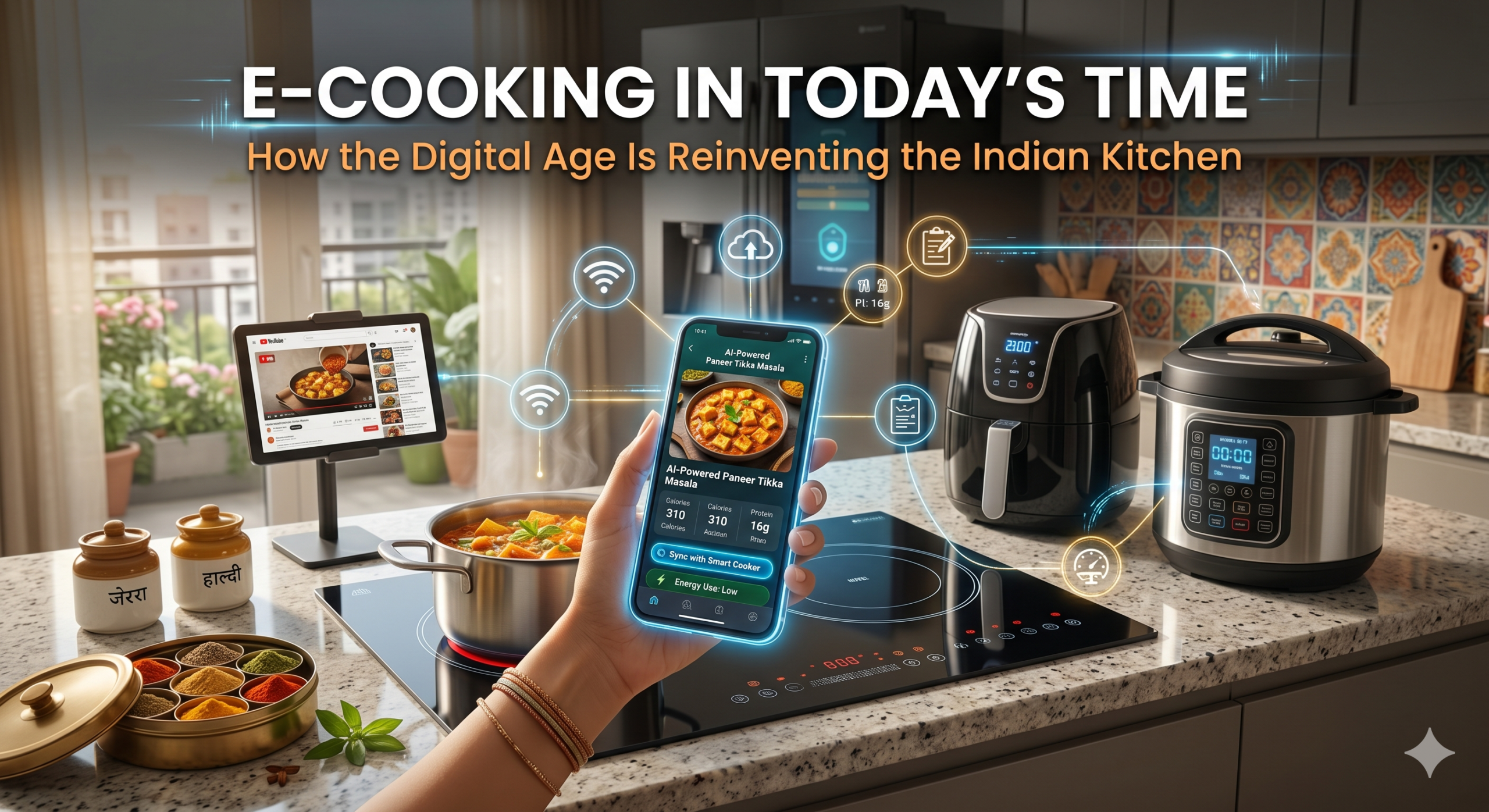
Imagine asking your phone what to cook tonight, having it suggest a recipe based on the ingredients in your refrigerator, preheat your oven, and order the one missing spice — all before you even step into the kitchen. Sounds like science fiction? The rapid rise of E-Cooking in India in 2026 has made this very much a science fact.
Welcome to the era of E-Cooking — an umbrella term for the convergence of electronic appliances, the internet, artificial intelligence, and digital platforms with the timeless human act of cooking food. Whether it is a homemaker in Lucknow following a YouTube recipe, a young professional in Bengaluru using an air fryer guided by a smartphone app, or a chef in Delhi using an IoT-connected oven — all of them are part of this silent but sweeping revolution.
As a legal professional who also deeply values our cultural food heritage, I have watched this transformation with both admiration and analytical curiosity. This article attempts to capture every dimension of e-cooking — its technology, its social impact on Indian households, its economic implications, and the regulatory questions it inevitably raises.
"The kitchen has always been the heart of the home. E-Cooking has not replaced that heart — it has simply given it a digital pacemaker."
What Exactly Is E-Cooking?
E-Cooking is not simply about cooking with electricity — that has existed since the 1890s. Rather, it refers to the intelligent, connected, and digitally-mediated approach to food preparation that has accelerated dramatically in the last decade, especially post-COVID.
It encompasses several overlapping domains:
Digital Recipe Ecosystems
Apps, platforms, and video channels that guide cooking in real time — from Archana's Kitchen to global platforms like Yummly.
Smart Appliances
IoT-connected ovens, air fryers, induction cooktops, and pressure cookers controllable via smartphone apps.
AI-Powered Assistance
Machine learning that personalises recipes, plans meals based on health data, and manages grocery lists automatically.
Meal Kit Delivery
Pre-portioned, e-ordered ingredient kits paired with digital instructions — a growing category in Indian metros.
Online Culinary Education
Professional and amateur cooking courses on platforms like Udemy, MasterClass, and YouTube.
Cloud Kitchens
Technology-managed cooking facilities operating purely for delivery, without dine-in infrastructure, driving a new food economy.
At its core, e-cooking in India is about the democratisation of culinary knowledge combined with the automation of culinary effort — two forces that are reshaping how India eats and feeds itself.
The Technology Behind E-Cooking
E-cooking runs on a sophisticated technological stack. Understanding each layer helps us appreciate both its capabilities and its vulnerabilities.
Smart Appliances and the IoT Layer
Modern kitchen appliances are no longer passive machines. Brands like Philips, Instant Brands, Samsung, and LG now offer refrigerators that track expiry dates, ovens that self-calibrate temperatures, and rice cookers that sync with recipe apps. These devices communicate over Wi-Fi or Bluetooth with companion apps, allowing remote control, data logging, and in some cases, automatic recipe execution.
In India, induction cooktops have become the entry point for most households — energy-efficient, safe for children, and now increasingly app-compatible. The government's push for clean cooking through the Pradhan Mantri Ujjwala Yojana has paradoxically created space for electric cooking to fill the affordability gap in urban slums and peri-urban areas.
Cloud and App Infrastructure
Recipe apps are no longer simple digital cookbooks. Platforms like BigBasket's Cookbook, Tarla Dalal's App, and international players like Serious Eats now use cloud databases to serve personalised content. They sync with grocery delivery, track nutritional intake, and remember your preferences. Some Indian apps now support regional language interfaces, making e-cooking accessible to non-English speakers.
Video and Live Streaming
YouTube has arguably become the most powerful e-cooking platform for India. Channels like Nisha Madhulika (14M+ subscribers), Kabita's Kitchen, and Chef Ranveer Brar attract millions of daily views. Instagram Reels and YouTube Shorts have compressed recipe education into 60-second formats that are particularly effective for Gen Z cooks.
India is the second-largest market for food content on YouTube globally. Over 500 million minutes of cooking content is watched every month in India alone, according to YouTube's 2024 India Insights report.
Today's Situation: E-Cooking in India 2025
The present landscape of e-cooking in India is a story of breathtaking contrasts. On one end, a family in rural Madhya Pradesh receives its first induction cooktop under a government subsidy. On the other, a tech-enabled dark kitchen in Hyderabad processes 800 orders a night, its entire operation — from inventory to delivery — managed by algorithms.
The Urban Surge
In Indian metros — Delhi-NCR, Mumbai, Bengaluru, Hyderabad, Pune — e-cooking adoption has been explosive. Several converging forces explain this:
- Post-COVID hygiene consciousness made home cooking fashionable; people who never cooked bought appliances and subscribed to recipe platforms.
- Dual-income households with time pressures adopted smart cookers, instant pots, and meal kits.
- Rising health awareness drove demand for air fryers (replacing deep frying), steam cookers, and apps that calculate macronutrients.
- Affordable smartphones and cheap data (Jio's disruption) made streaming recipes and controlling smart devices mainstream even for lower-middle-class urban households.
- Food content economy on Instagram and YouTube created aspirational home cooking culture.
The Semi-Urban and Rural Story
While metro India races ahead, the picture in smaller cities (Tier 2 and Tier 3) and rural India is more nuanced. Induction cooktops have penetrated deeply, often replacing traditional wood-fire chulhas due to government promotion and reduced pollution concerns. However, truly "smart" e-cooking — with apps, AI, and IoT — remains largely aspirational here.
Importantly, YouTube cooking content in Hindi and regional languages has been a genuine equaliser. A homemaker in Raipur learning paneer recipes from a YouTube tutorial is participating in e-cooking even without a smart appliance — the digital knowledge layer is itself transformative.
The Cloud Kitchen Explosion
India's cloud kitchen sector has grown at a CAGR of over 12% and is projected to be a ₹3,000 crore industry by 2027. Players like Rebel Foods (Faasos, Behrouz Biryani), Biryani by Kilo, and hundreds of smaller entrepreneurs operate purely digital food businesses. These are entirely e-cooking operations — no physical restaurant, no walk-in customers, just data-driven kitchens cooking for delivery platforms like Swiggy and Zomato.
| E-Cooking Category | Penetration Level | Key Users | Growth Signal |
|---|---|---|---|
| Basic Electric Cookers / Induction | Very High | All urban + semi-urban | Stable + growing rural |
| Recipe Apps and YouTube | High | Smartphone users (60%+ India) | Regional language boom |
| Smart Appliances (IoT) | Medium | Upper-middle class, metros | Fast growing, price barrier |
| Meal Kit Delivery | Low-Medium | Young professionals, metros | Growing but niche |
| AI Personalised Cooking Assistants | Early Stage | Tech-early adopters | Rapid international expansion |
The Transformative Benefits of E-Cooking in India
1. Time Efficiency and Modern Lifestyles
The most immediate benefit is time. A smart pressure cooker that communicates with a recipe app can prepare a biryani while you are in a meeting, shutting off precisely at the right moment. Research by home appliance brands suggests urban Indians save 30–50 minutes per day on cooking tasks through smart appliances. For dual-income families, this time savings translates directly into quality of life.
2. Health and Nutritional Awareness
E-cooking platforms have made nutritional literacy mainstream. Apps now display calorie counts, macros, and glycaemic indices for traditional Indian recipes. Diabetic-friendly khichdi, heart-healthy dal tadka with controlled oil — these are not hospital canteen food anymore; they are algorithmically guided home meals. Studies published in journals like The Lancet affirm that easy access to nutritional information does correlate with healthier food choices.
3. Democratisation of Culinary Knowledge
Before YouTube, the secret recipes of a master cook died with them or stayed within families. Today, a 70-year-old grandmother's special pickle recipe can be watched by 10 million people. E-cooking is preserving and simultaneously democratising culinary heritage at an unprecedented scale. Regional Indian cuisines — Chhattisgarhi, Assamese, Konkani — which had minimal cookbook representation are finding global audiences online.
4. Energy Efficiency
Modern induction cooktops are 85–90% energy efficient compared to 40–55% for gas stoves. Smart ovens auto-calibrate heating to avoid energy waste. As India moves toward its renewable energy targets, e-cooking appliances aligned with smart grids can actively participate in energy demand management — cooking during off-peak hours when solar power is plentiful.
5. Economic Opportunity
E-cooking has created an entire new economy. Home bakers selling on Instagram, cloud kitchen entrepreneurs, recipe content creators, food stylists for digital platforms — these are careers that did not exist a decade ago. Women entrepreneurs, in particular, have found e-cooking a low-barrier path to income, often starting with home kitchens and digital marketing before scaling up.
According to the Food Safety and Standards Authority of India (FSSAI), registered home food businesses surged by over 200% between 2020 and 2024, with a large proportion being women-led micro-enterprises operating through digital platforms.
The Dark Side: Challenges and Concerns
Every revolution carries its shadows, and e-cooking is no exception. A balanced analysis demands we examine the genuine problems this transformation creates.
1. The Junk Food Algorithm Problem
Recipe recommendation algorithms optimise for engagement, not health. Videos of ultra-processed, high-calorie recipes — loaded cheese, excessive sugar — get more clicks than balanced meals. A teenager in India today has unprecedented exposure to junk food recipes through social media, and the WHO's rising obesity concerns are directly linked to food environment changes driven by digital media.
India's National Family Health Survey (NFHS-5) recorded a significant increase in overweight adults, particularly in urban areas. Nutritionists increasingly link "food content" on social media with unhealthy dietary shifts among the 18–35 age group.
2. Digital Divide and Exclusion
The benefits of e-cooking are still not equally distributed. Rural women without reliable internet or smartphones remain excluded from the recipe app revolution. Elderly populations often struggle with interface complexity. The poor quality of electricity supply in many Indian states makes smart appliances unreliable. E-cooking risks creating a culinary digital divide that mirrors India's broader inequality.
3. Food Safety and Quality Misinformation
Not all internet cooking advice is accurate or safe. Incorrect fermentation guidance can cause food poisoning. Recipe videos suggesting dangerously undercooked meats or raw-flour consumption have caused harm internationally. Without a regulatory framework for food content creators, misinformation spreads easily. The FSSAI has started addressing food business licensing for home kitchens but content regulation remains nascent.
4. Cultural Erosion vs. Cultural Amplification
E-cooking is simultaneously preserving and homogenising food culture. On one hand, regional recipes are being documented and shared. On the other, algorithm-driven content tends to promote a narrow range of trendy dishes, potentially making local food traditions less central to daily life. The overwhelming prevalence of North Indian cuisine on Indian recipe platforms, for instance, may inadvertently marginalise South and Northeast Indian culinary traditions.
5. Privacy, Data, and the Smart Kitchen
Smart refrigerators, connected ovens, and AI cooking assistants collect extensive data — what you eat, when you cook, your dietary preferences, your health conditions if synced with health apps. This data is valuable and potentially sensitive. Indian consumers largely sign away rights to this data without understanding the implications. The upcoming Digital Personal Data Protection Act, 2023 will begin to address this, but enforcement in kitchen appliance contexts is an uncharted territory.
6. E-Waste and Environmental Cost
The proliferation of kitchen gadgets — air fryers, instant pots, electric choppers — generates significant e-waste when discarded. India is already the world's third-largest generator of e-waste, and poorly disposed kitchen electronics contribute hazardous materials to soil and water. The environmental cost of e-cooking must be part of any honest assessment. TERI (The Energy and Resources Institute) has flagged kitchen e-waste as a growing concern.
Artificial Intelligence in the Modern Kitchen
Of all the e-cooking dimensions, AI is arguably the most transformative and the most controversial. It is worth examining in detail.
AI Recipe Generation
Tools like Whisk, Yummly, and now general-purpose AI assistants can generate personalised recipes based on available ingredients, dietary restrictions, cuisine preferences, and even the number of servings needed. For Indian cooking, AI is beginning to understand the nuance of tarka, the complexity of spice layering, and the regional diversity of dal preparations.
Computer Vision and Ingredient Recognition
Apps using computer vision can now photograph the inside of a refrigerator and identify ingredients, suggesting recipes accordingly. Some startups are developing cameras for smart fridges that track what is consumed, when items are about to expire, and automatically trigger grocery orders. For Indian pantries with dozens of spice jars, this technology is still maturing — but it is coming.
Robotic Cooking
While robotic kitchens are largely a commercial phenomenon so far, home versions are emerging. The Moley Robotics Kitchen, for example, is a fully automated kitchen system that can prepare 5,000 dishes. In India, startups are experimenting with roti-making robots and automated dosa dispensers — machines that are already in some restaurants and increasingly affordable for institutional use.
"The intersection of AI and Indian cuisine is fascinating and complex. Indian cooking is deeply sensory — the sound of mustard seeds spluttering, the aroma of cumin in hot oil. Training AI to truly replicate this intuitive knowledge is a decade-long project, at minimum. But AI as a sous chef — a tireless assistant that helps plan, portions, and suggests — that is very much today's reality."
Health Integration
Perhaps the most significant AI development is the integration of cooking AI with health data. Apps that sync with wearables like Fitbit or Apple Watch can suggest recipes based on that day's activity level, current blood glucose if you are a diabetic, or recovery nutrition if you are an athlete. This precision nutrition delivered through e-cooking platforms is a genuinely transformative health application.
The Legal and Ethical Lens on E-Cooking
As an advocate, I find the regulatory landscape around e-cooking to be simultaneously fascinating and deeply underdeveloped. Several important legal questions are emerging that Indian courts and legislators will need to grapple with in the years ahead.
Intellectual Property in Recipes: Indian copyright law, under the Copyright Act, 1957, does not protect bare recipes as literary works — the list of ingredients is factual data. However, the creative expression of a recipe — the way it is written, photographed, and presented — is protectable. Content creators copying recipe videos verbatim without credit face potential legal exposure, a grey area courts have not yet fully addressed.
Food Safety Liability for Online Recipes: If a food content creator shares a recipe that causes harm — incorrect cooking temperature guidance for chicken, for instance — does Indian tort law hold them liable? The FSSAI Act governs food businesses, but individual content creators remain in a legal grey zone.
Consumer Rights and Smart Appliance Data: Under the Consumer Protection Act, 2019, consumers have a right to information. A smart refrigerator that harvests dietary data must disclose this clearly — and manufacturers who bury such disclosures in complex terms of service are on increasingly thin legal ice.
The FSSAI Framework and Home Food Businesses
The FSSAI's Food Safety and Standards (Licensing and Registration of Food Businesses) Regulations, 2011, as amended, require home-based food businesses to obtain a basic registration. With the surge in home kitchen businesses post-COVID, FSSAI has streamlined the process, allowing online registration. However, enforcement is inconsistent, and many Instagram-based food businesses operate outside formal frameworks — a risk both to consumers and the entrepreneurs themselves.
Aspiring home chefs and cloud kitchen operators would do well to consult resources at FoSCoS (FSSAI's online licensing portal) and ensure proper compliance. Legal clarity protects both the business and the consumer.
GST and E-Commerce Food Sales
Selling food online through aggregators like Swiggy and Zomato or through one's own website attracts GST implications. Under India's GST framework, restaurant services attract 5% GST (without input tax credit), and e-commerce operators are now required to collect GST at source for restaurant services sold through their platforms. Many small home kitchen operators are unaware of these obligations — a significant compliance risk.
The Future: Where Is E-Cooking Headed?
The trajectory of e-cooking points toward a future where the boundaries between cooking, health management, sustainability, and digital culture become almost indistinguishable. Here is what is on the horizon:
Personalised Nutrition at Scale
Recipes tailored to your DNA, microbiome, and real-time health data — the merger of e-cooking with genomic medicine.
Sustainable Smart Kitchens
AI systems that minimise food waste, optimise energy use, and suggest plant-forward alternatives for carbon footprint reduction.
Lab-Grown and Printed Food
3D food printing and cultivated meat will enter home kitchens within this decade, requiring new regulatory frameworks globally.
Augmented Reality Cooking
AR glasses that overlay recipe instructions on ingredients in real time, showing you exactly how to chop, mix, and plate — step by step in your visual field.
Community Digital Kitchens
Shared smart kitchen spaces in apartment complexes or communities — a hybrid of cloud kitchens and cooperative cooking models.
Global-Local Fusion
AI will make global cuisine hyper-local — creating fusion dishes that respect local palates, seasonal availability, and regional nutrition needs.
For India specifically, the e-cooking future is deeply tied to the trajectory of digital public infrastructure. As ONDC (Open Network for Digital Commerce) matures and UPI-linked food commerce expands, e-cooking will not merely be an urban trend — it will become a national culinary infrastructure.
"The grandmother who memorised a hundred recipes in her mind, and the algorithm that holds a million — both are cooking for love. The technology changes; the human need to nourish does not."
Final Thoughts
E-Cooking in India is not a passing trend. It is a fundamental reimagining of humanity's oldest cultural act — preparing food. Done well, it will democratise nutrition, preserve culinary heritage, create economic opportunity, and help India cook its way to better health. Done carelessly, it risks widening inequality, spreading misinformation, eroding privacy, and homogenising our magnificent food diversity.
The responsibility lies with technology developers, regulators, content creators, and most importantly — with each of us as informed digital citizens and cooks.
Share Your Thoughts with Us →You May Also Like
FSSAI Licensing for Home Kitchens: A Complete Guide
Everything you need to know about legally operating a home food business in India.
Your Consumer Rights in the Digital Age
How India's Consumer Protection Act, 2019 protects you when you shop and eat online.
Smart Devices and Your Privacy: What Indian Law Says
Understanding DPDP Act implications for IoT devices in your home.