
The Price
of Charges
How Gautam Adani achieved the Adani US indictment settlement for $18 million without admitting guilt — and what the blueprint means for Mallya, Nirav Modi, Choksi, and our ongoing coverage of corporate justice in India.
- 01 The Adani US Indictment Settlement That Shook the World
- 02 The U.S. Legal Arsenal (FCPA, SEC)
- 03 What Indian Law Says — and Doesn't Do
- 04 U.S. vs. India: Full Legal Comparison
- 05 If India Had Prosecuted This
- 06 Mallya, Nirav Modi & the Blueprint
- 07 Geopolitics & the Weaponisation of Law
- ★ Editorial Verdict
The Adani US Indictment Settlement: From Brooklyn Grand Jury to Washington Deal Room
The world is still reacting to the controversial Adani US indictment settlement. On November 20, 2024, the initial indictment was unsealed when a federal grand jury in the Eastern District of New York published one of the most geopolitically charged corporate documents in recent American legal history.
The man at the centre is Gautam Adani, chairman of the Adani Group. His empire is India's most sprawling conglomerate, spanning ports, airports, coal mines, cement plants, renewable energy, and media. It was built over three decades from a base in Gujarat into a $100 billion-plus empire.
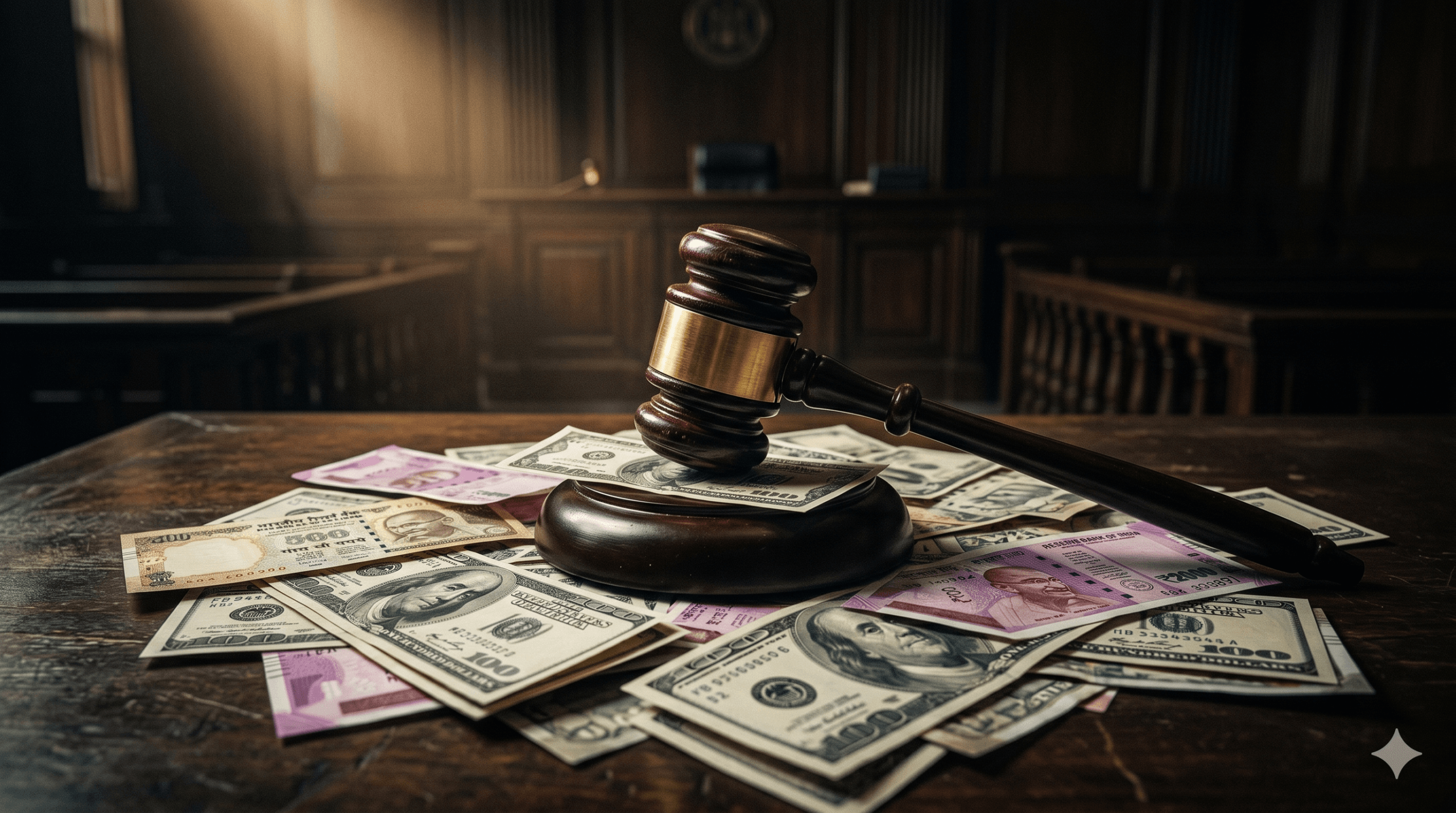
The case preceding the Adani US indictment settlement originally named eight defendants: Gautam Adani, his nephew and Adani Green's executive director Sagar Adani, the company's then-CEO Vneet Jaain, and five senior executives connected to Azure Power Global and its Canadian institutional backer, CDPQ.
The five-count indictment alleged that between 2020 and 2024, these individuals orchestrated a scheme to pay more than $265 million in bribes to government officials across Indian states. Targeted regions included Andhra Pradesh, Odisha, Tamil Nadu, Chhattisgarh, and Jammu & Kashmir. The goal was to secure solar energy supply contracts with the Solar Energy Corporation of India (SECI), projected to yield over $2 billion in profits.
To fund this expansion, Adani Green had raised approximately $750 million in corporate bonds — including $175 million directly from U.S. investors — and secured over $2 billion in U.S.-linked loans. While doing so, prosecutors alleged, the company repeatedly and falsely assured those investors it operated under rigorous anti-bribery compliance.
That alleged false assurance is what gave U.S. courts jurisdiction. Once the fraud touched American capital markets, American law applied — irrespective of where the underlying conduct occurred.
Eighteen months later, on May 15, 2026, the entire criminal architecture resolved into a civil conclusion. The final Adani US indictment settlement resulted in $18 million paid, yet no guilt admitted, and criminal charges were reportedly dropped entirely. This is the story of how that happened — what laws were in play, what money changed hands, who made the calls, and what every other Indian businessman accused abroad or at home should now be thinking.
The Adani US Indictment Settlement Timeline: Indictment to Resolution
Adani Group has consistently maintained that Gautam Adani and Sagar Adani were not named under the DOJ's specific bribery counts — those counts named Azure Power and CDPQ executives. The Adanis were charged in the securities and wire fraud conspiracy counts. The Group called all allegations baseless and has vigorously disputed the factual basis.
No court has found any defendant guilty. All accused are entitled to the presumption of innocence. The $18M settlement resolves only the SEC civil matter. These legal realities are not technicalities — they are foundations of due process.
FCPA, SEC, and the Long Arm of American Law
The central legal puzzle behind the Adani US indictment settlement is how a U.S. court acquired jurisdiction over conduct that occurred almost entirely on Indian soil. The events involved an Indian company, Indian government officials, and Indian government contracts. The answer lies in the architecture of American anti-corruption enforcement, deliberately built to reach across borders.
The Foreign Corrupt Practices Act (FCPA), 1977
Enacted in 1977 following Watergate-era revelations, the FCPA has two core pillars. The Anti-Bribery Provisions prohibit any person or entity with any nexus to the United States — however thin — from paying bribes to foreign government officials to secure business.
The nexus can be a wire transfer routed through a U.S. bank, a dollar-denominated transaction, shares listed on a U.S. exchange, or capital raised in U.S. markets. The Books and Records Provisions require companies to maintain accurate financial disclosures and internal controls — which is where investor fraud locks in.
Securities Fraud and Wire Fraud
The charges most directly targeting the Adanis were conspiracy to commit securities fraud and wire fraud. Each of these counts carries up to 20 years imprisonment. These are not FCPA bribery charges specifically; they are broader deception counts.
U.S. prosecutors chose to focus on the investor deception angle. Adani Green raised hundreds of millions in U.S. markets while falsely assuring investors of its compliance standards. That act — the false assurance to American investors — is the jurisdictional hook that made the entire prosecution possible. See the SEC complaint filings for the full charge text.
How U.S. Plea Bargaining Works
Approximately 90 to 97 percent of all federal criminal convictions in the United States are resolved through plea agreements rather than trials. A plea deal allows an accused to plead guilty — typically to reduced charges — in exchange for lighter sentencing, cooperation with investigators, or both. The alternative is a federal trial: expensive, unpredictable, fully public, and potentially devastating to business operations.
But what happened here is not even a conventional plea bargain. The SEC civil resolution leading to the Adani US indictment settlement is a regulatory conclusion requiring no admission of guilt. The DOJ criminal case is reportedly being abandoned entirely, without any guilty plea, without any cooperation agreement, and without any new exculpatory evidence being made public.
The law does not disappear. It acquires a price. And the price is set not by evidence, but by access.
What Indian Law Says — And What Indian Law Does Not Do
Here is the central discomfort: every charge that the U.S. filed corresponds to a cognizable offence under Indian statute. The alleged conduct — bribing Indian state government officials for Indian government contracts, for projects on Indian soil — is precisely what India's anti-corruption architecture was designed to address. Not one Indian enforcement agency has opened a case. Not the CBI, not the ED, nor SEBI.
Prevention of Corruption Act, 1988 (PC Act)
India's flagship anti-corruption law criminalises both sides of bribery. Section 7 covers any public servant obtaining a bribe — 3 to 7 years imprisonment. The pivotal Section 7A, introduced in the 2018 amendment, makes the bribe-giver equally culpable with identical punishment. Section 13 addresses criminal misconduct by public servants — 4 to 10 years.
Bharatiya Nyaya Sanhita, 2023 (BNS)
India's new criminal code, replacing the IPC from July 2024, captures the fraud and deception elements. Section 316 (cheating) carries up to 7 years. Section 61 (criminal conspiracy) attracts the punishment of the substantive offence. Combined with PMLA money-laundering provisions and SEBI's market abuse regulations, the statutory toolkit is comprehensive on paper.
Indian Plea Bargaining — An Entirely Different System
India introduced plea bargaining through a 2005 amendment to the CrPC, now incorporated into the Bharatiya Nagarik Suraksha Sanhita, 2023. But it bears almost no resemblance to the American model, and would not permit anything resembling the resolution of the Adani US indictment settlement.
It applies only to offences carrying a maximum of 7 years or less — automatically excluding major corruption and fraud. It is explicitly unavailable for offences affecting the socio-economic condition of the country, which corruption cases routinely are. The accused must admit guilt — there is no "without admitting or denying" option. For a full side-by-side, see Chapter 04's comparative table.
U.S. vs. India: The Full Legal Comparison
If India Had Prosecuted This: A Realistic Scenario
What Would Have Happened Under Indian Law?
Assume Indian enforcement agencies had the same evidence base the U.S. DOJ possessed — and the political will to act on it. Here is what the legal landscape would look like, and why the resolution available to Adani in the U.S. would simply not have existed in India.
Charges Available
PC Act Sections 7, 7A, and 13 against both the alleged bribe-givers and the government officials who allegedly received payments. BNS Section 61 (criminal conspiracy) and Section 316 (cheating). PMLA money-laundering charges if bribe proceeds were layered through corporate structures.
Available Penalties
Maximum imprisonment ranges from 7 to 10 years for corruption, extendable under PMLA to 10 years. SEBI penalties range up to ₹25 crore or three times the unlawful gains. Furthermore, ED asset attachment can potentially cover the full ₹2,000+ crore alleged bribe amount.
And critically: no "without admitting or denying" resolution path exists. Any settlement under Indian law requires either a guilty plea before a court — with all the consequences that carries — or an acquittal at trial. The comfortable middle ground that Adani found in the U.S. does not have an Indian equivalent in statute.
Why It Did Not Happen: The Structural Reality
India's anti-corruption laws are, on paper, adequate and in some respects rigorous. The gap is institutional, not statutory. The CBI requires government sanction to investigate serving officials and has historically followed political direction in politically sensitive cases. The Adani Group's deep entanglement with national infrastructure makes any government investigation structurally inconvenient.
India was the foreign country with the third highest number of whistleblower tips submitted to the U.S. SEC in Fiscal Year 2024 — Indian citizens taking allegations of Indian corruption to American regulators, because no credible domestic mechanism exists to hear them.
Mallya, Nirav Modi, Choksi: Could They Use the Adani Blueprint?
If what Adani did in the U.S. to reach the Adani US indictment settlement — pay a fraction, admit nothing, avoid trial — were possible in India, could other major businessmen have taken it? Now that they have watched the outcome play out in public, will they try something similar?
Why Their Situation Is Structurally Different From Adani's
The cases look superficially similar — Indian businessmen, large fraud allegations, international legal proceedings — but they are structurally inverted in one crucial way. Adani was being prosecuted in the U.S., a jurisdiction where the executive has wide prosecutorial discretion, where an FCPA pause order was in effect, and where a $10 billion investment pledge was politically attractive to the current administration. The U.S. prosecutor had full power to settle, drop, or continue.
Mallya, Nirav Modi, and Choksi are being pursued by India in foreign courts — courts in the UK and Belgium that apply their own legal standards. The UK courts and Belgian courts have no obligation to honour any settlement India might offer. The accused cannot propose $10 billion in investments to India in exchange for dropped charges and expect a British or Belgian judge to respect that transaction.
The alleged victims are also different in kind. In the Adani U.S. case, the alleged victims were U.S. investors. In the Mallya and PNB cases, the alleged victims are Indian public sector banks — and any settlement would require court approval, guilty admission, and the consent of those banks. None of that constellation permits the quiet, no-admission civil resolution Adani achieved in the U.S.
Mallya Has Already Started This Argument
It is significant that Mallya has been making a partial version of the Adani-style argument for some time. He claims that Indian banks have already recovered ₹14,131 crore — well above the judgment debt of ₹6,203 crore — and that extradition is therefore disproportionate. This is, at its core, an economic restitution argument: the damage is restored, so criminal accountability is no longer warranted.
Could the Adani Precedent Be Used as Legal Ammunition?
Yes — and it almost certainly will be. Every defence lawyer in every extradition proceeding involving an Indian accused now has access to the Adani US indictment settlement as a precedent for the proposition that economic restitution can substitute for criminal accountability, and that the Indian government applies accountability standards selectively based on political considerations.
More specifically: India's government actively shielded its most prominent accused businessman from U.S. legal process — refusing twice to serve civil summons — while simultaneously pursuing aggressive extradition of other accused businessmen through UK and Belgian courts. A Belgian or British judge reviewing an extradition request from India, presented with documented evidence of this selective cooperation, is entitled to ask whether India's commitment to accountability is consistently applied.
India's Supreme Court Has Already Noticed
A petition before India's Supreme Court, noticed in May 2026, flagged precisely this inconsistency: that Indian authorities pursued Nirav Modi aggressively in the UK while handling Christian Michel — a British national accused in the AgustaWestland helicopter deal — very differently, allegedly serving different political purposes in different moments. The top court issued notice to the government and its enforcement agencies.
Geopolitics, Trade & the Weaponisation of Law
The Adani US indictment settlement cannot be read as purely a legal story. It sits at the intersection of three tectonic forces: the U.S.-India bilateral relationship, the current U.S. administration's transactional approach to international legal enforcement, and the deep structural entanglement between large Indian capital and Indian state power.
The Executive Order That Changed Everything
On February 10, 2025, the U.S. executive signed an order formally pausing FCPA enforcement for 180 days and ordering a review of all active enforcement actions. The stated rationale: FCPA enforcement was hurting American business competitiveness abroad. The practical effect — visible in retrospect — was to convert every active FCPA action from an immovable legal commitment into a negotiable political asset.
The $10 Billion Offer: Law or Commerce?
Per The New York Times reporting, the Washington meeting included an explicit offer: drop the criminal charges, and Adani commits to $10 billion in U.S. investments and 15,000 American jobs. This is not how plea bargaining is intended to function. A plea deal reduces criminal exposure in exchange for legal cooperation, admission, or information useful to prosecutors.
India's Diplomatic Non-Cooperation
Several opposition leaders publicly alleged a diplomatic quid pro quo — that ongoing India-U.S. trade negotiations may have influenced the prosecution's trajectory. No formal evidence of any such arrangement has been established. What is on the public record is that India's government twice refused to serve U.S. legal summons on its most prominent businessman, at the same time as it was actively cooperating with the UK and Belgium for the extradition of other accused businessmen.
The Honest Verdict
No court has found Adani guilty. The $18M settlement is a civil resolution. The criminal indictment has not produced a conviction. Adani is legally entitled to the presumption of innocence, and these facts matter. Allegations are not convictions, and legal process exists for good reason.
A $265M alleged bribery scheme — backed by a federal grand jury, years of investigation, and parallel SEC and DOJ enforcement — resolved for $18M without any admission and with criminal charges reportedly dropped entirely, shortly after the accused retained the sitting President's personal attorney and offered $10 billion in investments. The sequence is deeply corrosive to institutional trust, regardless of what the legal paperwork says.
The alleged bribery occurred on Indian soil, involving Indian government officials, for Indian government contracts worth billions. Not one Indian enforcement body has opened a case. The Indian officials who allegedly received the bribes remain unnamed and uncharged anywhere in the world. That gap is the most damning fact in this entire story — and it belongs entirely to India's institutional failure, not America's.
India cannot credibly pursue fugitive businessmen through foreign courts while simultaneously shielding its most prominent accused businessman from foreign legal process at home. The diplomatic and moral authority required for extradition proceedings rests on consistent, visible application of accountability. That consistency has been publicly and documentably compromised.
The FCPA, the OECD Anti-Bribery Convention, the UK Bribery Act, the UN Convention Against Corruption — 50 years of global anti-corruption norms rest entirely on enforcement credibility. When the world's most powerful enforcer resolves a major case through access, economic pledges, and the right lawyer, every corrupt actor globally recalibrates their risk model. The price list has been posted. Prices, once posted, tend to be paid.
Indian electricity consumers who may have paid above-market energy rates. Indian investors whose capital was raised under allegedly false pretenses. Indian citizens whose public officials were allegedly corrupted. The unknown whistleblowers who risked everything to report this conduct to foreign regulators because no domestic forum would hear them. The settlement speaks of penalties paid and charges dropped. It says nothing about any of these people.
What This Case Demands India Ask of Itself
The Adani US indictment settlement — from filing to resolution — is a stress test of institutions, Indian and American alike. It will be cited in law schools, in parliamentary debates, in compliance boardrooms, and in extradition courtrooms for a generation. Not as a triumph of accountability. As a precise, publicly documented measurement of how much accountability costs when you are wealthy enough to set the price.
India must ask: if its enforcement agencies can refuse to serve foreign legal summons for one prominent businessman, on what basis does it demand that foreign governments serve Indian extradition warrants for others? If the alleged bribery of Indian officials for Indian government contracts produces zero Indian investigation, what does the Prevention of Corruption Act actually prevent in practice?
For the Mallya, Nirav Modi, and Choksi cases: every defence lawyer in every foreign court has now read this chapter. The argument — that India applies accountability selectively, that economic restitution is an acceptable substitute for criminal accountability, that the Indian government's own conduct undermines its authority to demand extradition — has just received its most powerful, globally visible evidentiary footnote.
The case ends not with a verdict, but with a question mark. One that hangs, unresolved, over every institution that was meant to answer for it — and over every Indian citizen who was told those institutions existed to protect them.
Primary Sources: U.S. DOJ Indictment, Eastern District of New York (Nov 20, 2024) • SEC Civil Complaint No. 24 Civ. 8080 • Adani Green Energy filings to BSE (May 15, 2026) • The New York Times • CNBC • AFP • ABC News • France 24 • The Wire • The Quint • Business Standard • Free Press Journal • American Bazaar Online • Asia Times • Common Dreams • Vidhi Centre for Legal Policy • Kohn, Kohn & Colapinto LLP • Wikipedia • Supreme Court of India notice, May 2026 • Cyril Amarchand Mangaldas Dispute Resolution Blog • SEC FY2024 Whistleblower Program Annual Report
Statutes Referenced: FCPA 1977 • Securities Exchange Act 1934 • 18 USC § 1343 • Prevention of Corruption Act 1988 (as amended 2018) • Bharatiya Nyaya Sanhita 2023 • PMLA 2002 • SEBI Act 1992 • Fugitive Economic Offenders Act 2018 • Bharatiya Nagarik Suraksha Sanhita 2023
Read more on our corporate justice hub.
This is an analytical and editorial blog. All facts are sourced from published public reporting and court documents. Adani Group has denied all allegations. No court has found any defendant guilty. All individuals mentioned are entitled to the presumption of innocence. This blog does not constitute legal advice.