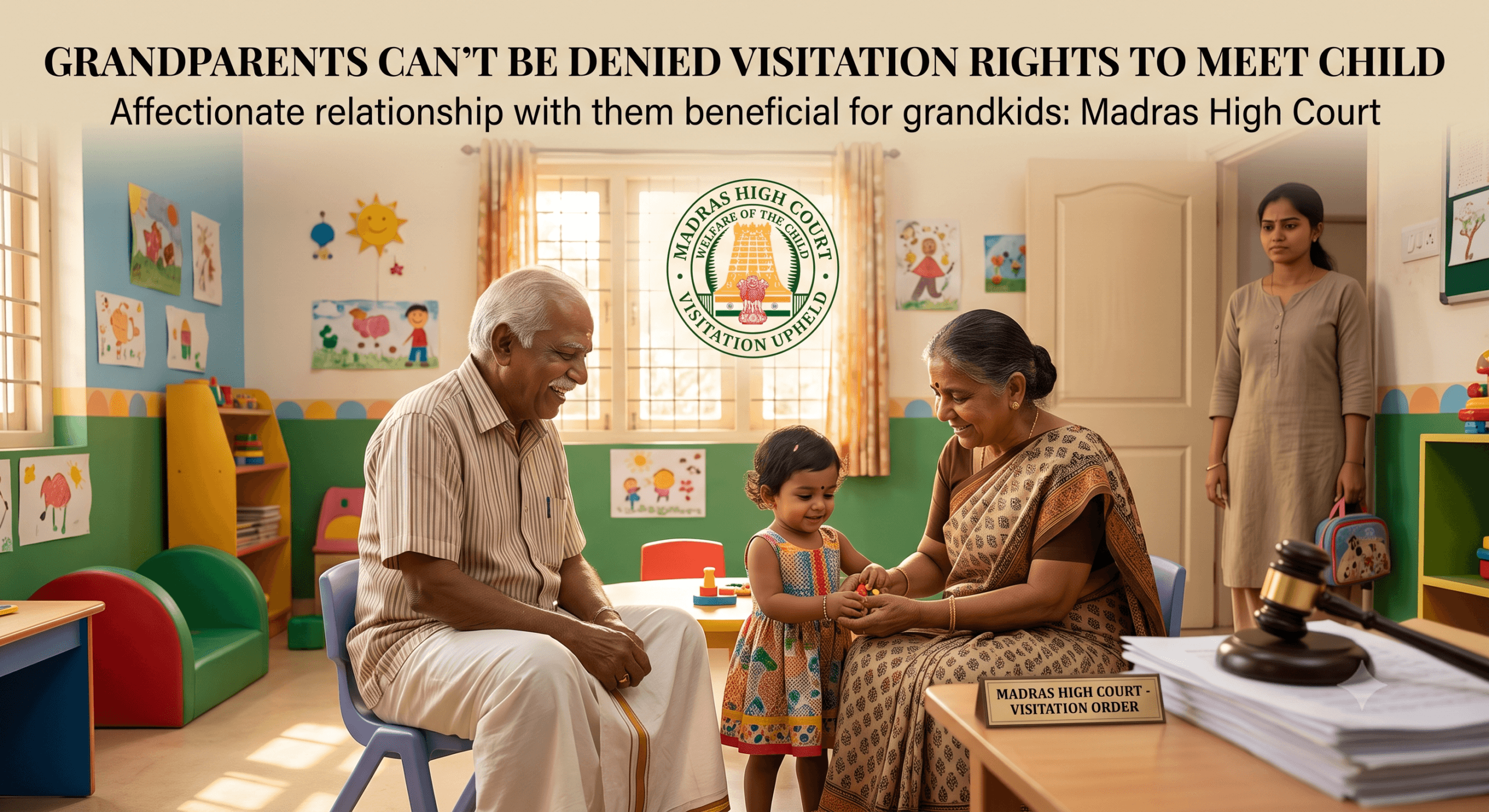
Grandparents Can't Be Denied Visitation Rights To Meet Child
Affectionate relationship with them beneficial for grandkids: Madras High Court
When a young father passed away barely a year into his marriage, the fallout triggered a complex legal battle over grandparents visitation rights. What followed was a tense standoff between a grieving mother and grieving grandparents — and a Madras High Court ruling that drew a careful line between who a child lives with, and who a child is allowed to love.
The Court's conclusion was unambiguous: grandparents visitation rights cannot be arbitrarily denied, because an affectionate relationship with them is recognised as beneficial for the child's normal development. It's a line that is likely to be cited in custody disputes across India for years to come.
How the Dispute Over Grandparents Visitation Rights Began
The child at the centre of the case was born in September 2021. Her father, the only son of the respondent grandparents, died in October 2022 — just over a year after his marriage. In the aftermath of this loss, relations between the mother and her in-laws broke down entirely, eventually resulting in criminal cases being registered against the grandparents.
During the course of investigation, the two sides struck an agreement: the mother would retain custody of the child, while the family would be granted grandparents visitation rights. It seemed, briefly, like a workable compromise. But the mother soon refused to honour the arrangement, denying the grandparents any access to their granddaughter.
Left with no other option, the grandparents approached the family court, seeking both custody and visitation. The court granted custody to the mother but upheld their right to visitation — a decision the mother then challenged before the High Court.
The Arguments on Both Sides
Mother's Case
Argued the grandparents had unjustly accused her after her husband's death, neglected the child's health, and damaged her parents' home — and that access would harm the child's welfare. Family courts weigh such conduct allegations the same way they assess claims of mental cruelty in matrimonial disputes.
Grandparents' Case
Said they had already been shattered by the loss of their only son, and that they were better placed — both emotionally and financially — to support the child's upbringing.
The Court chose not to adjudicate these competing allegations at this preliminary stage, noting that questions of fact would need to be tested through evidence at trial. Its task here was narrower — deciding only whether the visitation order already in place deserved to stand.
What the Court Actually Held Regarding Grandparents Visitation Rights
The bench was clear that, given the child's tender age, custody could reasonably stay with the mother. But it refused to treat that as the end of the matter.
The grandparents cannot be denied reasonable access/visitation rights, which will also help the child's normal development. An affectionate relationship with grandparents is recognised as beneficial for the child.Madras High Court — Justices R. Mahadevan & Mohammed Shaffiq
The judges grounded this in a wider principle that runs through Indian custody jurisprudence: the welfare of the minor child is the paramount consideration in any guardianship matter. They went further, observing that courts have a responsibility to safeguard the country's family system and to ensure children grow up in a proper environment that supports their overall development, which includes honoring grandparents visitation rights — a concern that echoes through other Indian family disputes too, from custody battles to questions of who a family truly owes its care and inheritance to.
Weighing the totality of circumstances, the Court ultimately upheld the principle of visitation but tightened its frequency. Here is the order as it now stands:
- Frequency
- Once a month
- Day
- First Saturday of every month
- Time
- 2:00 PM – 6:00 PM
- Venue
- Child Care Centre, Family Court, Chennai
- Handover
- Mother to personally bring and collect the child
Why This Ruling on Grandparents Visitation Rights Matters Beyond One Family
Indian custody law has long been built around the rights and responsibilities of parents, often leaving grandparents in legal limbo — especially when a parent's death triggers conflict between the surviving spouse and in-laws over grandparents visitation rights. This judgment reinforces an important judicial instinct: that custody and visitation are not the same question, and that denying one doesn't have to mean denying the other.
This isn't an isolated voice either. Other High Courts, including the Orissa High Court, have echoed the same reasoning in subsequent rulings, describing grandparents as an integral part of a child's upbringing in Indian society. Even the Supreme Court has previously cautioned that custody disputes between parents should not become a means of cutting children off from extended family on either side.
The Takeaway
Custody decisions will always centre on what's best for the child and which parent is best placed to provide that. But this ruling is a reminder that a child's emotional world doesn't end at the front door of the custodial parent's home. Where it's safe and appropriate, courts are increasingly inclined to protect a grandchild's bond by enforcing grandparents visitation rights — as something the child is entitled to for their own healthy growth.
Frequently Asked Questions
01Are grandparents visitation rights legally recognized in India?
Yes. While there is no single codified statute spelling out a grandparent's right to visitation, courts — including the Madras High Court in this case — have consistently held that grandparents cannot be denied reasonable access, since an affectionate bond with them benefits the child's development.
02Does this ruling give grandparents custody of the child?
No. The Court was careful to separate custody from visitation. Custody stayed with the mother; the grandparents received only limited, supervised visitation — once a month, at a designated Child Care Centre.
03How often were the grandparents allowed to meet the child?
The High Court limited visitation to once every month — the first Saturday, from 2:00 pm to 6:00 pm — at the Child Care Centre attached to the Family Court in Chennai, with the mother required to personally bring and collect the child.
04What law governs grandparents visitation rights in India?
There isn't a dedicated statute for grandparents visitation rights. Courts derive this protection from the broader "welfare of the child" principle under guardianship and custody law, including the Guardians and Wards Act, 1890, rather than from an explicit standalone provision.
05Can a parent permanently block grandparents from seeing a child?
Not arbitrarily. Courts treat the child's welfare, not a parent's personal grievance, as the deciding factor, and will generally protect reasonable grandparental access unless there is clear evidence it would harm the child.