MBBS Admissions: NMC Puts the Focus on Ability, Not Disability
A new circular outlining the NMC PwBD guidelines tells every medical college to set up an Enabling Unit for students with disabilities — the latest move in a broader shift away from percentage-based rejection and toward functional, case-by-case assessment.
Why This Matters
For years, a student's dream of becoming a doctor in India could be crushed by a single number: the percentage of disability recorded on a certificate.
A candidate could clear NEET, secure a seat, and still be turned away at the admission stage simply because a rigid cut-off — often an arbitrary threshold like 40% or 80% — said so, regardless of what the student could actually do.
That is now changing under the new NMC PwBD guidelines: the question is shifting from "how disabled are you on paper" to "what can you do, and what support would help you do it well."
At Vijay Foundation, this question comes up often through our free legal aid desk, where students and families frequently ask how disability certification actually affects admission and employment rights.
What the New NMC PwBD Guidelines Actually Announce
Two connected reforms have surfaced in late July 2026:
01 · Assessment Guidelines
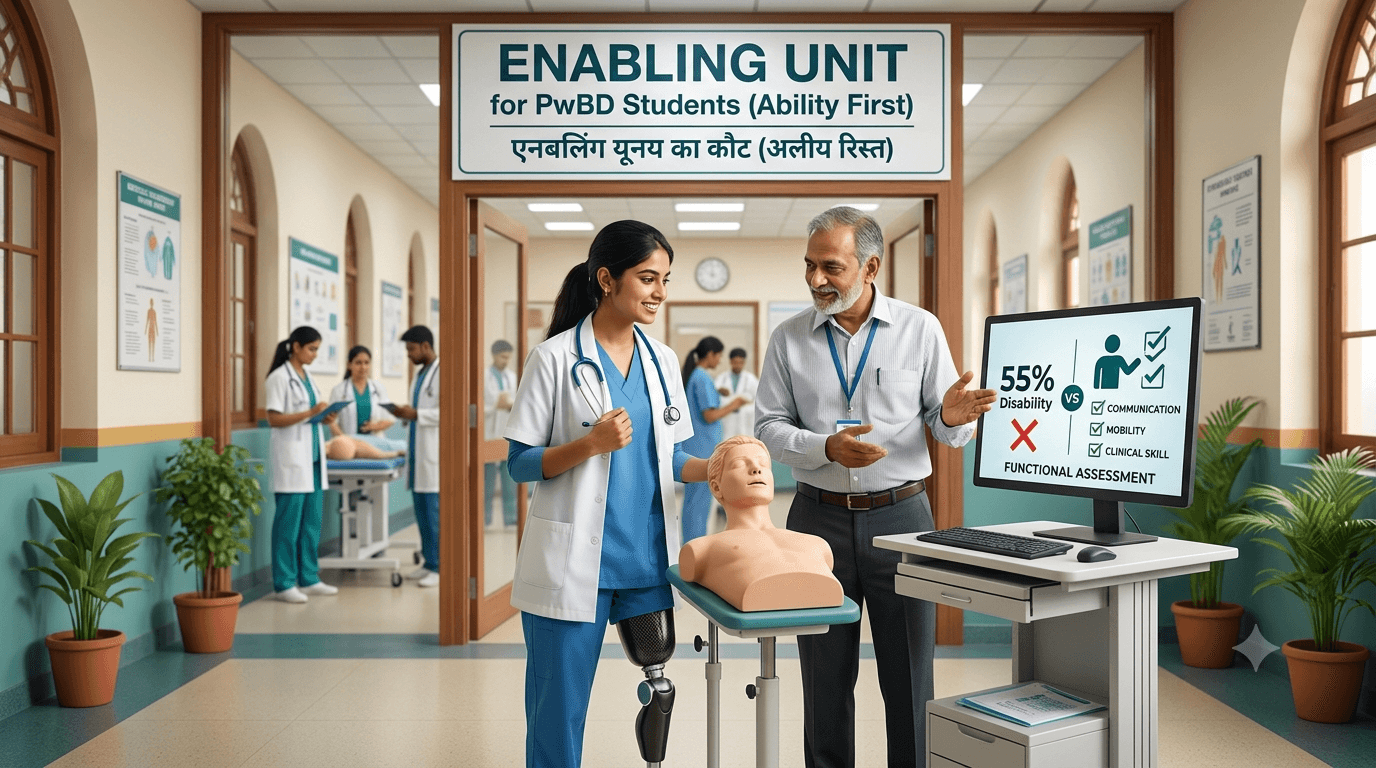
Disability percentage can no longer be the sole eligibility criterion. Medical Assessment Boards must run an individualised functional assessment — covering communication, mobility, comprehension, and vision — before deciding eligibility, and give reasoned justification for any rejection. Candidates can appeal to a DGHS Appellate Authority.
02 · Enabling Units
Every regulated medical college must set up an Enabling Unit — a single point of contact for PwBD students from admission through clinical training and internship — or appoint a Nodal Officer where a full unit isn't feasible.
Who Qualifies Under the PwBD Quota
Under the NEET-UG framework, 5% of seats are reserved for candidates with benchmark disabilities — meaning at least 40% of a specified disability, certified by a competent medical authority and reflected on a Unique Disability ID (UDID) card. What's changed in the NMC PwBD guidelines is not who is covered, but how eligibility is now decided once a candidate applies.
| Step | What Happens Now |
|---|---|
| Certification | UDID card + disability certificate from a government medical board |
| Self-declaration | Affidavit on functional ability — communication, mobility, vision, comprehension |
| Board assessment | Individualised functional evaluation, not a flat percentage cut-off |
| Decision | Reasoned order; blanket rejection on percentage alone is not permitted |
| Appeal | Appellate Authority constituted by the DGHS |
Why "Percentage" Is Giving Way to "Function"
Disability percentage is bureaucratic shorthand — it doesn't tell you whether a student can take notes, examine a patient, or navigate a ward. Two people with the "same" percentage can have very different functional capacities, and vice versa.
- Communication
- Mobility
- Comprehension
- Clinical task fit
What an Enabling Unit Must Actually Do
The NMC PwBD guidelines are specific about duties — this isn't a symbolic appointment.
- →Act as the single point of contact for students with benchmark disabilities
- →Facilitate reasonable accommodation and barrier-free access on campus
- →Coordinate with the Disability Assessment Board, faculty, and hospital administration
- →Arrange accommodations during clinical postings and internship
- →Maintain confidential records of requests and accommodations
- →Publicise itself clearly — at admission, on the website, on notice boards
The Legal Backdrop
This isn't a voluntary gesture — it's rooted in law and a court order, and it's been years in the making.
Priyanshi Meena, a NEET-qualified candidate, is denied an MBBS seat in Madhya Pradesh purely because her disability is assessed at 65% against an 80% cut-off. The Jabalpur High Court intervenes.
The Supreme Court, in Om Rathore v. Union of India, rules that denying admission on disability percentage alone — without functional assessment — is unconstitutional, and strikes down the "both hands intact" requirement as ableist.
NMC issues its circular for the NMC PwBD guidelines, directing every medical college to establish an Enabling Unit, citing Sections 16–17 of the RPwD Act, 2016 and the Supreme Court's directions.
If a College Doesn't Comply
Since the NMC PwBD guidelines act as a binding regulatory circular and not a voluntary advisory, non-compliance is actionable. Students or parents facing denial, an unresponsive Enabling Unit, or an unreasoned rejection can:
- →File a written representation with the college's Enabling Unit or Nodal Officer first, in writing, with copies retained
- →Escalate to the Appellate Authority constituted by the DGHS if the Medical Assessment Board's decision seems unreasoned
- →Approach the Chief Commissioner for Persons with Disabilities (CCPD), which has previously intervened in similar NMC-related complaints
- →Seek free legal aid — our team at Vijay Foundation regularly assists families navigating exactly this process through our Free Legal Aid programme
Who This Changes Things For
Aspirants
Fairer eligibility criteria and a real appeal route if wrongly denied a seat.
Colleges
A concrete compliance duty under the NMC PwBD guidelines — staff and publicise a functioning unit, not just a name on paper.
The Profession
A slow shift toward a healthcare workforce that includes doctors with disabilities and their lived clinical insight.
Frequently Asked Questions
Does this circular change who is eligible for the PwBD quota in NEET?
No. Under the NMC PwBD guidelines, the 5% PwBD reservation and the 40% benchmark-disability threshold for eligibility remain as they were. What has changed is how a candidate's eligibility is assessed once they apply — through individualised functional evaluation rather than a rigid percentage cut-off alone.
Is the Enabling Unit only for admission-time support?
No. The circular is explicit that the unit's role continues through the full academic journey, including clinical postings and internship — arguably the most demanding phase for a student with a disability.
What can a student do if a college has not set up an Enabling Unit yet?
Students can write to the college administration referencing the NMC circular, escalate to the DGHS Appellate Authority or the Chief Commissioner for Persons with Disabilities, and seek assistance from a free legal aid provider to draft the representation correctly.
Does the "both hands intact" rule still apply anywhere?
The Supreme Court specifically rejected this requirement in its February 2025 judgment as ableist and inconsistent with the RPwD Act, 2016. The revised NMC PwBD guidelines are meant to give effect to that ruling, so this rigid physical requirement should no longer be applied as a bar to eligibility.
Is this circular legally binding on private medical colleges too?
Yes. The circular applies to all medical colleges and institutions regulated by the NMC, which includes government and private institutions alike, since NMC's regulatory authority covers the sector as a whole.
The Road Ahead
Policy on paper is only the first step. The real test of the NMC PwBD guidelines will be implementation: whether colleges actually staff these units, whether boards apply functional criteria fairly instead of reverting to old habits, and whether students even know the support exists.
Still, the direction is clear — Indian medical education is being nudged, by both judiciary and regulator, toward asking not "how disabled is this person" but "how can we help this capable person succeed."