
Tryst With the Constitution: A Visit to the Mutt That Gave Us the Basic Structure Doctrine
In a quiet monastery in Kasaragod, a young seer went to court to save his land — and, without quite meaning to, left India with the doctrine that protects its Constitution to this day.
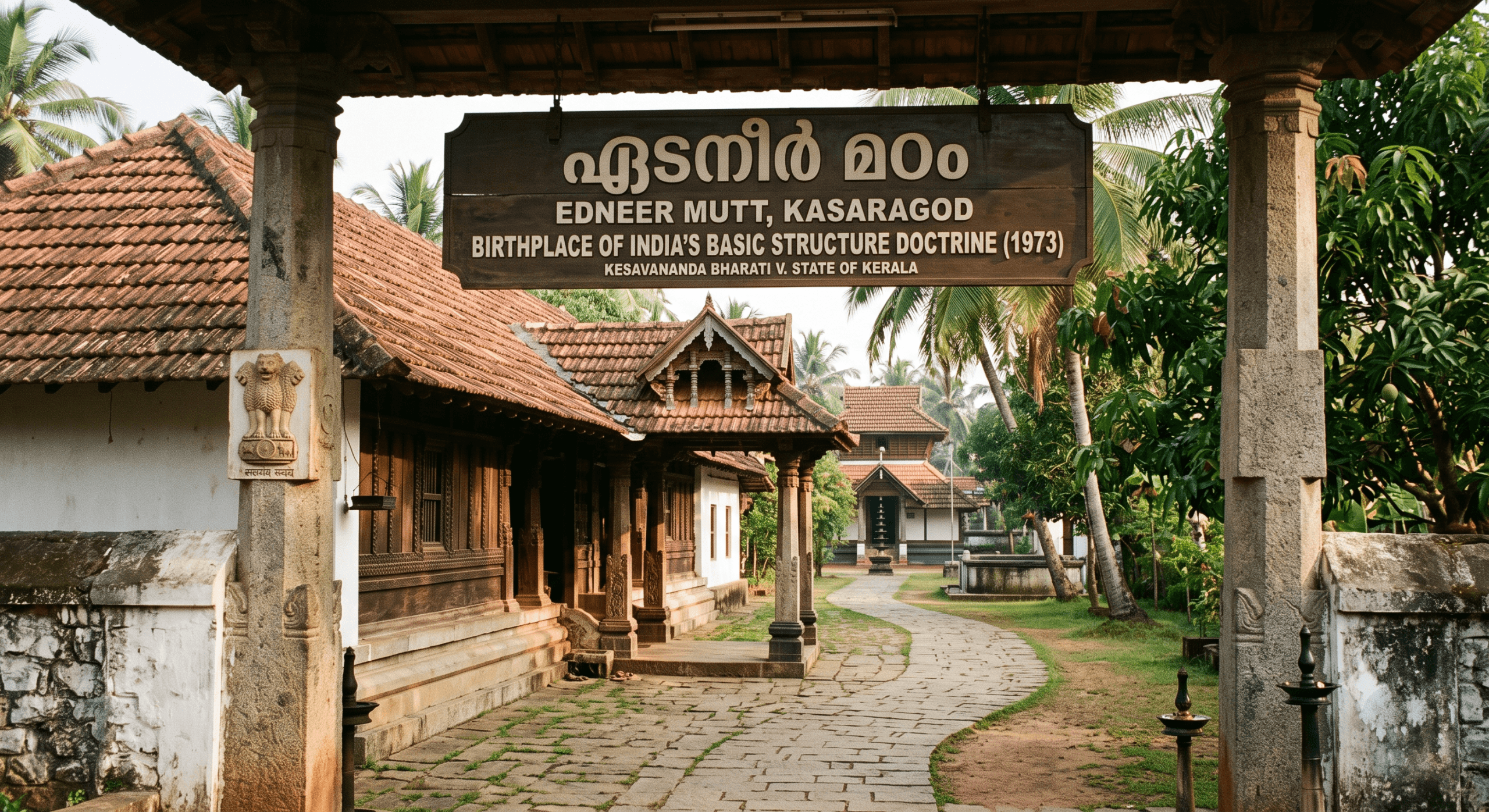
The Kesavananda Bharati case (1973) began as a dispute over the Edneer Mutt's land, challenged by its young seer under the Kerala Land Reforms Act. A 13-judge Bench — the largest in Supreme Court history — ruled 7:6 against the Mutt on the land question, but in doing so laid down the Basic Structure doctrine: Parliament can amend the Constitution, but never destroy its essential identity, including secularism, democracy, and judicial review.
Last week, I visited the Edneer Mutt in Kasaragod, Kerala, to find the roots of the landmark Kesavananda Bharati case. At first glance, the name might mean nothing at all — just another quiet religious site tucked into the state's northern edge. But for lawyers, and arguably for every Indian, it ought to be synonymous with the most consequential judgment the Supreme Court has ever delivered.
A Young Seer Against the State
In 1970, Kesavananda Bharati — then a young pontiff of the Edneer Mutt — approached the Supreme Court to challenge the constitutional validity of the Kerala Land Reforms Act, 1963. The law capped how much land any individual or institution could hold, and empowered the state to acquire the excess for redistribution. The Mutt, by most accounts, held around 681 acres at the time. More than 400 of those acres would eventually be taken.
In a later interview, Bharati recalled a simple, almost unromantic motive: the acquisition would have stripped the Mutt of the very property that sustained it — the land it depended on to survive. This wasn't philosophy. It was survival. The grand constitutional theory came later, carried in through the arguments of his lawyer, the celebrated jurist Nani Palkhivala.
How the Kesavananda Bharati Case Outgrew Its Own Question
What began as a dispute over one mutt's paddy fields grew, almost by accident, into a referendum on the limits of Parliament's power. As the government pushed through further constitutional amendments to insulate land reform from judicial scrutiny, the Kesavananda Bharati case widened into the deepest question Indian constitutional law had yet asked: could Parliament, using its amending power under Article 368, change the Constitution into something unrecognisable — even into something undemocratic — and still call it an amendment?
Parliament may amend any provision of the Constitution, including Fundamental Rights, but it cannot use that power to dismantle the Constitution's essential identity.
— The reasoning at the heart of the Kesavananda Bharati case
Thirteen judges heard arguments for 68 days — still the longest hearing in the Supreme Court's history. On April 24, 1973, they answered by a wafer-thin 7:6 majority: yes, Parliament can amend the Constitution, even its Fundamental Rights. But no, it cannot destroy the Constitution's "basic structure" — the features so fundamental that removing them would leave something that is no longer the same Constitution at all. Secularism, democracy, federalism, the rule of law, and judicial review itself were named among these essential features.
The Seer Who Lost, and What He Left Behind
A colleague accompanying me on the visit asked the obvious question: surely the seer must have won, given that the Court's ruling is remembered as such a triumph? The answer, somewhat startlingly, is no. On the specific question of the Mutt's land, the Court ruled against Kesavananda Bharati. The land reform stood. The acres were gone.
And yet, in losing that argument, he left India with something far larger than any acreage — a doctrine that has since stopped Parliament from doing away with judicial review, from undermining free and fair elections, and from converting India's constitutional democracy into something else entirely by mere legislative majority. The doctrine established by the Kesavananda Bharati case has gone on to influence constitutional courts in Bangladesh, Pakistan, and Malaysia.
A Quiet Irony
There is something genuinely moving in the fact that a religious institution played such a foundational role in shaping a doctrine whose core features explicitly include secularism. The Edneer Mutt didn't set out to defend the separation of religion and state — it set out to keep its land. The Constitution's most important safeguard was, in that sense, a by-product of an entirely different fight.
What Remains at Edneer Today
Even for visitors aware of its history, the Mutt makes no effort to announce its own significance. There is no plaque narrating a landmark judgment, no museum wing dedicated to constitutional history. The only visible marker of Kesavananda Bharati's legacy is an Ashoka Stambh installed after his passing — a modest, almost incidental nod to a legal legacy that towers over modern India. The place remains, in effect, invisible to its own history.
Perhaps that quiet is fitting. The Basic Structure doctrine was never meant to announce itself loudly either — it exists precisely so that, no matter who governs, the Constitution's essential character need never be defended out loud at all.
Sources & Further Reading
- Bar & Bench — Tryst with the Constitution: A visit to the mutt that gave us the Basic Structure doctrine
- Bar & Bench — 50 years of Kesavananda Bharati: Why the Basic Structure matters
- Bar & Bench — The Basic Structure case and India's court-packing episode
- Indian Kanoon — Full text of Kesavananda Bharati v. State of Kerala (1973)
- The Hindu — The petitioner who saved democracy but lost his case
- Kerala Tourism — Edneer Mutt, Kasaragod