No More "Lawyer Life" Reels: BCI's New Social Media Rulebook Is Here
From mandatory affidavits at enrolment to a ban on courtroom reels and deepfakes — the Bar Council of India has drawn a hard line on how lawyers, interns, and law students behave online.
for New
Enrolment
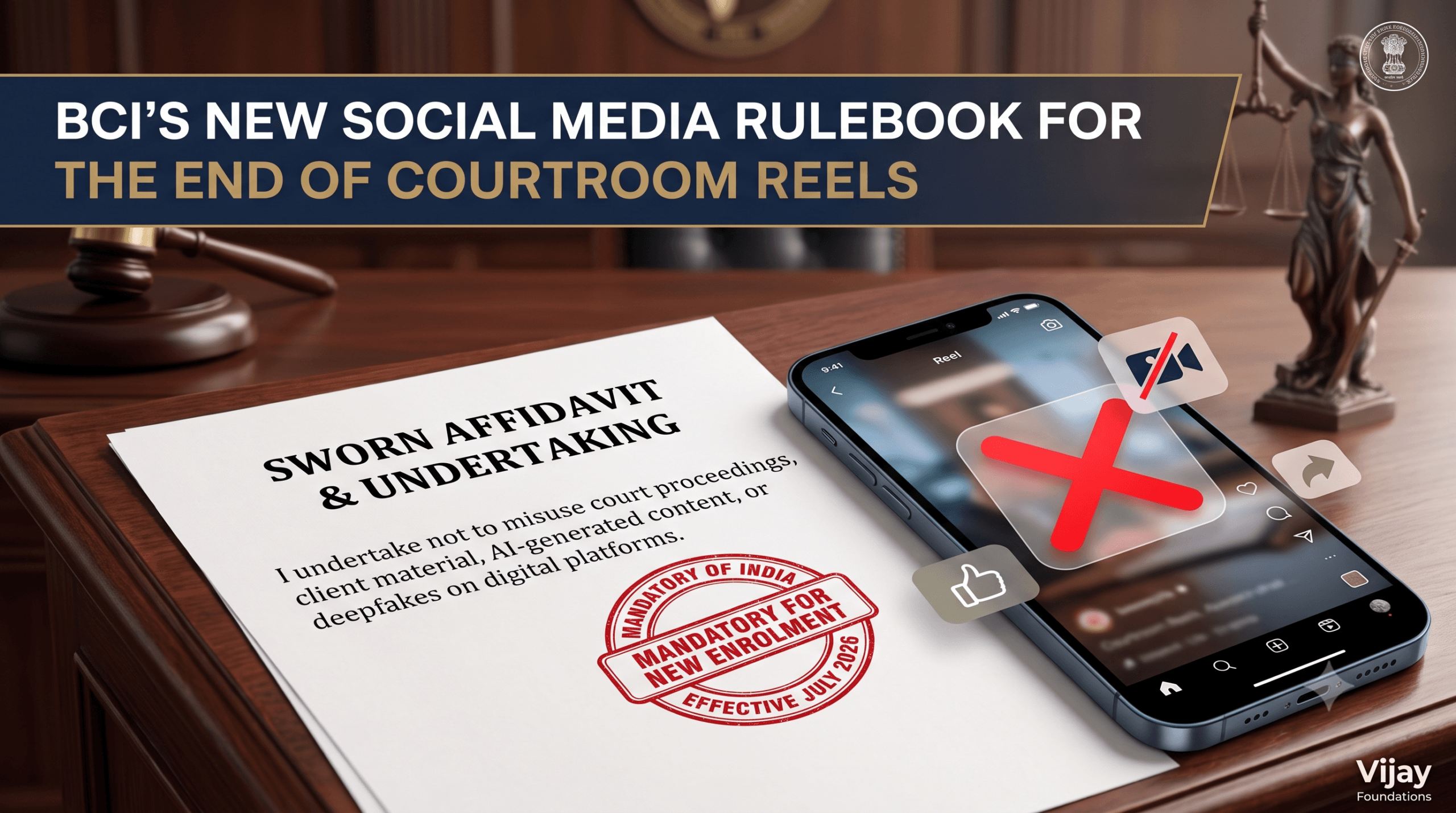
Under the new BCI social media rules, a July 17, 2026 circular makes an ethics affidavit mandatory for anyone newly enrolling as an advocate, and requires law students to sign undertakings at admission and before every internship. It bans court reels, deepfakes, and confidentiality breaches, and sets up Digital Ethics Committees to handle complaints. Existing advocates don't need a fresh affidavit, but State Bar Councils must actively sensitise them to the new standards.
- Issued by
- Bar Council of India, dated July 17, 2026
- Applies to
- New advocates, law students, interns; existing advocates via sensitisation
- Key tool
- Mandatory sworn affidavit / compliance undertaking
- Oversight
- State-level Digital Ethics Committees + a central BCI Digital Ethics Nodal Cell
The official BCI social media rules have finally put pen to paper on something every senior in every chamber has muttered about for years: lawyers posting a little too freely online. A new circular lays down, in unusually specific detail, what advocates, interns, and law students may and may not do on social media — and backs it with a mandatory undertaking at the point of entry into the profession.
Who Has to Sign What
Anyone seeking enrolment as an advocate must now execute a standalone sworn affidavit committing to digital restraint and client confidentiality. Law students face the same requirement twice over — once at admission to their LL.B., LL.M. or diploma course, and again before starting any internship, whether with a judge, senior advocate, law firm, or tribunal. Existing advocates are spared a fresh paperwork exercise, but State Bar Councils have been told to actively brief them on the new standards governing advertising, solicitation, and confidentiality.
BCI Social Media Rules: What is Now Off-Limits?
The circular's banned list reads like a greatest-hits of everything that's gone viral from the legal community in recent years: "day in court" and "lawyer life" reels, filming inside chambers or court corridors, posting client details, wearing robes for personal branding, and — pointedly — AI-generated or deepfake content depicting judges, lawyers, or litigants. Fabricated judgments, fake testimonials, and undisclosed paid promotions are explicitly called out too.
- Short-form legal education content — reels, threads, carousels — if accurate and non-soliciting
- General awareness posts about law and legal rights
- Podcast clips and commentary that don't promise outcomes
- Recording hearings, client meetings, or chamber discussions
- "Lawyer life" and "day in court" style reels
- Deepfakes, voice clones, and fabricated legal content
- Robes or court visuals used for personal branding
Internship is meant for learning discipline, humility, research, drafting, observation, court craft, professional ethics and responsibility.
— Bar Council of India, Circular dated July 17, 2026
Who Polices This?
To enforce the BCI social media rules, every State Bar Council must now stand up a Digital Ethics Committee and an online complaint portal. Breaches are graded into minor, serious, and aggravated categories — a first slip might draw counselling or a warning, but aggravated violations involving deepfakes, fabricated citations, or serious confidentiality breaches go straight to disciplinary or contempt proceedings. A central BCI Digital Ethics Nodal Cell has also been created to coordinate directly with social media platforms.
Why This, Why Now
These strict BCI social media rules didn't emerge in a vacuum. Days earlier, the Supreme Court issued notice on a PIL flagging the misuse of social media by lawyers for advertising and solicitation — conduct the Advocates Act and Bar Council rules have long restricted but rarely enforced online. The Court has separately pushed the BCI to tackle AI-generated fake case citations showing up in filings. Taken together, the judiciary's patience with an unregulated legal-content boom appears to have run out.
Why It Matters
Advertising and solicitation have been barred for Indian lawyers since long before Instagram existed — this circular is really that old rule catching up with reels, AI content, and algorithmic self-promotion. It's less a new restriction than an old one finally being enforced online.
Quick FAQs
Do existing advocates need to sign a new affidavit?
No. Only new enrolments require the sworn affidavit. Existing advocates will be sensitised on the standards by their State Bar Council instead.
What happens if a law student breaks the rules during an internship?
Depending on severity, it can mean counselling, a warning, withdrawal of the internship opportunity, or referral for formal disciplinary action.
Are legal education reels banned entirely?
No — short-form educational content is allowed if it's accurate, non-soliciting, non-sensational, and doesn't promise specific outcomes.
The Bottom Line
For law students and new entrants, the message of the BCI social media rules is unambiguous: sign the undertaking, or the enrolment doesn't proceed. For the profession's more seasoned "content creators," the grace period is informal — sensitisation now, scrutiny soon after. Either way, the era of casual courtroom content is officially over, and the Bar Council has, for the first time, put teeth behind saying so.
Related on Vijay Foundations
- Why Advertising Is Restricted for Lawyers in India: The Legal Basis
- AI-Generated Fake Citations: How Indian Courts Are Responding