
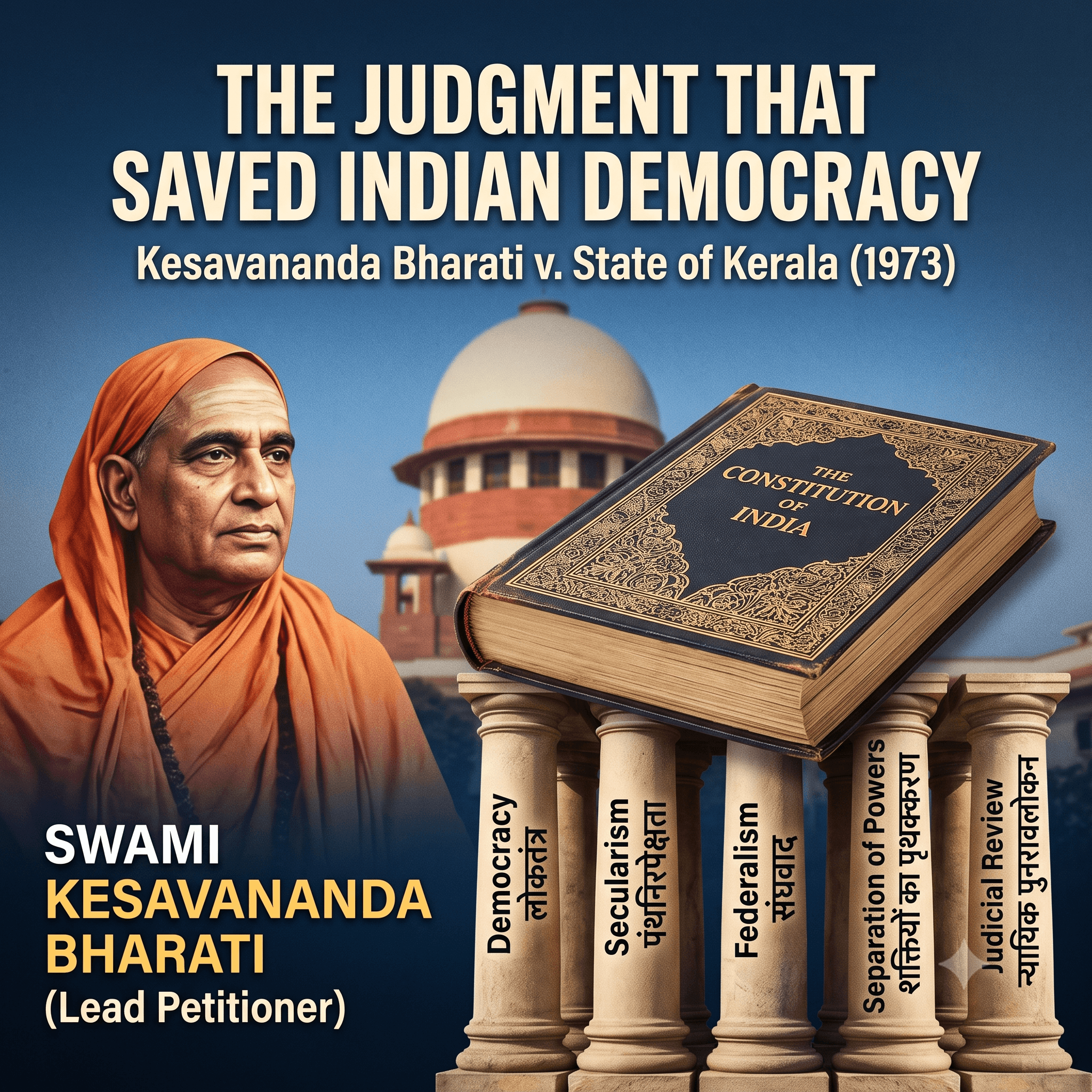
Kesavananda Bharati v.
State of Kerala
How thirteen judges, one Mutt's land dispute, and a single doctrine redrew the boundary between Parliament and the Constitution.
Widely regarded as the most significant constitutional decision in Indian legal history, the Kesavananda Bharati v. State of Kerala judgment introduced the Basic Structure Doctrine — the principle that Parliament, though free to amend the Constitution under Article 368, can never destroy or alter its essential features.
The ruling preserved the balance between parliamentary authority and constitutional supremacy, and remains one of the strongest pillars of Indian democracy more than five decades later.
01Background of the Case
The case originated when His Holiness Swami Kesavananda Bharati, head of the Edneer Mutt in Kerala, challenged the constitutional validity of the Kerala Land Reforms Act, which imposed restrictions on the ownership and management of the Mutt's property.
During the proceedings, the challenge expanded far beyond property rights and evolved into one of the biggest constitutional questions ever considered by the Supreme Court: did Parliament possess unlimited power to amend every part of the Constitution, including the Fundamental Rights?
Facts at a Glance
- Swami Kesavananda Bharati challenged the Kerala Land Reforms Act.
- The case questioned Parliament's amendment powers under Article 368.
- Earlier constitutional amendments had attempted to limit judicial review and Fundamental Rights.
- The matter was referred to the largest Constitution Bench in Indian history — 13 judges.
02Legal Issues Before the Court
- Can Parliament amend every provision of the Constitution?
- Can Fundamental Rights be amended or removed?
- Does Article 368 grant unlimited constituent power?
- Can Parliament destroy the identity of the Constitution while amending it?
03Arguments on Both Sides
Petitioner
- The Constitution has certain permanent features.
- Parliament cannot convert a democratic Constitution into an authoritarian one.
- Fundamental Rights are essential for protecting citizens.
- Unlimited amendment power would destroy constitutional democracy.
Government
- Parliament represents the will of the people.
- Article 368 provides unlimited power to amend the Constitution.
- No part of the Constitution is beyond amendment.
- Constitutional evolution requires unrestricted amendment powers.
04Judgment of the Supreme Court
By a narrow 7:6 majority, the Court held that Parliament can amend any provision of the Constitution — but cannot alter, destroy, or damage its Basic Structure.
Any amendment violating the Basic Structure can be declared unconstitutional by the Supreme Court of India. This principle became known as the Basic Structure Doctrine.
05What Is the Basic Structure?
The Court did not provide an exhaustive list, but identified several essential constitutional features that cannot be destroyed by any amendment:
06Historical Significance
The judgment transformed Indian constitutional law by protecting democracy from misuse of amendment powers, preventing any government from abolishing judicial review, and ensuring Parliament remains subject to constitutional limitations. Above all, it established that the Constitution is supreme, not Parliament.
07Why This Judgment Matters
Without the Basic Structure Doctrine, Parliament could abolish elections, judicial independence could be removed, democracy could be replaced by dictatorship, and fundamental constitutional values could disappear altogether. The doctrine ensures that amendments can only improve the Constitution — never erase its identity.
08Impact on Constitutional Law
- Indira Nehru Gandhi v. Raj Narain1975
- Minerva Mills v. Union of India1980
- Waman Rao v. Union of India1981
- I.R. Coelho v. State of Tamil Nadu2007
09Key Constitutional Provisions
10Key Takeaways
- Decided in 1973 — the largest Bench in Indian history, 13 Judges.
- Decision passed by a narrow 7:6 majority.
- Introduced the Basic Structure Doctrine.
- Parliament can amend the Constitution but cannot destroy its fundamental features.
- Established Constitutional Supremacy over Parliamentary Supremacy.
11Frequently Asked Questions
What is the Kesavananda Bharati case?
It is a landmark Supreme Court judgment (1973) that introduced the Basic Structure Doctrine and limited Parliament's power to amend the Constitution.
What is the Basic Structure Doctrine?
It means Parliament cannot amend or destroy the essential features of the Indian Constitution, even through a constitutional amendment.
Which Article was interpreted in this case?
The case primarily interpreted Article 368 of the Constitution.
How many judges heard the case?
The case was heard by 13 judges — the largest Constitution Bench in Indian history.
Why is this judgment called the "Constitution's Shield"?
Because it protects the fundamental identity of the Constitution from being destroyed by constitutional amendments.
12Conclusion
The Kesavananda Bharati v. State of Kerala (1973) judgment remains the cornerstone of Indian constitutional democracy. By introducing the Basic Structure Doctrine, the Supreme Court ensured that while the Constitution remains flexible enough to evolve with changing times, its core values — democracy, secularism, judicial independence, federalism, and the rule of law — remain permanently protected.
More than five decades later, it continues to safeguard the constitutional identity of India — one of the greatest judicial achievements in the nation's history.