The Real Economic Cost of Unpaid Domestic Labor
Every day, hundreds of millions of Indian women cook, clean, care for children and the elderly, and keep households running — work that never shows up in a payslip, a pension, or the GDP. Here is what the economic cost of unpaid domestic labor actually looks like when we try to quantify it.
A Full-Time Job No One Gets Paid For
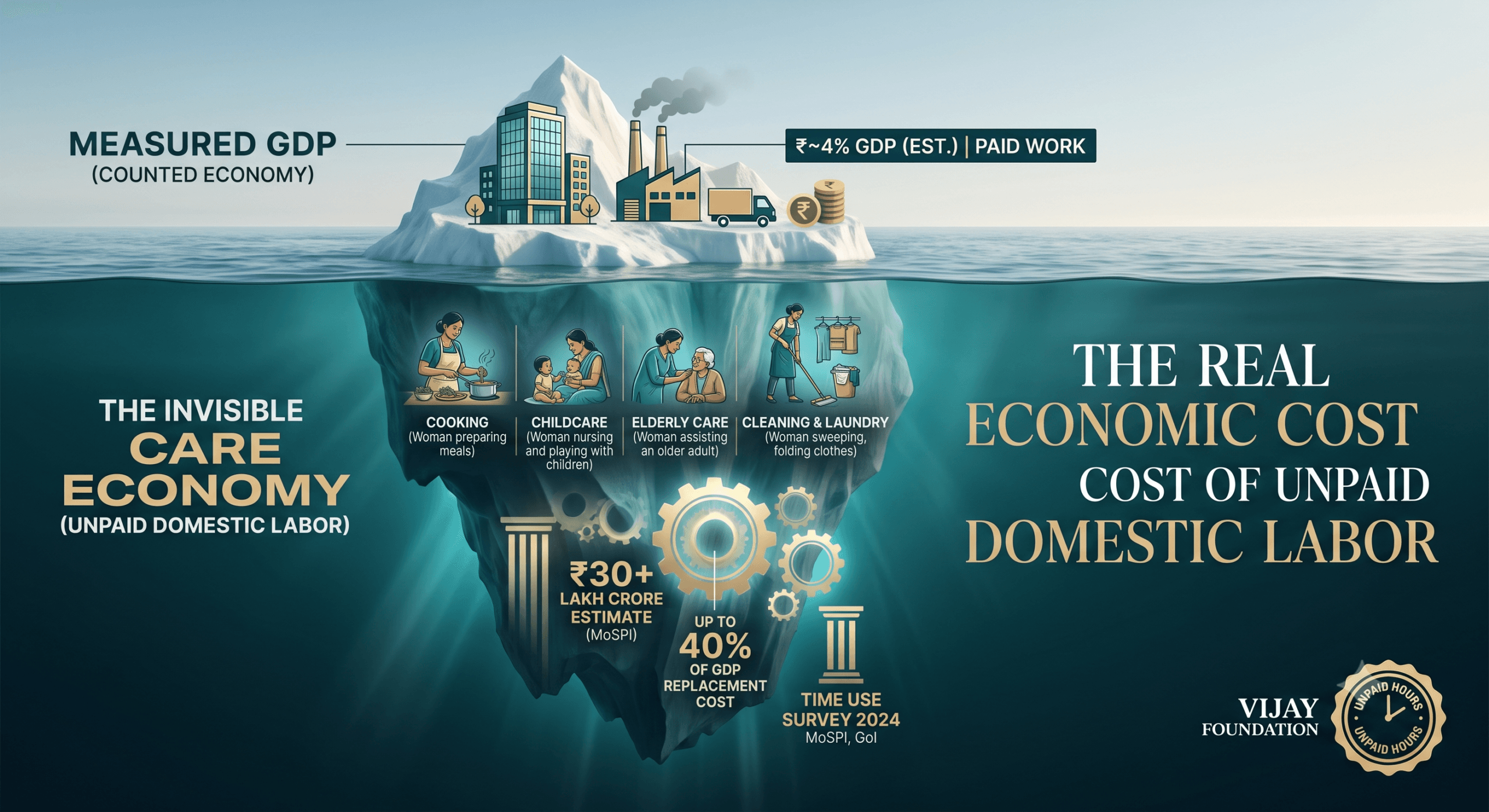
If unpaid domestic and care work were counted as a sector of the economy, it would likely be India's largest one — bigger than manufacturing, bigger than agriculture — and yet it appears nowhere in the GDP.
The Ministry of Statistics and Programme Implementation's Time Use Survey (TUS) 2024 confirms what has long been visible in every Indian household: women spend around 289 minutes a day on unpaid domestic services and another 137 minutes on unpaid caregiving, while men's contribution to both stays far lower. That is close to seven hours a day of labour that keeps a family fed, clean, cared for, and functioning — labour that no employer pays for, no tax authority records, and no pension scheme recognises.
At Vijay Foundation, this comes up constantly through our free legal aid desk — in maintenance disputes, divorce settlements, and inheritance claims, where a woman's decades of unpaid labour are treated in court as if they carried no economic value at all. Establishing the economic cost of unpaid domestic labor in these legal battles is essential for securing financial justice for homemakers.
What the Time Use Survey Actually Shows
India has only run this survey twice — in 2019 and again in 2024 — and the gap between men and women has barely moved in five years.
Combined daily minutes on unpaid domestic services + caregiving, TUS 2024. Figures rounded for illustration.
The 2019 survey had already shown that Indian women spent more than eight times as long on unpaid domestic and care work as men did — a wider gap than in most other countries, and cooking, cleaning, and childcare alone accounted for the overwhelming majority of that time. The 2024 round shows only a marginal shift: women's participation in unpaid domestic activity actually rose slightly, from about 81% in 2019 to 84% in 2024, even as more women also entered paid work.
Meanwhile, the labour market split remains stark: around 75% of men and only 25% of women participated in employment-related activities on an average day in 2024. Women aren't doing less work — they're simply doing more of it for free, which continues to mask the true economic cost of unpaid domestic labor across the nation.
Putting a Number on the Economic Cost of Unpaid Domestic Labor
Economists have tried to value the economic cost of unpaid domestic labor for decades, usually through one of two methods: the opportunity cost approach (what a woman could have earned in paid work instead) or the replacement cost approach (what it would cost to hire someone else to do the same tasks). Depending on the method, India's estimates vary widely — but every single one is large.
Government estimate (2024)
A Ministry of Finance-linked policy brief valued women's unpaid care work at roughly ₹30.7 lakh crore under a minimum-wage method — close to 5% of GDP — rising to about 17% of GDP when valued at prevailing average wages.
Oxfam India estimate
Oxfam has separately valued unpaid work by Indian women at around ₹19 lakh crore, or roughly 8% of GDP, while its wealth-inequality reporting puts women's direct contribution nearer 3.1% of GDP on a PPP basis.
Global benchmark (ILO)
Across countries, the International Labour Organization estimates unpaid care and domestic work is worth somewhere between 10% and 39% of GDP — a range so wide precisely because so few countries measure it consistently.
Upper-bound estimates
Some analyses go further still: research cited by Oxfam India suggests that valued at full replacement cost, unpaid care work could account for as much as 15–40% of India's GDP — a figure some campaigners have compared to nearly double the country's total tax revenue.
Whichever method you use, the conclusion is the same: unpaid domestic labour isn't a private, personal matter sitting outside the economy — it's a subsidy the economy quietly depends on.
Why It Doesn't Show Up in GDP
GDP measures only market transactions — goods and services bought and sold for money. A meal cooked at a restaurant counts; the same meal cooked at home does not. A nurse's salary counts; a daughter nursing her elderly parent does not. This isn't an oversight so much as a founding design choice of national accounting systems built nearly a century ago, when the economic cost of unpaid domestic labor was assumed to be free, infinite, and someone else's problem to measure.
- Cooking for the family
- Childcare & eldercare
- Cleaning & household upkeep
- Fetching water & fuel
The Cost No Ledger Captures
Being unpaid doesn't mean being costless. When we ignore the economic cost of unpaid domestic labor, the burden shows up elsewhere — just never on a balance sheet.
- →Lost lifetime earnings: years out of the paid workforce translate into lower pensions, weaker credit histories, and no retirement savings of one's own.
- →Suppressed labour force participation: globally, an estimated 708 million women remain outside the paid workforce specifically because of unpaid care responsibilities, according to ILO figures.
- →Time poverty: women who work a "double shift" — paid job plus unpaid care — have measurably less time for rest, skill-building, and their own health.
- →Weak legal recognition: in maintenance, divorce, and inheritance proceedings, unpaid domestic contribution is often treated as a moral debt rather than an economic one — with no formula to quantify it.
- →A statistical blind spot for policy: if a government can't see where a country's labour is actually going, it can't design tax, pension, or infrastructure policy around it.
How Other Countries Are Measuring It
India isn't alone in confronting this. Several countries have begun building "satellite accounts" — a supplementary economic ledger, run alongside GDP, that assigns a monetary value to unpaid household production.
India's first (pilot) national time-use survey lays the groundwork, though it would take two more decades before a full national round was conducted.
India's first large-scale Time Use Survey is released, exposing the scale of the gender gap in unpaid work for the first time with national data.
Bangladesh builds its first Unpaid Household Production Satellite Account with UN Women, following its own national time-use survey — assigning a formal monetary value to unpaid care and domestic work.
India's second Time Use Survey confirms the gender gap has barely narrowed since 2019, even as female labour force participation in paid work has risen.
What Recognition Would Actually Change
To finally address the economic cost of unpaid domestic labor, policy conversations usually converge on what advocates call the "Three Rs":
Recognise
Measure unpaid work through regular time-use surveys and build it into a satellite account alongside GDP, so it's visible to policymakers.
Reduce
Invest in public infrastructure — water, sanitation, clean cooking fuel, childcare, eldercare — that cuts the sheer number of hours the work takes.
Redistribute
Shift some of the load toward men, the state, and the market through paid parental leave, public care services, and workplace policy.
On the investment side, the case is not purely moral — it's fiscal too. Oxfam India's analysis suggests that direct public investment of around 2% of GDP in the care economy could potentially create 11 million new jobs, turning currently unpaid labour into a source of paid employment and tax revenue at the same time.
Who This Affects Most
Married women & homemakers
No independent income, pension, or credit history built over decades of full-time domestic contribution — a gap that surfaces sharply in divorce and maintenance disputes.
Working women
A paid job on top of an unpaid "second shift," with the survey data showing paid work hours have risen only marginally while unpaid hours have barely fallen.
Rural women
Additional unpaid time spent fetching water and fuel, on top of cooking, cleaning, and caregiving — work rarely captured in labour statistics at all.
Family caregivers of the elderly or ill
Often absorb income loss, reduced work hours, and productivity impacts silently. The economic cost of unpaid domestic labor falls heavily on their shoulders with zero formal compensation.
Frequently Asked Questions
Why isn't unpaid domestic work counted in India's GDP?
GDP, by international convention (the UN's System of National Accounts), only records transactions that occur in the market. Because unpaid domestic and care work isn't bought or sold, it falls outside the standard calculation — entirely hiding the economic cost of unpaid domestic labor from official economic reports.
What is a "care economy satellite account"?
It's a supplementary set of accounts, run alongside a country's main GDP figures, that estimates the monetary value of unpaid household and care work using time-use survey data. Several countries, including Bangladesh, have begun building these to make the scale of unpaid labour visible to policymakers.
Does a homemaker's unpaid work have any legal value in India?
Courts increasingly recognise a homemaker's non-monetary contribution in maintenance and matrimonial property matters, but there is still no standardised formula for valuing it, which is why outcomes vary widely from case to case. This is an area where legal aid support can help build a stronger claim.
Has the gender gap in unpaid work improved over time?
Only marginally. Comparing India's 2019 and 2024 Time Use Surveys, women's daily unpaid domestic work time fell by roughly ten minutes, while the share of women participating in unpaid activities each day actually edged up slightly — showing the underlying imbalance has been slow to shift despite rising female participation in paid work.
Which estimate of unpaid work's value is the "right" one?
There isn't a single correct figure — estimates range from roughly 3% to nearly 40% of GDP depending on whether the calculation uses opportunity cost, replacement cost at minimum wage, or replacement cost at average market wages. This wide range itself highlights the urgent need to formally standardise how we measure the economic cost of unpaid domestic labor.
The Bottom Line
Somewhere between 3% and 40% of India's GDP is being generated every single day by people who will never see a payslip for it. However wide the range, no serious estimate puts the number at zero — and that gap between "economically vital" and "economically invisible" is exactly where policy, law, and household norms need to catch up.
Recognising the economic cost of unpaid domestic labor isn't just an accounting exercise. It's the first step toward fairer maintenance settlements, better retirement security for homemakers, and an economy that finally counts the work that has always kept it running.