
Jeans don't corrupt boys.
Delhi High Court says a woman's clothing is her own choice — and overturns an acquittal to say so.
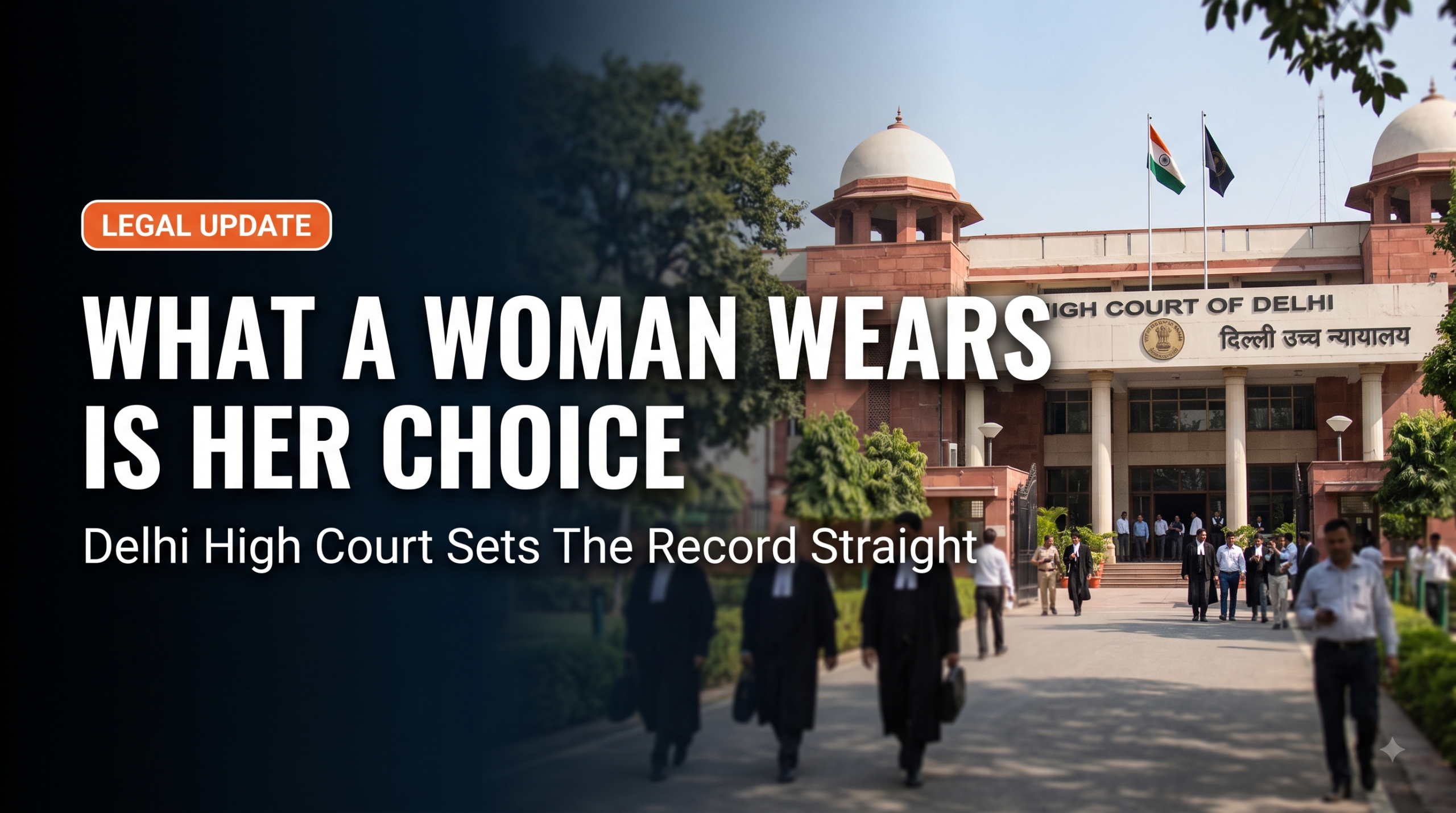
The recent Delhi High Court jeans judgment has legally affirmed what women across India have long asserted: what a woman wears is nobody's business but her own. On August 10, 2026, in the landmark case of State (NCT of Delhi) v. Sajid Ali, the Delhi High Court set aside an acquittal in a sexual harassment case, delivering a sharp and necessary judicial rebuke to the archaic argument that a woman's clothes somehow invite, justify, or excuse sexual harassment.
For decades, defence attorneys, societal commentators, and sometimes even judicial officers have casually allowed the character assassination of survivors based on their attire. Women have been subjected to humiliating cross-examinations regarding whether they wore "western clothes," jeans, or short dresses. The Delhi High Court jeans judgment fundamentally disrupts that practice, making it clear that a survivor’s appearance and the accused’s conduct are two separate issues that cannot be conflated to secure an acquittal.
The Delhi High Court Jeans Judgment: Rejecting the "Jeans Corrupt" Narrative
To truly understand the weight of this ruling, we must look at the facts of the case. The incident dates back to July 17, 2013. The prosecution established that the accused, Sajid Ali, who was a neighbour of the survivor, had repeatedly stalked her, passed sexually coloured remarks, and subjected her to unwelcome physical contact despite her clear objections. The initial complaint was filed under Section 354A of the Indian Penal Code (IPC) for outraging modesty and sexual harassment, alongside charges under the Protection of Children from Sexual Offences (POCSO) Act, 2012.
Shockingly, in 2014, the trial court acquitted the accused. What was more disturbing than the acquittal itself was the defence strategy used during the trial. The accused and a group of local residents had filed counter-complaints against the survivor and her mother. Their primary grievance? The fact that the survivor lived in a female-headed household without a male guardian, that she wore western clothes (specifically jeans), and the outrageous claim that her lifestyle and attire were "corrupting" the young boys of their neighbourhood.
During the trial, the defence counsel actively used these neighbourhood complaints to cast doubt on the survivor's character, asking invasive and humiliating questions about her wardrobe choices during cross-examination. The trial court allowed this line of questioning, eventually leading to the acquittal. The State of Delhi rightfully challenged this decision, escalating the matter to the High Court.
"A Matter of Personal Choice"
Upon hearing the appeal, Justice Chandrasekharan Sudha of the Delhi High Court took a strong, uncompromising stance against this form of legal victim-blaming. The Court meticulously separated the evidence of the accused's unwanted advances from the irrelevant noise surrounding the survivor's clothing. This aspect of the Delhi High Court jeans judgment officially dismantled the narrative that a woman's lifestyle could ever justify harassment.
The High Court unequivocally stated that a woman's choice of attire—whether traditional or western, modest or modern—is deeply personal. The Court rejected the dangerous societal suggestion that a woman wearing jeans could "corrupt" the minds of young men. Instead of regulating women's bodies and wardrobes, the Court noted that society must teach boys and men to respect boundaries and manage their own conduct lawfully.
"What a girl or woman chooses to wear is a matter of her personal choice. It is simply none of their concern."
Delhi High Court in State (NCT of Delhi) v. Sajid AliJustice Sudha strongly criticised the defence's line of questioning, clarifying that cross-examination is meant to test the validity of evidence, not to act as a license to insult, embarrass, or morally judge a survivor. The Court ruled that neighbourhood gossip regarding a family's living situation or a woman's clothing has absolutely zero evidentiary value in a sexual harassment trial.
Consequently, the High Court reversed the 2014 acquittal and convicted Sajid Ali under Section 354A(1)(i) IPC. However, the Court dropped the POCSO charges. This was due to a technical failure by the prosecution to satisfactorily prove the survivor's exact age at the time of the 2013 incident using robust official records or ossification tests. Regardless, the conviction under the IPC stands as a massive victory for women's rights and can only be challenged further at the Supreme Court of India.
Key legal frameworks protecting survivors
To fully grasp the implications of this judgment, it is essential to understand the legal terms and statutes discussed in the courtroom:
Why this ruling changes the landscape
The core message of the Delhi High Court jeans judgment is not just about a single case from 2013; it is a directive for how future trials must be conducted. The ruling establishes a powerful, citable precedent that defence lawyers cannot use irrelevant questions about lifestyle or fashion to derail a harassment trial. It draws a hard line protecting the dignity of women who step into the witness box.
At Vijay Foundation, we recognize that the fear of character assassination is one of the primary reasons women hesitate to report harassment. Whether it is a stalker on the street or an inappropriate manager at work, the first question society often asks is, "What were you wearing?" This judgment loudly answers that question: It does not matter.
If you or someone you know is navigating the complex process of filing a sexual harassment complaint, preserving evidence, or dealing with a hostile workplace committee, you do not have to fight alone. Vijay Foundation exists to support survivors through these systemic challenges, offering free legal aid to ensure justice is accessible to all without fear of humiliation.
Frequently asked questions about the judgment
What is the main takeaway from the Delhi High Court jeans judgment?
Can a defence lawyer ask a survivor about her clothes during cross-examination?
How does the Delhi High Court jeans judgment address the 2014 acquittal?
Why were the POCSO charges dropped by the High Court?
Does this ruling apply to workplace harassment (POSH) cases as well?
What is the punishment for sexual harassment under Section 354A IPC?
Is this judgment legally binding on all courts in India?
What immediate steps should a survivor take if they face harassment?
How can the Vijay Foundation help survivors of sexual harassment?
Need help with a harassment complaint?
Vijay Foundation's legal desk offers free guidance on POCSO, POSH, and criminal complaint procedure — no cost, no pressure. You don't have to fight the system alone.
© 2026 Vijay Foundation · Registered Charitable Trust · This article is for general legal awareness and does not constitute formal legal advice.