
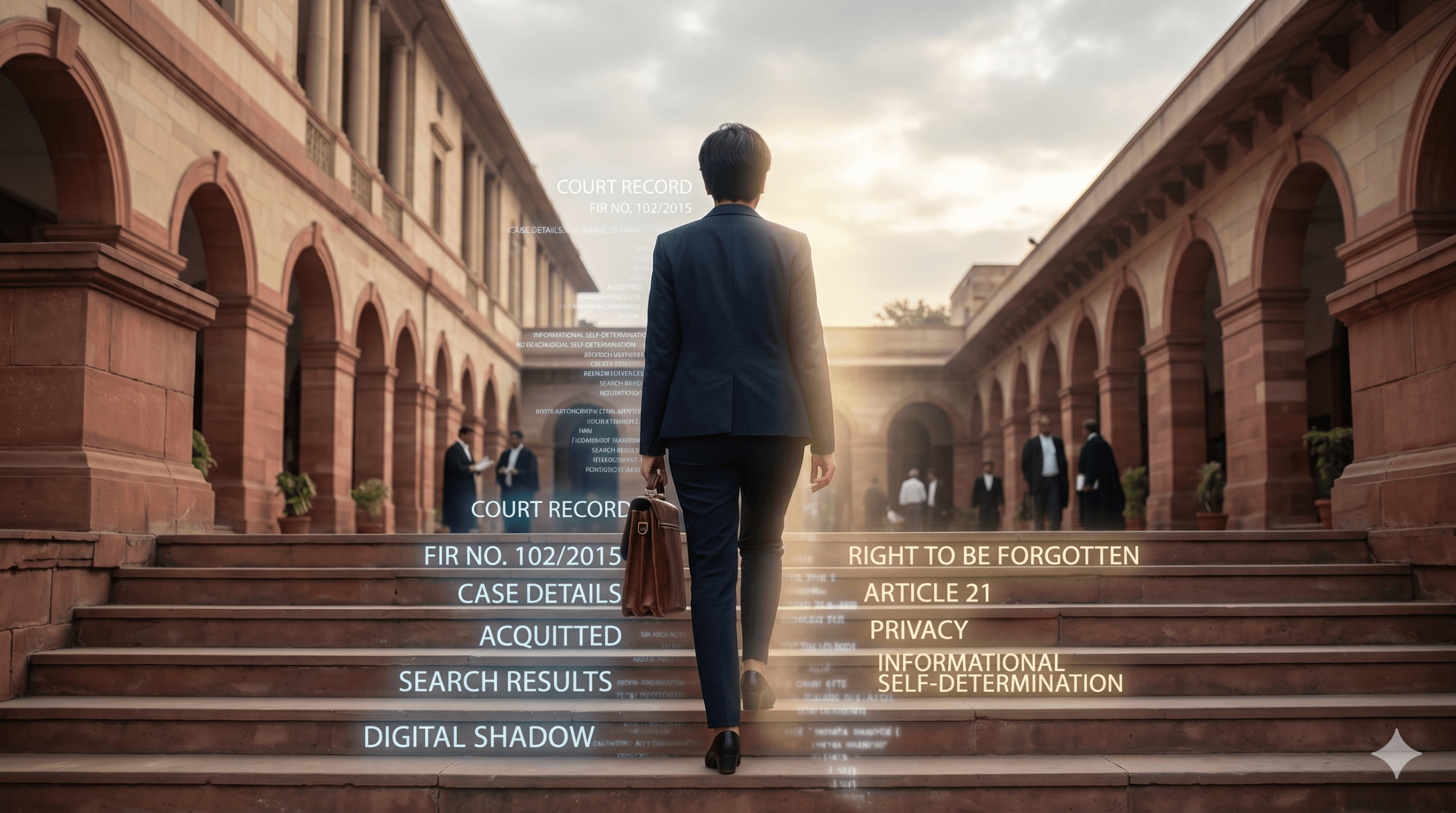
Image: The tension between digital permanence and an individual's right to privacy in India's judicial landscape.
Your Past Does Not Define You Forever: The High Court's Landmark Stand on the Right to Be Forgotten
A Delhi High Court ruling has changed how India thinks about digital identity, judicial records, and the human desire to move on. Here is why the Right to Be Forgotten matters for every citizen.
The Right to Be Forgotten is no longer just a legal theory—it is an urgent necessity. Imagine being acquitted of a criminal charge, completely cleared by a court of law, yet finding that every time a potential employer, a matrimonial prospect, or a landlord searches your name online, the first result staring back is a decade-old court record carrying words like "accused" and "arrest." The acquittal is buried. The stigma is not. This is the quiet, corrosive reality that thousands of Indians have been living with. And on May 29, 2026, the Delhi High Court finally said: enough.
In a sweeping 144-page judgment delivered by Justice Sachin Datta in the matter of Laksh Vir Singh Yadav v. Union of India & Ors., the court adjudicated a batch of over thirty petitions filed by individuals seeking relief from the perpetual exposure of their personal information. The ruling firmly recognises the Right to Be Forgotten as an inseparable facet of the fundamental right to privacy under Article 21 of the Constitution of India—a right that now compels search engines, legal platforms, and courts themselves to reckon with the digital afterlife of their own orders.
What Exactly Did the Court Rule on the Right to Be Forgotten?
The High Court held that to exercise the Right to Be Forgotten, individuals may seek two distinct but related reliefs: de-indexing and masking. De-indexing means that a judicial record will no longer surface when someone searches for a person's name on a search engine like Google. The record itself is not deleted—it remains intact in court archives—but it becomes invisible to the casual online searcher. Masking goes a step further, replacing the names and personal identifiers of individuals in the publicly accessible digital version of an order with neutral placeholders such as "ABC" or "XYZ."
Critically, the court drew a firm line: the substance of every judgment—its legal reasoning, findings, and conclusions—would remain entirely untouched. Only the identifying details change. Unredacted copies would continue to live in official court records. This implementation of the Right to Be Forgotten is not erasure of justice; it is erasure of unjust exposure.
"The Right to Be Forgotten reflects the evolution of privacy in response to the permanence of online information. In a society where digital records are virtually indelible, the ability to seek erasure ensures that informational self-determination remains effective."
— Justice Sachin Datta, Delhi High Court, May 29, 2026Who Can Seek This Relief, and When?
The court was careful not to open floodgates. It laid down guiding principles for when exercising the Right to Be Forgotten may be appropriate—primarily in cases involving acquittals, discharge orders, quashing of criminal proceedings, settled civil disputes, and purely private matrimonial or family matters. The threshold is proportionality: does the continued online accessibility of this information cause disproportionate harm to the individual's privacy, dignity, and reputation relative to any legitimate public interest?
- Cases ending in acquittal or discharge
- Criminal proceedings that have been quashed
- Settled civil or commercial disputes
- Matrimonial, custody, or family court matters
- Cases where continued online access causes disproportionate personal harm
An acquittal buried in search results while allegations dominate the digital narrative, the court rightly observed, is not a feature of open justice—it is a distortion of it. This reasoning aligns with earlier precedents, such as the Kerala High Court's direction to Indian Kanoon to remove the name of a rape survivor from a published judgment, cementing the Right to Be Forgotten in the broader trajectory of privacy jurisprudence in India.
Does the Right to Be Forgotten Undermine Transparency?
Critics of the Right to Be Forgotten often raise a legitimate concern: does allowing individuals to scrub their names from public records not undermine the transparency that a functioning democracy requires from its judiciary? It is a fair question, and one the High Court directly engaged with.
The answer lies in the distinction between accessibility and discoverability. Open justice demands that judicial proceedings be open to public scrutiny. It does not demand that every private individual's name remain permanently pinned to search engine results for eternity. The court's framework preserves transparency while sparing individuals from being the permanent subjects of a Google search result they have no power to control.
This addresses the imbalance built into the current digital ecosystem. Legal platforms serve immense public value, but that same accessibility can devastate a survivor of domestic violence or a first-time offender whose sentence has been served. The ruling acknowledges that digital rights are legal rights, and the Right to Be Forgotten acts as a necessary safeguard.
India's Right to Be Forgotten in a Global Context
India is not navigating this terrain alone. The Right to Be Forgotten has firm international roots—most prominently in the European Union's General Data Protection Regulation (GDPR), which grants EU residents an explicit right to erasure of personal data. The European Court of Justice's seminal 2014 ruling established that search engines must, on request, delist links to outdated or irrelevant personal information.
India's approach, emerging organically through constitutional interpretation rather than a dedicated statutory framework, is nuanced. While the recently enacted Digital Personal Data Protection Act, 2023 provides a nascent legislative foundation for data rights, the Delhi High Court's ruling on the Right to Be Forgotten fills the immediate gap and will become a key reference point as India's privacy law landscape matures.
How to Exercise Your Right to Be Forgotten
If you or someone you know is dealing with old judicial records that continue to cause harm online, the Delhi High Court's framework now offers a path forward. An application can be made to the concerned court seeking masking of personal identifiers, or to the relevant search engine seeking de-indexing of specific URLs. Courts have been directed to deal with Right to Be Forgotten requests expeditiously, recognising the compounding nature of digital harm.
Legal counsel remains essential in navigating this process, as each application requires demonstrating proportionality. For individuals in matrimonial disputes, survivors of crime, or those who faced prosecution and were acquitted, the case is often clear. Read more on how to initiate a Right to Be Forgotten petition in India.
The Larger Message: You Are More Than Your Worst Moment
There is something profoundly human at the heart of this judgment. Every person who has navigated the Indian legal system carries the experience. For most, life moves on, but the internet does not heal. It indexes, archives, and retrieves with indifferent precision.
The Delhi High Court's ruling on the Right to Be Forgotten affirms that the Constitution of India must evolve alongside the technologies that shape human lives. Informational self-determination—the right to decide what the world knows about you and when—is not a luxury. It is a dimension of dignity. And dignity, as Article 21 has always insisted, is not negotiable.