
Federalism Under Fire? The Supreme Court, the MMDR Amendment 2026, and the Battle for India's Mineral Wealth
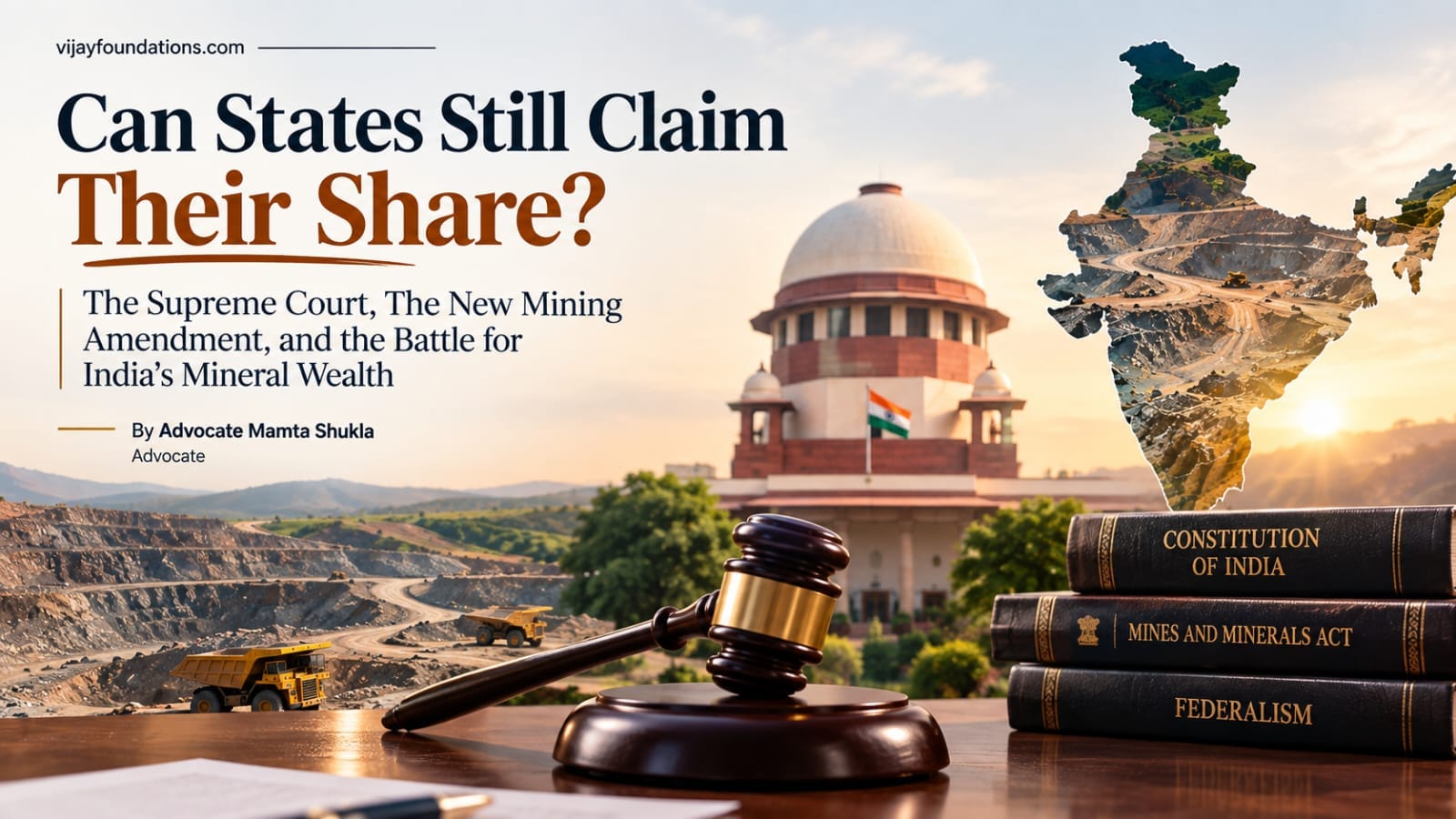
The Mines and Minerals (Development and Regulation) Amendment Act, 2026 has reopened a fiscal-federalism dispute that the Supreme Court appeared to settle in 2024. (Representative image)
Introduction
In July 2024, mineral-rich states such as Jharkhand, Odisha and Chhattisgarh won a Supreme Court battle three decades in the making — the right to tax mineral rights and mineral-bearing land on their own terms. By August 2026, Parliament had passed a law designed to take much of that power back. The Mines and Minerals (Development and Regulation) Amendment Act, 2026, received presidential assent on 17 August 2026, and its new Section 9D now bars states from taxing mineral rights or mineral-bearing land except as the Centre permits. Jharkhand's government has since approved a Supreme Court challenge to the amendment. This is not a routine tax dispute. It goes to the constitutional question of who controls the wealth beneath India's states, and how far Parliament can go in legislating around a Constitution Bench judgment it does not like.
The Constitutional Bedrock: Union vs. State Powers Over Minerals
The dispute sits within the Seventh Schedule of the Constitution, which splits legislative subjects between Parliament (Union List) and State Legislatures (State List). Three entries matter here:
- Entry 54, List I (Union List): Empowers Parliament to regulate mines and mineral development "to the extent declared by Parliament by law to be expedient in the public interest." The Mines and Minerals (Development and Regulation) Act, 1957 (MMDR Act) is the principal law enacted under this entry.
- Entry 49, List II (State List): Gives states the power to tax "lands and buildings" — a power that, unlike Entry 50, carries no express subordination to Parliament.
- Entry 50, List II (State List): Specifically allows states to tax "mineral rights," but expressly "subject to any limitations imposed by Parliament by law relating to mineral development."
For over two decades, mining companies and the Union argued that the MMDR Act — enacted under Entry 54 — fully occupied the field, leaving states no room to impose any levy on minerals beyond the Centre-prescribed royalty.
The 2024 Verdict: Mineral Area Development Authority v. SAIL
On 25 July 2024, a nine-judge Constitution Bench led by then Chief Justice D.Y. Chandrachud delivered an 8:1 majority verdict in Mineral Area Development Authority and Another v. Steel Authority of India and Another, (2024) 10 SCC 1. The Court held:
Mineral Area Development Authority v. Steel Authority of India
Court: Supreme Court of India, nine-judge Constitution Bench
Decided: 25 July 2024 (main verdict); 14 August 2024 (ruling on retrospective application)
Legal Issue: Whether royalty payable under the MMDR Act is a "tax," and whether states retain the power to tax mineral rights and mineral-bearing land despite the Union's Entry 54 legislation.
Court's Reasoning: The Bench overruled the 35-year-old ruling in India Cement Ltd. v. State of Tamil Nadu (1990), which had treated royalty as a tax. It held that royalty under Section 9 of the MMDR Act is a contractual consideration for the right to extract minerals, not a sovereign tax. It further held that mineral-bearing land falls within Entry 49, and that states may use the value or quantity of minerals extracted as a yardstick to tax that land.
Principle Established: States possess independent legislative competence under Entries 49 and 50 of the State List to tax mineral rights and mineral-bearing land; this power exists alongside, and is not extinguished by, the Union's regulatory law under Entry 54.
Dissent: Justice B.V. Nagarathna dissented, cautioning that treating royalty as distinct from tax, while allowing uncoordinated state cesses, risked "economic balkanisation" and undermined a uniform national mineral policy.
Practical Significance: The ruling unlocked a major, previously disputed revenue stream for mineral-bearing states and triggered new state legislation, including the Jharkhand Mineral Bearing Land Cess Act, 2024.
Mining revenue is not a marginal line item for these states. Jharkhand's own submissions record that mining contributed close to 84.9% of its non-tax revenue in 2024-25 — underscoring why the 2024 verdict, and the 2026 amendment that followed it, carry such high fiscal stakes.
The Retrospective Shock — And Its Limits
On 14 August 2024, the Court additionally permitted states to recover tax dues retrospectively from 1 April 2005. To cushion industry, it directed that actual collection begin only from 1 April 2026, staggered over 12 years, with a full waiver of interest and penalties accrued before 25 July 2024. Even with these safeguards, mining companies faced substantial contingent liabilities — a key reason the Centre moved swiftly to legislate.
The MMDR Amendment Act, 2026: The Centre Responds
During the Monsoon Session, the MMDR Amendment Bill, 2026 cleared the Lok Sabha on 12 August 2026 and the Rajya Sabha the following day, without being referred to a Select Committee. President Droupadi Murmu gave assent on 17 August 2026, notwithstanding Chief Minister Hemant Soren's written appeal urging reconsideration on federalism and revenue grounds.
The amendment's central feature is a new Section 9D, which states that no tax, cess or other levy — "by whatever name called" — shall be imposed by a State Government on mineral rights or mineral-bearing land, whether based on mineral quantity, mineral value or royalty payable, except as permitted under conditions the Central Government prescribes by rule. It also:
- Expands Section 2 of the MMDR Act so the Union's declared regulatory field covers "mines and mineral-bearing lands," not just mines;
- Inserts a definition of "mineral-bearing land" in Section 3, tied to parameters the Centre will separately prescribe;
- Treats any state levy not already collected before the amendment as invalid, through a non-obstante clause overriding contrary judgments or court orders — though amounts already deposited or recovered are protected from refund; and
- Amends Section 13 to give the Central Government rule-making power over the conditions under which states may impose any levy at all.
Jharkhand's Pushback and the Road to the Supreme Court
The reaction from mineral-rich states has been sharp. Jharkhand, which holds a substantial share of India's coal and iron-ore reserves, has separately pressed claims of roughly ₹1.36 lakh crore in coal royalty and land-rent dues against the Centre and coal companies. On 14 September 2026, Jharkhand's Finance Minister Radha Krishna Kishore confirmed that Chief Minister Hemant Soren had approved moving the Supreme Court against the 2026 Amendment, estimating the law could cost the state around ₹14,000 crore in expected mineral-cess revenue for 2026-27 alone. The state intends to contest the amendment both politically and in court, while continuing to press its pending dues.
Where the Amendment Is Constitutionally Vulnerable
Legal commentary since the amendment's passage has converged on three likely lines of challenge:
- Colourable legislation — Entry 49 vs Entry 54: Parliament may limit the Entry 50 power to tax "mineral rights," because that entry is expressly made "subject to" parliamentary law. Entry 49 (tax on "lands and buildings") carries no such qualification, and the 2024 judgment itself recognised that the Union's Entry 54 authority does not extend into Entry 49. By defining "mineral-bearing land" and folding it into an expanded Union field, Section 9D arguably does indirectly — restrict a State List taxing power — what it cannot do directly.
- Separation of powers: A law that nullifies the practical effect of a Constitution Bench judgment, without altering the underlying constitutional basis for that judgment, invites scrutiny over whether the legislature is overriding a judicial determination of legislative competence rather than genuinely changing the law.
- Excessive delegation: Section 9D leaves the actual "conditions and restrictions" governing any state levy entirely to rules framed by the Union executive, without legislative guardrails in the parent Act — a pattern courts have previously scrutinised as an abdication of essential legislative function.
Whether Section 9D survives will likely turn on whether courts read it as a genuine regulatory limitation on Entry 50, permissible under the Constitution's own text, or as a de facto prohibition that also reaches into Entry 49 territory Parliament was never given the power to touch.
Practical Scenario: What This Means on the Ground
Consider a mining company operating in Jharkhand that received a demand notice under the state's 2024 cess law for dues going back several years. Before the 2026 Amendment, the company had to plan for staggered retrospective liability under the Supreme Court's 12-year schedule. After the amendment, any part of that demand not yet paid or recovered by the state is, on the face of Section 9D, treated as invalid — though the company should note that this protection does not extend to amounts it has already paid. Equally, a state finance department that had budgeted future welfare spending against expected cess collections must now reassess that revenue projection pending the outcome of litigation. Neither side's position is final until the Supreme Court rules on the amendment's validity.
Common Misconceptions
- "Royalty and tax are the same thing." The 2024 judgment specifically rejected this — royalty is contractual consideration for extraction rights, not a sovereign tax, even though both are compulsory payments.
- "The 2024 judgment settled the matter permanently." A Supreme Court ruling on legislative competence does not bar Parliament from later legislating within its own domain; the real question is whether the 2026 Amendment stays within Parliament's competence under Entry 50, or reaches beyond it into Entry 49.
- "States can no longer tax minerals at all." Section 9D restricts levies "by whatever name called" on mineral rights and mineral-bearing land specifically; it does not, on its face, alter every other head of state taxation, and its own scope is now the subject of litigation.
- "Amounts already paid to states will be refunded." The amendment expressly protects already-deposited or recovered amounts from refund claims; it is future and uncollected past dues that are affected.
What You Should Do
- If you are a mining company or lessee, track both the Jharkhand cess demand and the Supreme Court challenge before making final provisioning decisions, and seek independent legal advice on your specific liability.
- If you are a state government stakeholder or policy professional, distinguish between amounts already collected (protected) and amounts still pending (contested) when assessing fiscal exposure.
- Follow the Supreme Court docket once Jharkhand's petition is filed and admitted, since the outcome will likely apply to similarly situated mineral-bearing states.
What You Should Avoid
- Do not assume the 2026 Amendment is the final word — its constitutional validity is squarely contested and untested before courts.
- Do not treat "royalty," "tax" and "cess" as interchangeable terms in any filing or public communication; the distinction is legally significant.
- Do not rely on general news summaries for compliance decisions involving specific demand notices — the facts of each levy and its collection status matter.
Critical Analysis and the Road Ahead
This dispute is ultimately about who bears the cost of extraction and who gets to fund development from it. States that host mines absorb the ecological and social burden — land use change, displacement, pollution — while a rule-based Union override risks concentrating the resulting revenue decision-making in Delhi. At the same time, the Centre's concern about disparate, unpredictable state cesses deterring investment in critical minerals is not without basis. A durable resolution probably needs more than a single amendment or a single writ petition: a negotiated, rule-based framework — developed with, not merely imposed on, mineral-bearing states — that gives investors predictability while preserving the constitutional core of Entry 49. Until the Supreme Court rules on Section 9D, or Parliament revisits it, mineral-rich states, mining companies and everyday residents of these regions will operate under continuing uncertainty.
Conclusion
Two years after the Supreme Court's landmark ruling in favour of state taxing power, the 2026 Amendment has reopened, rather than closed, India's oldest fiscal-federalism fight. Jharkhand's decision to approach the Supreme Court sets up a fresh constitutional test — this time not over whether states can tax minerals, but over how far Parliament can go in narrowing that power after the Court has already spoken. The outcome will shape not just mining revenue, but the broader balance between Union authority and state autonomy in Indian federalism.
Watch: State's Power to Tax Mines and Minerals — Judgment Explainer
Frequently Asked Questions
1. Does the MMDR Amendment Act, 2026 completely remove states' power to tax minerals?
Not entirely. Section 9D restricts states from imposing tax, cess or other levies on mineral rights or mineral-bearing land except as permitted under conditions the Central Government prescribes by rule. Whether this amounts to a near-total bar, or a regulated limitation states can still work within, is itself part of the pending constitutional challenge.
2. What happened to the dues states had already collected under their own mineral cess laws?
The amendment protects amounts already deposited with, or recovered by, a state before the law's commencement from being refunded. It is levies assessed but not yet collected that the amendment treats as invalid.
3. Is royalty on minerals legally the same as a tax?
No. The Supreme Court in Mineral Area Development Authority v. SAIL (2024) held that royalty paid under Section 9 of the MMDR Act is contractual consideration for mineral extraction rights, not a tax, overruling the earlier India Cement position that had blurred this distinction.
4. On what grounds is Jharkhand expected to challenge the 2026 Amendment?
Reported grounds include that Section 9D amounts to colourable legislation reaching into Entry 49 (which Parliament cannot subordinate, unlike Entry 50), that it improperly nullifies a Constitution Bench ruling, and that it delegates essential legislative functions to Union rule-making without adequate statutory guidance.
5. Does this dispute affect ordinary citizens in mineral-bearing states?
Yes, indirectly. Mineral revenue funds a significant share of some states' budgets — in Jharkhand's case, a large majority of non-tax revenue — so the outcome of this litigation can influence funding for local infrastructure, welfare schemes and development spending in mining-affected regions.
Authoritative Sources
- Constitution of India, Seventh Schedule — Entries 49, 50 (List II) and 54 (List I)
- Mines and Minerals (Development and Regulation) Act, 1957, and the MMDR Amendment Act, 2026 (Press Information Bureau factsheet, pib.gov.in)
- Mineral Area Development Authority and Another v. Steel Authority of India and Another, (2024) 10 SCC 1 — Supreme Court of India, Civil Appeal Nos. 4056-4064 of 1999 and connected matters
- PRS Legislative Research — MMDR (Amendment) Bill, 2026, Bill text and Statement of Objects and Reasons (prsindia.org)
- Bar & Bench — "Reclaiming the field: Mineral taxation, federalism and the MMDR (Amendment) Act 2026"
Recommended Related Reading
- Tryst With the Constitution: The Mutt That Gave Us the Basic Structure Doctrine — how Kesavananda Bharati still shapes the limits of what Parliament can do to a Supreme Court ruling.
- More from Vijay Foundation's Constitutional Law desk
- Vijay Foundation's Free Legal Aid resources — for individuals seeking guidance on rights-related matters.