AI vs. Constitution: 5 Key Takeaways from the Gujarat High Court Deepfake PIL (2026)
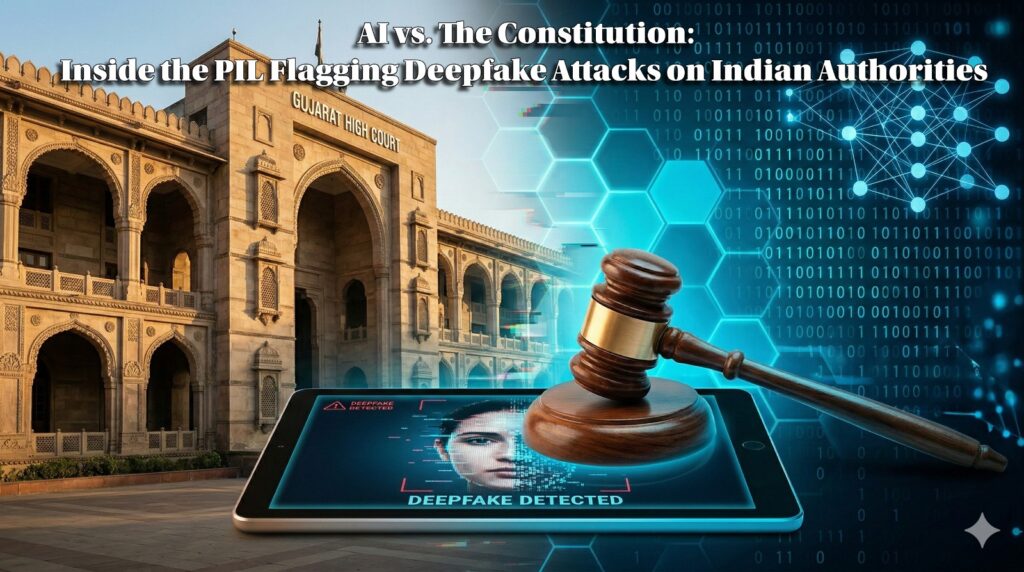
The digital landscape has reached a historic inflection point. In early 2026, the age-old adage “seeing is believing” was effectively rendered obsolete as Generative AI achieved a level of “startling accuracy” that now threatens the very pillars of Indian democracy. The Gujarat High Court Deepfake PIL (Public Interest Litigation) has emerged as the definitive legal battleground where technology meets constitutional sovereignty.
In a landmark move on February 24, 2026, the Gujarat High Court took center stage in the national discourse on AI regulation. Presiding over this specific Gujarat High Court Deepfake PIL which flags the “alarming rise” of synthetic media, a Bench comprising Chief Justice Sunita Agarwal and Justice DN Ray demanded a comprehensive accounting from the Union and State governments.
1. Judicial Intervention: Prioritizing State Accountability
The Gujarat High Court Deepfake PIL, filed by advocate Vikas Vijay Nair, serves as a formal warning that the current legal framework is struggling to keep pace with the velocity of AI-generated misinformation. During the preliminary hearings of the Gujarat High Court Deepfake PIL, the High Court issued notices to the Central Government, State authorities, and the DGP.
- The Central Government (Union of India)
- The Gujarat State Government
- The Gujarat Director General of Police (DGP)
The Court strategically prioritized government accountability, stating it would only consider issuing notices to tech giants like Meta, Google, and X after reviewing official enforcement roadmaps. This ensures that the Gujarat High Court Deepfake PIL remains focused on the state’s responsibility for “epistemic security.”
2. The Anatomy of a Digital Threat
Deepfakes are sophisticated pieces of synthetic media where an individual’s likeness, voice, and gestures are mapped onto another person using deep learning. This “weaponized identity” discussed in the Gujarat High Court Deepfake PIL bypasses traditional biometric security and social trust.
| Category | Description | Impact |
|---|---|---|
| Institutional Devaluation | Fabricated videos of judges or ministers making controversial statements. | Erodes public trust in constitutional offices. |
| Character Assassination | Generating non-consensual or derogatory content targeting public servants. | Leads to “irreparable damage” to reputation. |
| Public Incitement | Distorting official briefings to trigger unrest or manipulate markets. | Threatens national security and order. |
3. The Policy Gap: The 3-Hour Takedown Struggle
While India notified the IT Amendment Rules, 2026 on February 10, several practical hurdles remain that the Gujarat High Court Deepfake PIL aims to address:
- The 3-Hour Takedown Challenge: The rules slashed the timeline to just 3 hours. However, the PIL argues that without real-time technical support, even 180 minutes is enough for a deepfake to go viral.
- Lack of SOPs: Local cybercrime units currently lack a unified Standard Operating Procedure (SOP) to distinguish between malicious deepfakes and parody.
- The Watermarking Vacuum: The Gujarat High Court Deepfake PIL pushes for mandatory “Digital Signatures” to provide a provenance standard.
4. International Benchmarks: The EU AI Act Model
Advocate General Kamal Trivedi noted that the problem is global. Experts point toward the European Union’s AI Act as a North Star. Unlike India’s timeline-centric approach, the EU focuses on Risk-Based Regulation, classifying AI systems targeting democratic processes as “High Risk.” This classification is a central theme in the ongoing Gujarat High Court Deepfake PIL discussions.
5. Conclusion: Reclaiming the Truth
The court has scheduled the next hearing for March 20, 2026. This date is highly anticipated, as the DGP and Central government are expected to present concrete steps for enforcement, potentially involving Section 69 of the IT Act. As an organization dedicated to digital rights, we invite you to learn more about our mission on our About Us page.
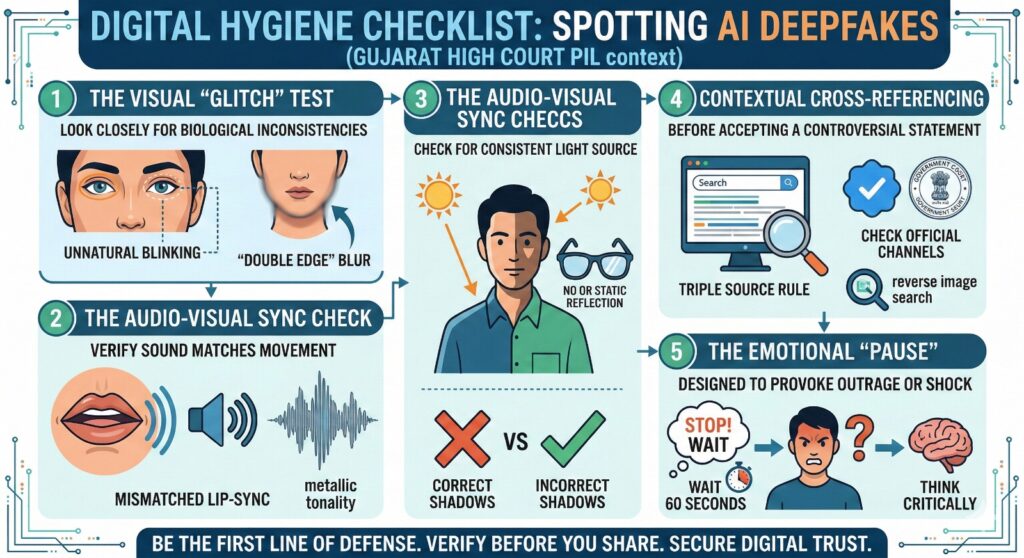
The Digital Hygiene Checklist: Protect Yourself
- Visual Glitches: Look for unnatural blinking or “ghosting” near the jawline.
- Audio Sync: Watch if lip movements perfectly match “B,” “M,” and “P” sounds.
- Source Verification: Check verified government portals like pib.gov.in before sharing.
The Path Forward: Building for Dignity
To move from “Optional” to “Absolute,” organizations must audit their internal cultures via data minimization, transparent breach notifications, and empowering the Data Protection Officer (DPO). The Gujarat High Court Deepfake PIL is the catalyst we need for this nationwide shift.
Final Thought: Data Dignity India is about respecting the human being behind every byte of data. As India cements its place as a global leader, our legacy won’t be the volume of our data, but the sovereignty we grant to the individuals who create it.
Share This Investigation
Help us spread awareness about critical digital rights and the Gujarat High Court Deepfake PIL.