
From Tradition to Regulation: Why Madras HC Barred Private Jallikattu Organisers
Introduction: Tradition Meets Judicial Regulation
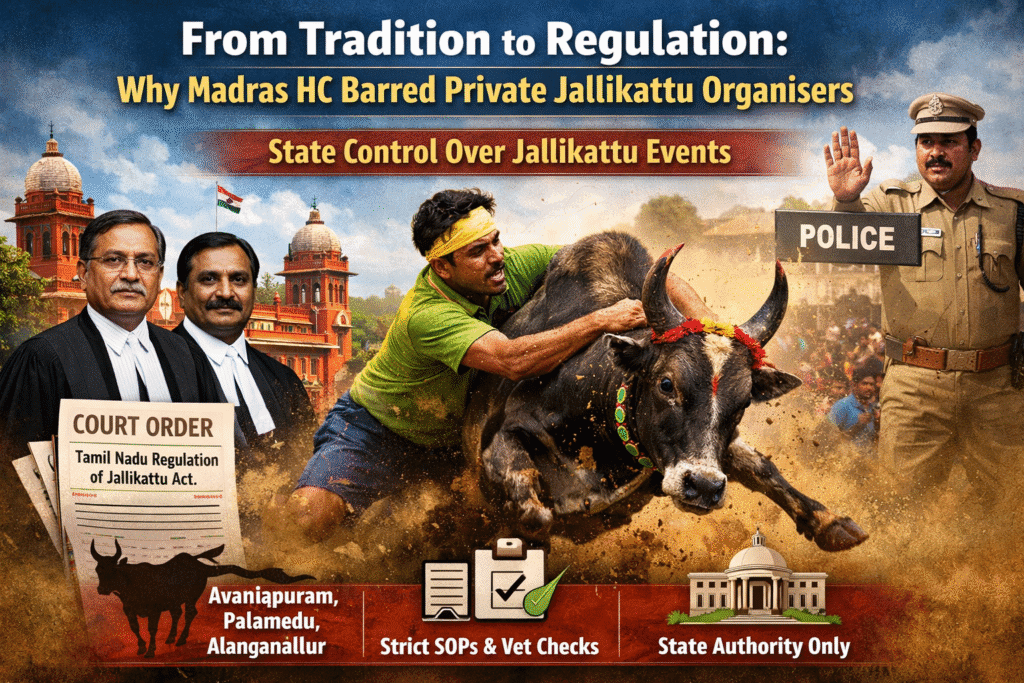
Recently, the Madurai Bench of the Madras High Court ruled that Jallikattu events conducted at prominent venues such as Avaniyapuram constitute state-organised events of international importance. Consequently, the Court prohibited private individuals from independently hosting such events. This ruling arose from a petition filed by P. Murugan, who sought permission for his village committee to conduct Jallikattu on January 15, 2026. Ultimately, the decision reinforces state control during the Pongal festivities while carefully balancing cultural tradition with regulatory oversight.
Madras High Court Ruling on Private Jallikattu Organisers
Court Judgment Breakdown
In this context, Justices G. Jayachandran and K.K. Ramakrishnan dismissed the writ petition in P. Murugan vs. District Collector, citing the provisions of the Tamil Nadu Regulation of Jallikattu Act, 2009. Notably, the Court emphasised direct state involvement through revenue officials and village advisory committees at Avaniyapuram, Alanganallur, and Palamedu—venues recognised for their international stature.
Role of SOPs and State Authorities
Further, by referring to the Standard Operating Procedure (SOP) dated November 21, 2025, issued by the Animal Welfare Department, the Bench mandated that Jallikattu events must be executed under state leadership, allowing only limited community assistance.
Moreover, the Additional Advocate General confirmed adherence to the 2020 High Court guidelines requiring inclusive advisory panels. As a result, the petition was dismissed without granting interim relief. Accordingly, requests for police protection for privately organised events were also denied, thereby underscoring the exclusive authority of the government in conducting Jallikattu at major venues.
Understanding the Jallikattu Tradition
Traditionally, Jallikattu—known as eru thazhuvuthal—is a centuries-old Tamil bull-taming sport celebrated during the Pongal festival across Madurai, Theni, and Sivaganga districts. During these events, bulls are released into crowds, where participants attempt to grip their humps and ride them, thereby symbolising agrarian valour and the conservation of native cattle breeds.
Major Pongal Jallikattu Events
In particular, the key events include:
Avaniyapuram (January 15)
Palamedu (January 16)
Alanganallur (January 17)
Additionally, these prominent events are often inaugurated by political leaders, including Chief Minister M.K. Stalin, reflecting their cultural as well as administrative significance.
However, while Jallikattu is widely revered as a vital component of Tamil cultural heritage, it has simultaneously faced criticism over concerns of animal cruelty and human injuries. Consequently, this criticism has led to the introduction of increasingly stringent regulatory measures.
Legal History and Evolution of Jallikattu Regulation
Tamil Nadu Regulation of Jallikattu Act, 2009
Initially, enacted in 2009, the Tamil Nadu Regulation of Jallikattu Act permits the conduct of Jallikattu events between January and May at approved venues with prior permission from the District Collector. At the same time, it prescribes penalties, including imprisonment up to one year or fines of ₹10,000, for violations.
Supreme Court Ban in A. Nagaraja v Union of India (2014)
Subsequently, in 2014, the Supreme Court banned Jallikattu under the Prevention of Cruelty to Animals Act, 1960, declaring the practice inherently exploitative.
2017 Amendments and Cultural Rights Argument
In response, Tamil Nadu enacted legislative amendments in 2017, asserting Jallikattu as a protected cultural practice under Article 29(1) of the Constitution of India.
Supreme Court Constitution Bench Verdict (2023)
Thereafter, in a unanimous 5:0 verdict delivered in 2023, the Supreme Court upheld the validity of the amended law. Importantly, it allowed regulated conduct of Jallikattu subject to veterinary checks, prohibition of stimulants, and oversight by the Animal Welfare Board of India. Over time, SOPs continued to evolve, ultimately culminating in the 2025 guidelines governing the 2026 events.
Key Milestones in Jallikattu Regulation
| Milestone | Year | Key Outcome |
|---|---|---|
| Tamil Nadu Act Passed | 2009 | Regulated permissions required |
| Supreme Court Ban (A. Nagaraja) | 2014 | Declared cruel |
| State Amendments | 2017 | Cultural exemption claimed |
| SC Upholds Jallikattu | 2023 | Validity affirmed with SOPs |
| Madras HC Ruling | 2026 | State monopoly at major venues |
Status of Major Jallikattu Venues
Significantly, Avaniyapuram, Alanganallur, and Palamedu are accorded “international importance.” Therefore, these venues require Collector-level oversight through Revenue Divisional Officers, unlike smaller local events. As a result, this structure prevents fragmented private initiatives and ensures enhanced safety amid global viewership.
Furthermore, the 2025 SOP standardises bull selection, health certification, and crowd management exclusively under state machinery.
Broader Implications of the Madras High Court Verdict
Overall, this ruling centralises authority and curbs recurring disputes over permissions and token allotments for bulls—an issue frequently raised by organisers and bull owners. Additionally, it aligns with Supreme Court directives on animal welfare by mandating pre-event fitness checks and expressly prohibiting the use of aids such as alcohol or irritants.
Consequently, for Tamil Nadu’s rural economy, state control seeks to sustain tradition while simultaneously mitigating risks, thereby preserving Jallikattu’s role in native breed conservation and Pongal festivities. Nevertheless, while critics may challenge restrictions on private participation, the judiciary’s emphasis on uniformity ultimately prioritises public order and public safety.
Finally, as Pongal 2026 approaches, heightened state preparedness at these iconic arenas reflects a conscious effort to blend cultural heritage with regulatory accountability.
Sources
- https://www.barandbench.com/news/litigation/jallikattu-a-state-event-private-individuals-cannot-organise-it-madras-high-court
- https://www.livelaw.in/high-court/madras-high-court/madras-high-court-no-independent-request-to-conduct-jallikattu-festival-519057
- https://www.indiacode.nic.in/bitstream/123456789/19515/1/tna_27_of_2009_tamil_nadu_regulation_of_jallikattu_act,_2009.pdf
- https://www.newindianexpress.com/amp/story/states/tamil-nadu/2026/Jan/08/jallikattu-of-international-importance-only-government-can-organise-it
- https://www.jallikattu.tn.gov.in/assets/pdfs/SOP_Jallikattu – 2025.pdf
- https://timesofindia.indiatimes.com/city/madurai/plea-to-allow-village-panel-to-conduct-jallikattu-rejected/articleshow/126512102.cms
- https://www.news18.com/photogallery/cities/chennai-news/from-alanganallur-to-palamedu-tamil-nadus-biggest-jallikattu-arenas-ws-l-9827639.html
- https://www.clearias.com/jallikattu/
- https://thoonganagaram.com/en/avaniyapuram-palamedu-alanganallur-jallikattu-dates-announced-2/
- https://www.scobserver.in/journal/sco-daily-supreme-court-upholds-jallikattu-in-tamil-nadu/
- https://www.freelaw.in/supremecourtupdates/Overview-of-Jallikattu-Verdict
- https://vajiramandravi.com/current-affairs/sc-upholds-validity-of-jallikattu/
- https://www.drishtiias.com/daily-updates/daily-news-analysis/jallikattu-7
- https://awbi.gov.in/uploads/circular/163299330532guidelines_jallikattu_jan2018.pdf
- https://www.newindianexpress.com/states/tamil-nadu/2026/Jan/10/bull-owners-flag-lack-of-transparency-in-issuing-tokens-for-jallikattu-events
✍️ Adv. Mamta Singh Shukla
Supreme Court of India | PoSH Trainer
Finally, the article was originally published by Vijay Foundation. For more legal and public-interest articles, readers may visit vijayfoundations.com.
Support Vijay Foundation
If you value independent analysis and public-interest work on technology and privacy, consider supporting our mission.