
THE VERDICT ON PRIVILEGE: MCDONALD’S INDIA V. STATE OF NCT
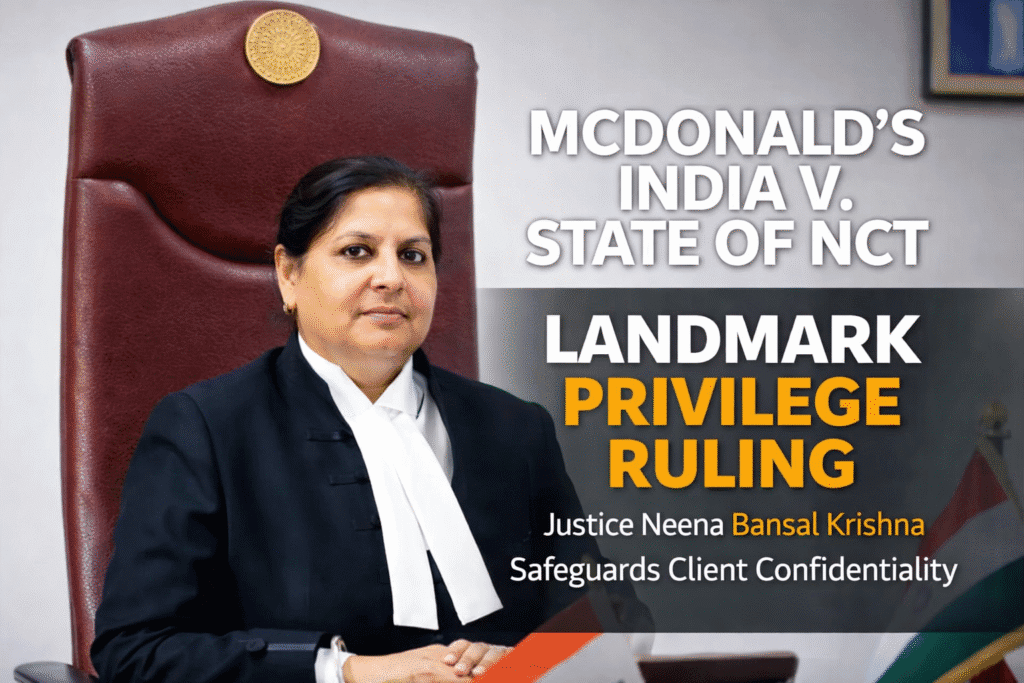
In a resounding victory for the sanctity of the legal profession, the Delhi High Court has fortified the walls of confidentiality between lawyers and their clients. On January 12, 2026, Justice Neena Bansal Krishna delivered a definitive ruling in McDonald’s India Ltd v State of NCT of Delhi (2026 DHC 228), declaring that courts cannot force advocates to disclose the source of documents filed on behalf of their clients.
This isn’t just a procedural win; it is a vital reinforcement of the constitutional and statutory rights that allow justice to function without fear of intimidation.
THE DISPUTE: FROM BURGERS TO BARRICADES:-
The case emerged from a complex legal battle involving franchise operations at McDonald’s India. During trial proceedings, McDonald’s counsel submitted documents that the complainant, Deepak Khosla, alleged were illicitly obtained—possibly “stolen” from police or court records.
In a move that stunned the legal community, the trial court ordered the McDonald’s advocates to file personal affidavits detailing exactly how they acquired these documents. When the lawyers stood their ground and refused, citing professional privilege, they were met with a contempt notice.
The High Court’s Verdict: Justice Krishna quashed the trial court’s order, ruling that forcing an advocate to betray a client’s confidence without concrete evidence of a crime is an overreach of judicial authority.
DECODING SECTION 126: WHY YOUR SECRETS ARE SAFE:-
At the core of the judgment is Section 126 of the Indian Evidence Act, 1872 (and its modern counterpart in the Section 132 of the Bharatiya Sakshya Adhiniyam (BSA). This statute acts as the “Shield of Silence” for the legal profession.
The Court’s Interpretation:
- Expansion of “Communication”: Privilege isn’t just about what is whispered in a lawyer’s office. The Court ruled that the physical or digital act of a client handing a document to their lawyer is a protected communication.
- Source Protection: Forcing a lawyer to say, “Client X gave me this,” is effectively forcing them to disclose the source of their instructions, which is strictly prohibited.
- The Advocate as Agent: The responsibility for a document’s authenticity lies with the party (the client), not the lawyer. A lawyer should not be treated as a witness against their own client.
“To compel an advocate to disclose that ‘Client X gave me this document’ is to compel disclosure of the source, which is protected by Section 126.” — Justice Neena Bansal Krishna
CAN THE PRIVILEGE EVER BE BROKEN?
While the shield is robust, it is not absolute. The law provides specific “safety valves” where privilege can be waived:
- If the communication is made in furtherance of an illegal purpose.
- If the lawyer observes a crime or fraud being committed after their engagement.
However, the High Court set a very high bar for these exceptions. A mere accusation of theft by an opponent is not enough. To pierce the veil, there must be a prima facie judicial finding—actual, material evidence of wrongdoing. In the McDonald’s case, the documents had a plausible “chain of custody” from previous filings, rendering the fraud allegations baseless.
WHY THIS MATTERS IN 2026:-
In an era of increasing regulatory scrutiny and digital surveillance, this ruling arrives as a providential safeguard.
- For Advocates: It eliminates the “contempt trap.” Lawyers can now represent clients without the fear of being hauled into the witness box to explain their procurement chains.
- For Litigants: Whether a private citizen or a global giant like McDonald’s, you can consult counsel knowing your strategy remains sealed.
- For the System: It preserves the adversarial system. True justice requires that people can speak freely to their lawyers so that they can receive the best possible defence.
A GLOBAL & HISTORICAL CONTEXT:-
The Court didn’t act in a vacuum. It drew on foundational precedents to support its stance:
- Three Rivers District Council v. Bank of England (UK, 2004): Established that privilege is a fundamental human right and a cornerstone of the rule of law.
- Satyen Bhowmick (India, 1981): Confirmed that lawyers are agents of their clients and cannot be penalized for non-disclosure of privileged content.
LOOKING AHEAD: PRIVILEGE IN THE DIGITAL AGE:-
As we move further into 2026, new questions emerge: How does this apply to cloud-sourced evidence? Can AI-assisted reviews trigger fraud provisos? While technology evolves, the McDonald’s India ruling stands as a sturdy bulwark, reminding us that effective justice demands trusted advocacy.
The message is clear: Lawyers breathe easier; clients confide bolder.
Sources:
1. Supreme Today Analysis: Delhi HC protects attorney-client privilege under Section 126
2. LiveLaw.in Coverage: Detailed report on advocate-client privilege ruling
3. Bar & Bench Article: Courts can’t compel lawyers to disclose document sources
✍️ Adv. Mamta Singh Shukla
Advocate, Supreme Court of India | PoSH Trainer
Originally published by Vijay Foundation. For more articles, visit vijayfoundations.com.
Support Vijay Foundation
If you value independent analysis and public-interest work on technology and privacy, consider supporting our mission.