
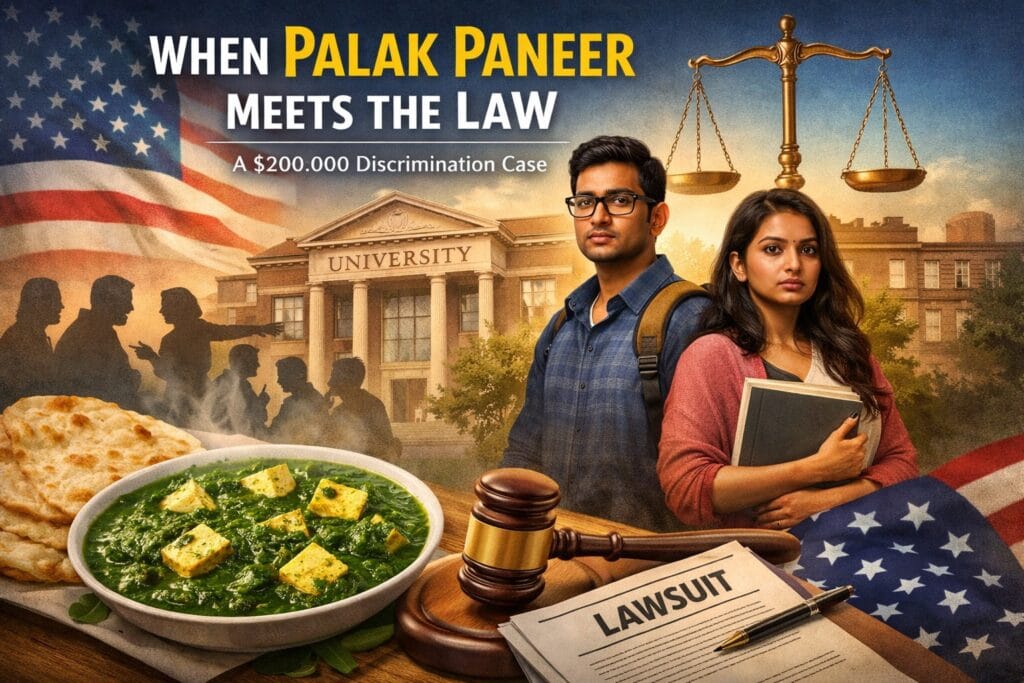
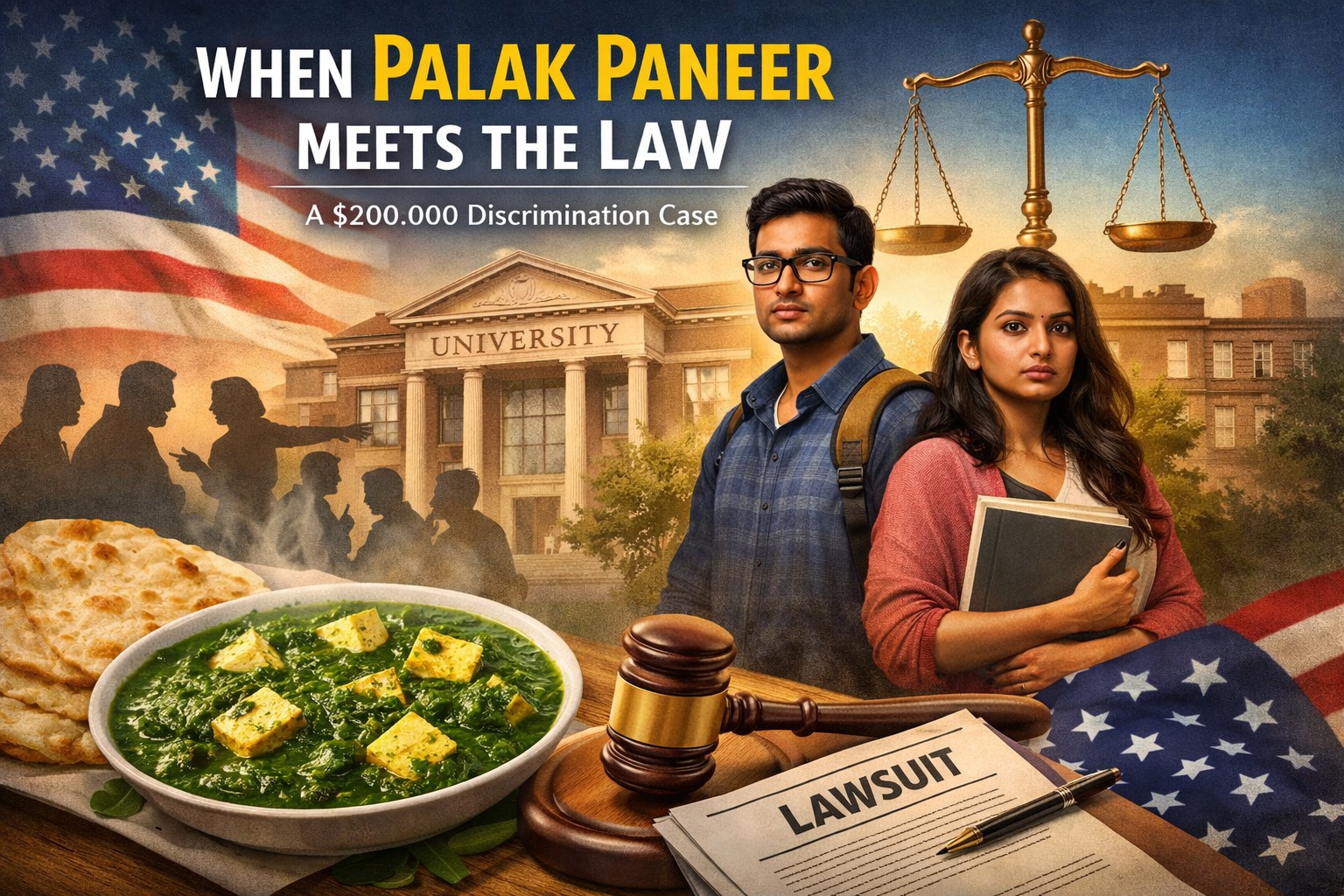
JUSTICE SERVED HOT: THE CASE OF THE $200,000 PALAK PANEER
It started with a lunchbox. It ended with a historic civil rights settlement.
Introduction: When Everyday Life Meets the Law
We have all been there—standing in an office pantry or university breakroom, quietly debating whether reheating fish, broccoli, or leftovers might offend someone nearby. Usually, such moments end in nothing more than awkward glances.
However, for two Indian PhD students at the University of Colorado Boulder, this everyday dilemma did not fade into silence. Instead, it spiralled into a two-year legal battle, allegations as extreme as “inciting a riot,” and ultimately culminated in a $200,000 (approximately ₹1.8 crore) civil rights settlement that has captured global attention.
This is the remarkable story of Aditya Prakash, Urmi Bhattacharyya, and the palak paneer that placed systemic bias on trial.
The “Offence”: A Lunch Heated, A Line Crossed
The controversy was set in motion on September 5, 2023. On that day, Aditya Prakash, a PhD scholar in the Anthropology Department, was seen doing what millions of students do daily—heating a homemade lunch in a shared microwave.
Instead of a warm meal, however, a cold rebuke was delivered.
A university staff member reportedly objected to the “pungent smell” of the food and instructed Prakash not to use the microwave for such meals. When it was argued that even vegetables like broccoli were similarly restricted, the contradiction was pointed out.
Prakash’s response was calm, measured, and quietly profound:
“It’s just food. I’m heating and leaving.”
When the comparison to broccoli was pressed further, a sharper truth was revealed:
“How many groups of people do you know who face racism because they eat broccoli?”
With that question, the issue ceased to be about etiquette—and became about identity.
The Escalation: From Tupperware to Tribunal
Had the incident ended there, it might have been dismissed as yet another microaggression. Instead, matters escalated.
According to the students, retaliatory actions followed:
- Prakash was allegedly summoned to repeated administrative meetings and accused of making staff “feel unsafe” merely by contesting the microwave restriction.
- Urmi Bhattacharyya, also a PhD student, was abruptly removed from her Teaching Assistant position, with no explanation offered.
- In a moment of profound irony for an Anthropology department, when the couple later shared Indian food with friends on campus, they were accused of “inciting a riot.”
At that point, the underlying message appeared unmistakable:
Your tuition is welcome—but your culture, especially its sensory presence, is not.
The Legal Battle: Smell as a Site of Discrimination
Refusing to retreat, Aditya and Urmi approached the US federal court, alleging violations of civil rights protections. It was argued that policing the smell of ethnic food functions as a form of “olfactory racism”—a subtle yet powerful method of exclusion disguised as concerns over etiquette or air quality.
In essence, the case challenged the idea that discrimination must always be loud or explicit. Instead, it demonstrated how bias often operates quietly, through everyday controls on space, behaviour, and culture.
The Outcome: #JusticeServed
The legal battle concluded with a $200,000 settlement agreed to by the University of Colorado Boulder.
Additionally, the Master’s degrees allegedly withheld during the dispute were formally awarded to both students.
It must be noted that:
- The university denied any admission of legal liability.
- As part of the settlement, the couple was barred from future employment or enrollment at the institution.
Following the resolution, Aditya Prakash and Urmi Bhattacharyya returned to India, not in defeat, but with dignity intact and a precedent firmly established.
Why This Case Matters
This outcome represents far more than financial compensation.
For decades, phrases like “curry smells” have been used as coded language in housing, workplaces, and educational institutions to marginalise immigrant communities. By challenging such behaviour, this case reaffirmed that cultural expression does not stop at festivals, clothing, or language—it extends to food, space, and daily life.
In a powerful Instagram post following the settlement, Urmi wrote:
“I fought a fight for the freedom to eat what I want… no matter the color of my skin, my ethnic extraction, or the unflinchingly unchanged Indian accent.”
Why This Case Matters for International Students
For international students, this case goes far beyond a disagreement over food. It exposes how discrimination in universities often appears not as open hostility, but as everyday regulation—what food is acceptable, how space may be used, and how visible one’s culture is allowed to be.
Cultural Identity Is Not Optional
International students are frequently expected to adapt while keeping their cultural identity discreet. This case reinforces that cultural practices, including food, are not privileges granted by institutions, but fundamental expressions of identity protected under civil rights law.
Microaggressions Can Become Systemic Discrimination
Terms like “smell,” “discomfort,” or “appropriateness” are often used as neutral-sounding justifications to police ethnic behaviour. When selectively applied, such actions amount to discrimination. This case demonstrates that even subtle bias, when repeated and enforced institutionally, can attract legal consequences.
Power Imbalance in Academic Institutions
Universities exercise enormous control over international students through visas, funding, teaching assistantships, and degrees. The removal of Urmi Bhattacharyya from her Teaching Assistant role highlights how this imbalance can be misused—and why legal oversight is essential.
A Precedent That Extends Beyond One Campus
Although the students paid a heavy personal cost, their legal action established a broader precedent. It sends a clear message to universities worldwide: diversity and inclusion cannot be limited to policy statements—they must extend into everyday spaces like cafeterias, breakrooms, and common facilities.
For international students everywhere, this case affirms one essential truth:
Belonging does not require cultural erasure.
Conclusion: My Food, My Pride
Ultimately, this case sends a clear message: food is not a nuisance—it is identity.
So the next time palak paneer, rajma chawal, or any home-cooked comfort food is reheated in a shared space, there should be no apology, no shame, and no fear.
Because as this case has shown—
Food is comfort. Food is culture. And if you try to ban it, food can also be a $200,000 liability.
Cheers to Aditya and Urmi—for reminding the world: My Food. My Pride. 🍛✊
Sources & Further Reading
News articles covering the case:
• Times of India — $200,000 palak paneer settlement resurface Read Times of India on the settlement
• Gulf News — Palak paneer ‘smell’ dispute and lawsuit Read Gulf News on the discrimination dispute
• Indian Express — Lunch that sparked the settlement Read Indian Express report
• Business Standard — Palak paneer discrimination case overview Read Business Standard on the $200,000 payout
• India Today — Detailed case and student statements Read India Today coverage
• The Federal — Settlement and broader implications Read The Federal on the case
 Adv. Mamta Singh Shukla
Supreme Court of India | PoSH Trainer
Finally, the article was originally published by Vijay Foundation. For more legal and public-interest articles, readers may visit vijayfoundations.com.
Support Vijay Foundation
If you value independent analysis and public-interest work on technology and privacy, consider supporting our mission.