Supreme Court Mandates Fixed Timelines for Oral Arguments
A Procedural Reset for Speedy Justice
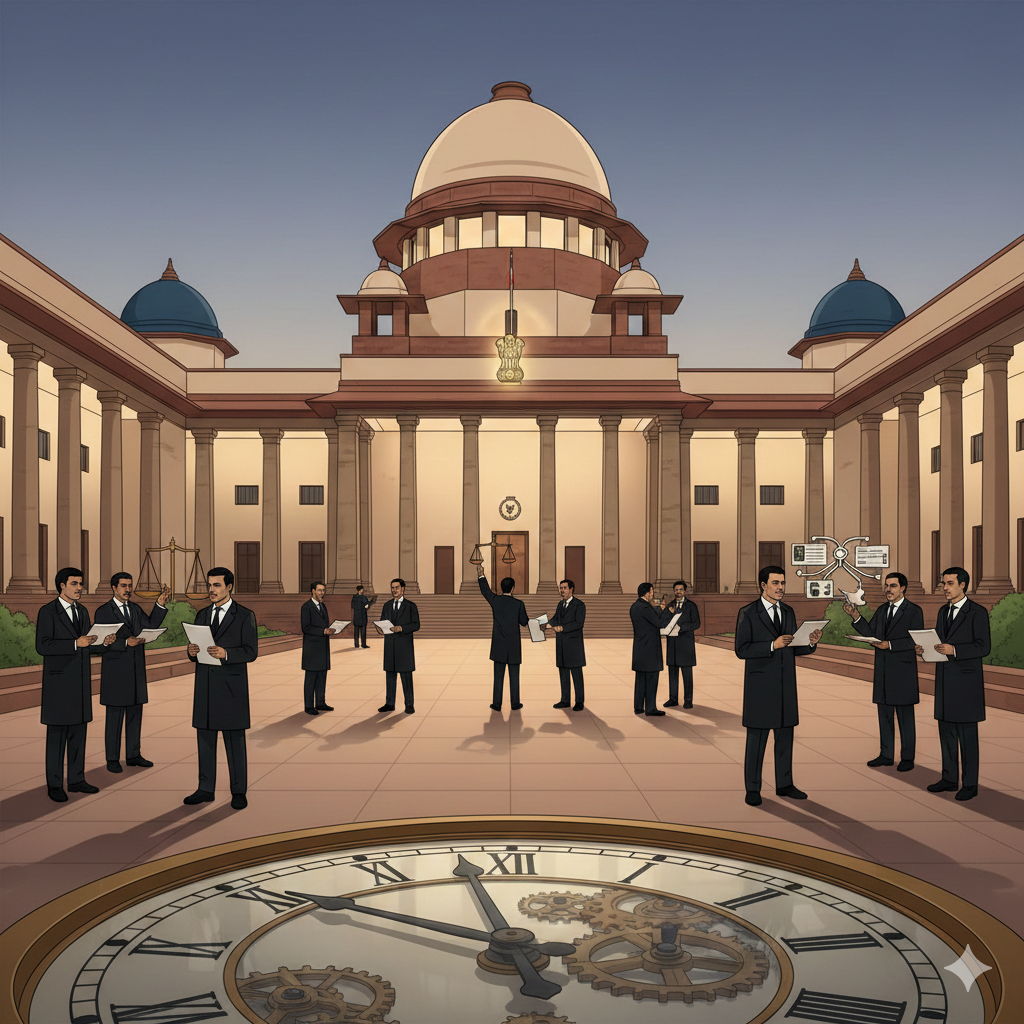
On December 29, 2025, the Supreme Court of India issued a landmark Standard Operating Procedure (SOP) mandating strict, pre-declared timelines for oral arguments in all post-notice and regular hearing matters. Issued under the directions of Chief Justice Surya Kant, the SOP applies uniformly to all advocates, including senior advocates, and takes effect immediately, with focused implementation from January 2026.
(Bar & Bench coverage)
Key Features of the SOP
Advance Declaration of Argument Time
Counsel must submit estimated oral argument duration at least one day before the hearing through the Court’s online Appearance Slip portal. Compliance responsibility lies jointly with senior advocates, arguing counsel, and Advocates-on-Record (AoRs).
(India Legal report)
Written Submissions Limited to Five Pages
All counsel must file concise written notes not exceeding five pages, served on the opposite party and filed three days before hearing.
(Verdictum analysis)
Mandatory Adherence to Approved Timelines
Once fixed by the Bench, oral arguments must conclude within the allotted time, with no entitlement to extension.
(Indian Express report)
Rationale Behind the Reform
The SOP addresses the Supreme Court’s long-standing problem of protracted hearings monopolizing judicial time, often at the cost of urgent bail matters and cases involving vulnerable litigants. With over 90,000 pending cases, the Court has emphasized that judicial time is a finite public resource.
(Hindustan Times)
CJI Surya Kant underscored this concern, noting that endless hearings deprive undertrial prisoners and marginalized litigants of timely justice. Empirical experience from Constitution Bench matters—where time overruns led to multiple additional hearings—further justified the shift to disciplined advocacy.
Part of Broader Procedural Reforms
The SOP aligns with parallel reforms prioritizing cases involving persons with disabilities, senior citizens above 80, BPL litigants, and acid attack victims. Constitutionally, the mandate draws authority from Articles 136, 141, and 145, consistent with precedent such as Salem Advocate Bar Association (II) v. Union of India (2005).
(Moneylife overview)
Professional Impact
- Greater reliance on precise written advocacy
- Reduced dominance of extended oral arguments
- Equal application to senior advocates, democratizing courtroom time
- Increased coordination responsibility for legal teams and AoRs
Open Questions
The SOP does not yet clarify:
- Flexibility for exceptionally complex matters
- Enforcement thresholds and sanctions
- Procedures for seeking extensions
- Variations in bench-wise implementation
Conclusion
The December 29, 2025 SOP marks a decisive shift from personality-driven advocacy to institution-centred justice delivery. By enforcing time discipline, the Supreme Court has acknowledged that who gets heard—and how long—directly affects access to justice. Its success will depend on consistent enforcement and calibrated discretion, but its intent is unmistakable: speed, equity, and accountability in India’s highest court.
About the Author
Support Vijay Foundation
If you value independent analysis and public-interest work on technology and privacy, consider supporting our mission.