

👁️🗨️ Can Visually Impaired People Watch Movies in Theaters & OTT Platforms?
👓 Understanding Visual Impairment
Contrary to myths, visually impaired individuals are not completely unable to experience the world. Most blind people have some level of vision, varying from light perception to blurry shapes, figures, or colors. People with total blindness cannot see anything, but alternative ways allow them to interact and perceive their surroundings:
✋ Touch
🔊 Sound
🎧 Audio Description (AD)
📖 Braille
🌟 Alternative Ways to Experience Films
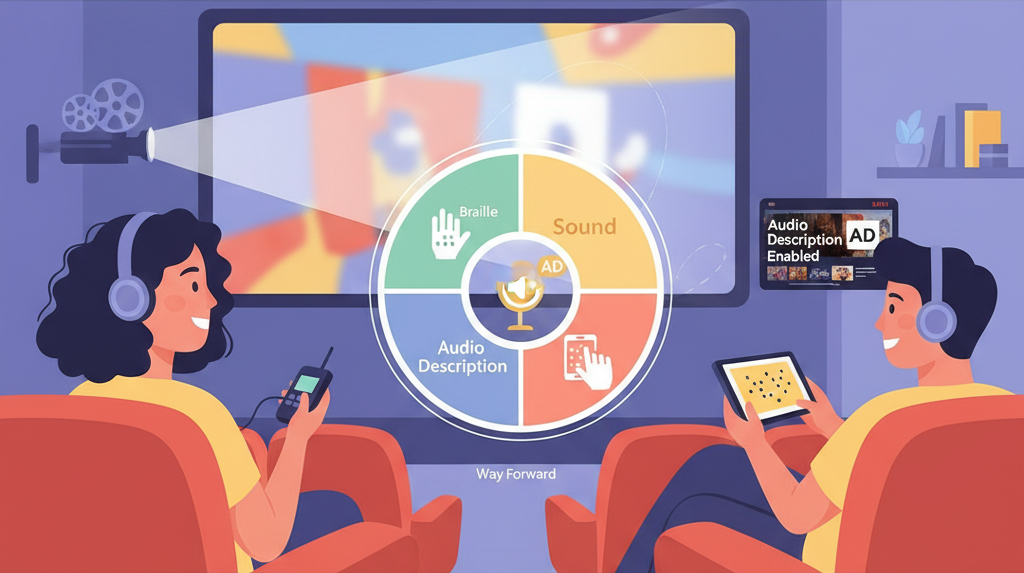
Visually impaired people use various methods to enjoy cinema and visual media:
Touch: Feeling props, tactile models, or Braille scripts.
Sound: Enhanced listening for audio cues, dialogues, and music.
Audio Description (AD): A separate narration describing visual elements.
Braille: Accessible scripts or subtitles in Braille for comprehension.
Alt text for image: Infographic of alternative ways for visually impaired individuals to enjoy movies
🎧 Audio Description: A Game Changer
In the 1980s, the Media Access Group at WGBH, Boston, developed audio description (AD) for PBS. AD provides a separate narration track describing visual elements such as settings, characters’ gestures, costumes, and actions. The narrator speaks during dialogue gaps to ensure visually impaired viewers don’t miss important details.
Alt text for image: Visually impaired person enjoying a movie with audio description
🍿 AD in Theaters
When visiting cinemas, visually impaired viewers can request transmitters and headphones to listen to the AD track. This enables them to enjoy movies as much as sighted audiences, especially during action sequences or complex scenes.
Alt text for image: Providing audio description equipment to visually impaired cinema-goers
📺 AD on OTT Platforms
Streaming platforms like Netflix, Amazon Prime, and Disney+ now offer audio-described content, allowing visually impaired users to experience films at home. AD ensures that cinema and TV shows are inclusive for all audiences.
Alt text for image: Audio-described movies for visually impaired users on OTT platforms
🌍 Global and Indian Context
Audio description is widely used worldwide in live theater, art galleries, and public events. In India, however, AD adoption has been slow, possibly due to production costs. NGOs like Saksham, along with UNESCO’s Accessible India Campaign, have promoted AD films at the 47th International Film Festival (IFFI), emphasizing the need for inclusive cinema.
Alt text for image: Accessible India campaign featuring audio-described films at IFFI
🛠️ The Need for Accessibility
Audio-described movies should be mandatory in theaters and OTT platforms. AD enhances understanding and enjoyment, making entertainment accessible to visually impaired individuals, promoting equality, social inclusion, and empowerment.
Alt text for image: Advocating for accessible cinema and audio-described movies
🧭 Conclusion
Audio description is a vital bridge that enables visually impaired audiences to enjoy cinema fully. By implementing AD universally, filmmakers, streaming services, and theaters can ensure inclusive entertainment, equal opportunity, and empowerment for all.