
To make public employment genuinely accessible, India must dismantle artificial percentage ceilings and align its infrastructure with modern standards of functional competence — and the time for incremental gestures is long past.
Somewhere between the intent of a law and its execution lies a chasm. In India, that chasm has cost over 26 million persons with disabilities — approximately 2.2% of the national population — a fair and dignified shot at public employment for decades. The culprit is not malice alone, but mathematics: an artificially imposed 4% disability reservation ceiling that reduces the full humanity of an applicant to a tokenistic slot on an administrative roster.
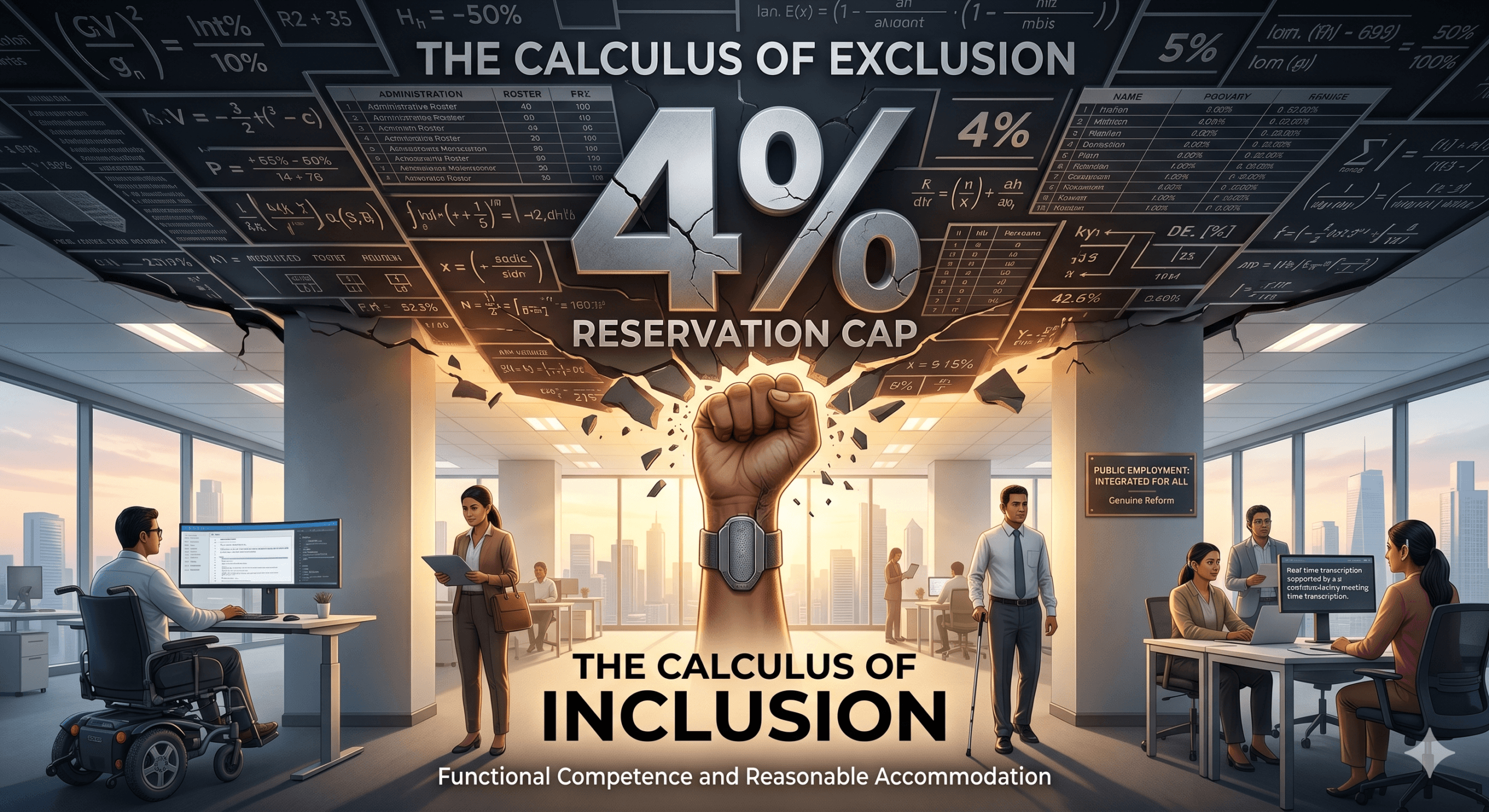
The Rights of Persons with Disabilities (RPwD) Act, 2016 — a landmark piece of legislation enacted after India ratified the United Nations Convention on the Rights of Persons with Disabilities (UNCRPD) — promised transformation. It expanded the recognised categories of disability from seven to twenty-one and raised the reservation threshold in government jobs from 3% to 4%. It was progress, yes — but progress calibrated in fractions, while the structural machinery of exclusion remained untouched and largely unchallenged.
The Disability Reservation Ceiling: The Arithmetic of Injustice
The 4% ceiling is not merely a number — it is a worldview encoded in policy. It carries the implicit assumption that disability is a marginal condition, an administrative exception rather than a dimension of human diversity that public institutions must genuinely and proactively accommodate. The Department of Empowerment of Persons with Disabilities (DEPwD) has repeatedly acknowledged implementation shortfalls in its own reports, yet the systemic scaffolding required to bridge those gaps — accessible examination centres, adaptive technologies, sensitised interview panels — remains largely theoretical and unevenly distributed across the country.
Consider the compounded barriers that a candidate with a locomotor disability must navigate: examination venues that violate basic accessibility norms, digital portals that fail WCAG international accessibility standards, and evaluation committees ill-equipped to assess functional competence independently of visible impairment. Each checkpoint operates as an unofficial filter, dramatically shrinking the effective talent pool before any formal reservation quota is even applied. The ceiling, in this sense, does not merely cap inclusion — it collapses the pipeline that leads to inclusion in the first place.
Research published in the Economic and Political Weekly has found that actual representation of persons with disabilities in central government employment consistently hovers well below the mandated reservation threshold — not because qualified candidates are scarce, but because the recruitment ecosystem itself is hostile. Announcing a percentage target means little when the physical infrastructure, technological accessibility, and attitudinal readiness to fulfil that percentage are absent at every stage of the process.
What Does the Law Actually Guarantee?
Under RPwD Act 2016, Section 34, every government establishment must reserve not less than 4% of vacancies for persons with benchmark disabilities. The Act also mandates accessibility standards for physical infrastructure and digital government services. If fully enforced, these provisions would fundamentally transform hiring and workplace practices across all central ministries, state departments, and public sector undertakings — creating genuinely inclusive institutions rather than institutions that meet a numeric minimum on paper.
Functional Competence Over Categorical Thinking
The deepest structural flaw in India's current approach is its dependence on categorical diagnosis rather than functional assessment. A candidate is evaluated primarily for what a medical certificate says they cannot do — inferred from a diagnostic label — rather than for what they demonstrably and professionally can. This approach directly contradicts the International Labour Organization's framework for inclusive employment, which centres task-based evaluation and employer-side reasonable accommodation as the twin, non-negotiable pillars of accessible hiring practice.
Nations that have made genuine strides — such as the United Kingdom through its Disability Confident scheme and Germany through its Federal Participation Act — have deliberately shifted from applicant-side quota models toward employer-side mandates coupled with tangible incentive structures. The philosophical and practical transformation is significant: instead of asking "how many disabled people must we hire to satisfy a legal minimum?", the governing question becomes "what must we fundamentally change about our institution so that a qualified person with any disability can perform this role effectively, equitably, and with dignity?" The moral and institutional burden moves from the candidate to the organisation — where it has always belonged.
Infrastructure, Accountability, and the Accessible India Promise
India's Accessible India Campaign (Sugamya Bharat Abhiyan), launched in December 2015 with considerable political fanfare, set ambitious targets for making government buildings, transport systems, and digital infrastructure accessible to all. Progress has been demonstrably inconsistent. A 2023 performance audit by the Comptroller and Auditor General of India flagged significant and recurring lapses in accessibility retrofitting across central government offices — the very workplaces into which reserved employees are being ostensibly recruited. Hiring persons with disabilities into structurally inaccessible workplaces is not inclusion; it is bureaucratic optics wearing the costume of social justice.
A Blueprint for Real Reform
Genuine reform demands that India decouple reservation percentages from the broader goal of substantive representation. The 4% figure must be treated as a minimum floor — a threshold below which no government establishment may legally fall — while individual departments develop higher, role-specific targets grounded in workforce plans and accessibility audits. Simultaneously, post-recruitment support infrastructure must be treated as non-negotiable: assistive technology provisions, accessible transport, mentorship pathways, and sensitised HR processes are not optional extras but foundational commitments.
The political economy of this reform matters enormously. Disability rights rarely generate the sustained political heat that other reservation debates command. The disability community in India, despite its scale, remains politically fragmented — a consequence of the very marginalisation that policy is supposed to remedy. Organisations like the National Centre for Promotion of Employment for Disabled People (NCPEDP) and civil society networks such as Disability India Network have long and credibly advocated for systemic overhaul. Their advocacy deserves legislative response, not administrative deferral.