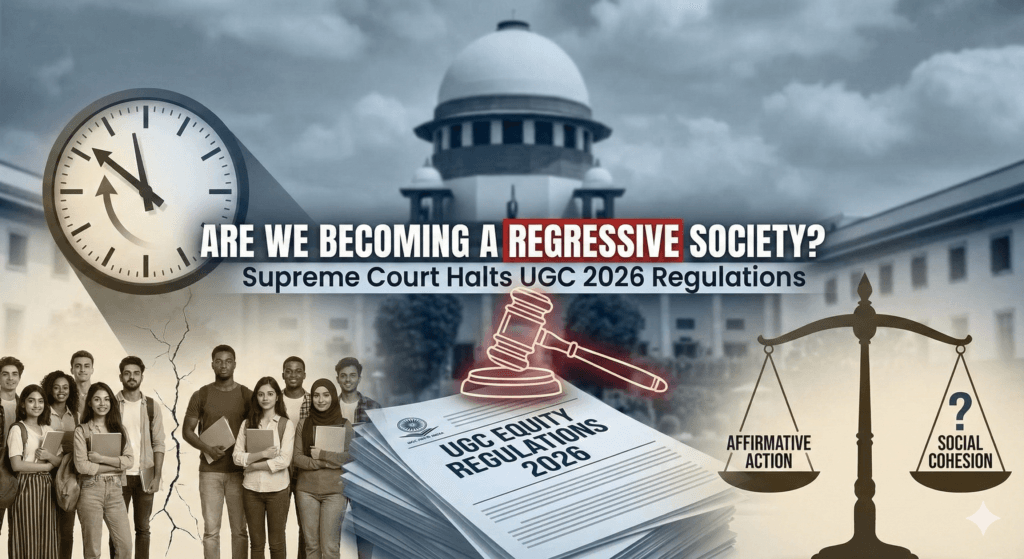
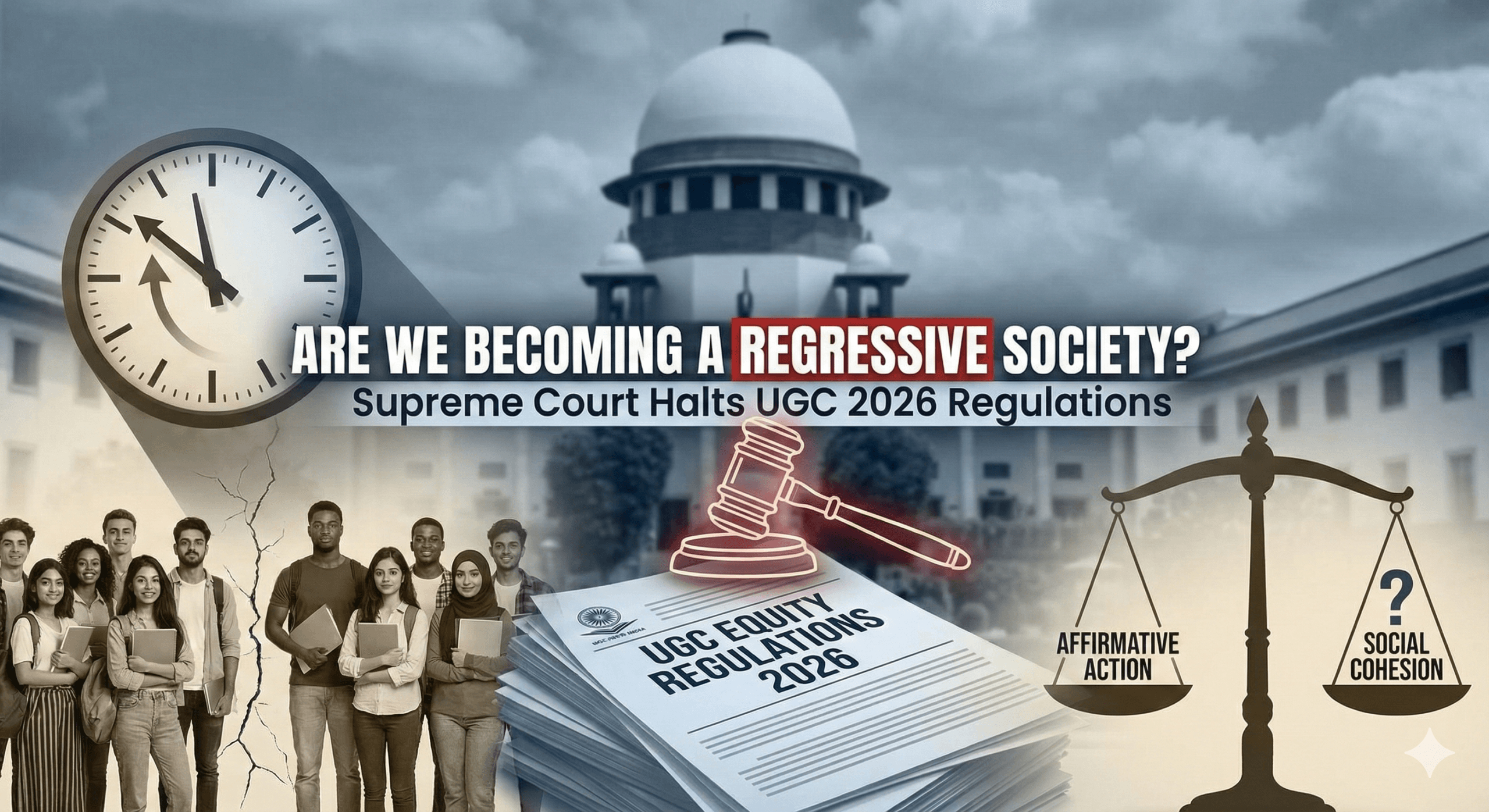
“Are We Becoming a Regressive Society?”: Why SC Halted UGC Equity Regulations 2026
Chief Justice Surya Kant and Justice Joymalya Bagchi halt the new rules.
Executive Summary
The Supreme Court of India has placed an interim stay on the newly notified UGC Equity Regulations 2026, warning they suffer from “complete vagueness” and could deepen social fractures. Educational institutions have been ordered to immediately revert to the 2012 framework to prevent “dangerous consequences.”
The Core Controversy: A “One-Way” Definition?
The primary legal challenge lay in Clause 3(c) of the new regulations released by the University Grants Commission. The rules defined “caste-based discrimination” exclusively as acts committed against members of Scheduled Castes (SC), Scheduled Tribes (ST), and Other Backward Classes (OBC).
Petitioners argued that this specific framing of the UGC Equity Regulations 2026 was exclusionary and violated Article 14 (Right to Equality). By legally presuming that discrimination is strictly unidirectional, the rule theoretically left students belonging to the “General Category” without a statutory remedy for caste-based harassment or bullying. This created a significant legal blind spot, suggesting that harassment is only a punishable offense when the victim belongs to a reserved category, thereby failing the test of universal protection.
The “Segregation” Alarm
Perhaps the most severe rebuke from the bench was directed at Regulation 7(d), which discussed the “selection, segregation, or allocation” of hostels and common spaces. The judges expressed deep concern that the UGC Equity Regulations 2026 used language that could inadvertently legitimize separate living spaces under the guise of “protection.”
Key Observations from the Bench:
- ■ Justice Joymalya Bagchi: “I hope we don’t go to segregated schools like the US, where blacks and whites went to different schools. Education is meant to be a melting pot, not a series of compartments.”
- ■ CJI Surya Kant: “For God’s sake… There are inter-caste marriages also. We should move towards a casteless society by assimilating students, not dividing them. These regulations seem to do the opposite.”
“Regressive” Policy & Regional Bias
The Court pointed out that while the UGC Equity Regulations 2026 focused heavily on caste identities, they failed to address other rampant forms of campus bias. Specifically, the bench highlighted the “North-South divide” and the persistent discrimination against students from the Northeast, which often manifests as linguistic or cultural alienation.
The bench noted that “ragging” often stems from these cultural clashes and regional prejudices. However, the UGC Equity Regulations 2026 lacked the explicit anti-ragging integration and regional sensitivity found in previous guidelines. By narrowing the definition of “equity,” the commission may have accidentally sidelined victims of non-caste-based bullying. At Vijay Foundation, we believe safe, inclusive campuses are a fundamental right for every student. Read more about our educational initiatives on our About Us page.
Comparative Analysis: 2012 vs. 2026
| Feature | UGC Regulations 2012 (Restored) | UGC Regulations 2026 (Stayed) |
|---|---|---|
| Nature | Advisory & Broad. Focused on healthy social guidelines. | Mandatory & Punitive. Introduced strict institutional penalties. |
| Protected Groups | Universal. Protected any student from harassment. | Specific. Strictly limited to SC, ST, and OBC. |
| Infrastructure | Encouraged mixed living and social integration. | Introduced terms like “segregation,” raising legal fears. |
Conclusion: The Path Forward
The Supreme Court’s stay is not a denial of the persistent problem of caste discrimination in India, but rather a sharp critique of the method proposed to solve it. The bench emphasized that the UGC Equity Regulations 2026 appeared to institutionalize identity-based divisions rather than dismantling them. For the time being, educational institutions across the country must return to the 2012 norms to ensure administrative and social stability.
The Court has suggested constituting an expert committee composed of sociologists and legal experts to “modulate” the language of the UGC Equity Regulations 2026. The goal is to ensure the final framework protects all students from harassment and bullying while preventing the “institutionalized segregation” that the bench warned could lead to a more fractured society.
For more deep dives into legal reforms, student welfare, and the future of Indian education, visit our Home Page for the latest updates.
Share This Investigation
Help us spread awareness about critical education reforms and legal updates.