
Geographic Discrimination vs. Commercial Necessity: The CCI’s Tightrope Walk
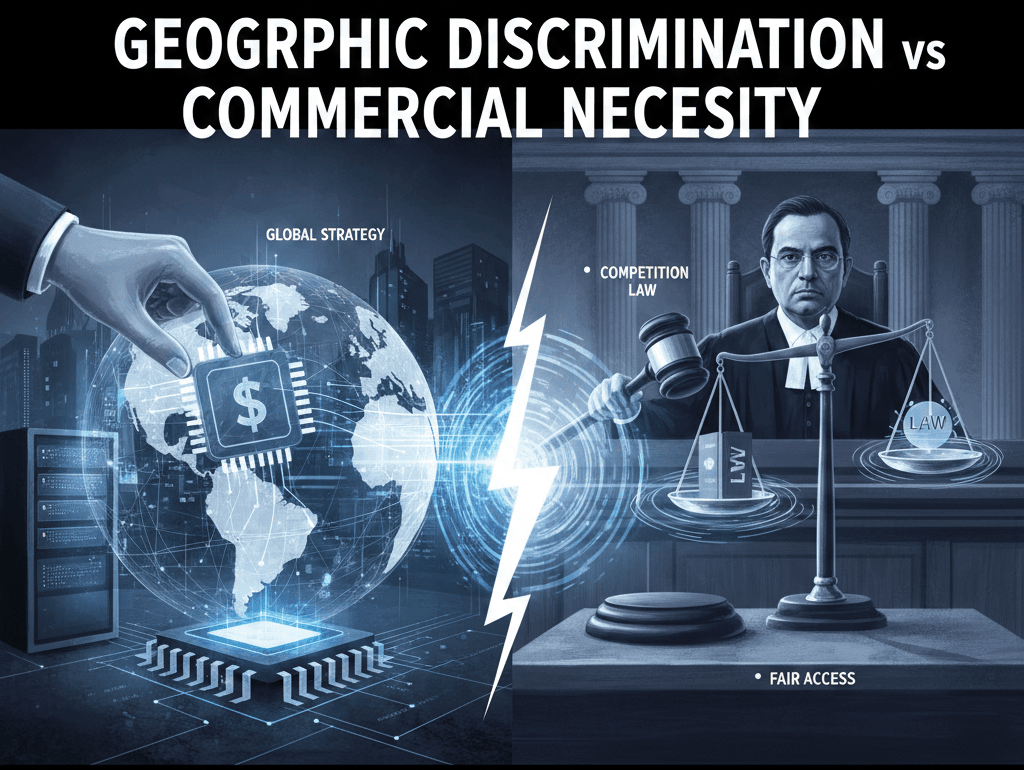
Analyzing the thin line between fair competition and geographic business tailoring in the Intel warranty case.
The landmark verdict in Matrix Info Systems v. Intel Corporation has fundamentally shifted the landscape of Indian anti-trust jurisprudence. The Competition Commission of India (CCI) recently concluded this high-stakes battle, imposing a penalty of ₹27.38 crore on the tech giant. At its core, the dispute explores a profound legal dilemma: When does a global company’s localized warranty policy transform from a strategic choice into illegal “geographic discrimination”?
The dispute in Matrix Info Systems v. Intel Corporation centered on Intel’s policy between 2016 and 2024, which restricted local warranty support for genuine processors purchased from international markets. While the CCI identified this as an abuse of dominance under Section 4 of the Competition Act, the ruling has ignited a global debate on where Commercial Necessity ends and Anti-Competitive Abuse begins.
Matrix Info Systems v. Intel Corporation: Protecting the Indian Consumer
The Commission’s reasoning in the Matrix Info Systems v. Intel Corporation case was built on the principle that dominant entities hold a “special responsibility” to ensure market fairness. By comparing Intel’s India policy with its operations in Australia and China—where global warranties were fully honored—the CCI concluded that the India-specific restrictions were discriminatory. This landmark decision ensures that Indian consumer rights are not compromised by multi-national corporate policies.
Key Violations Identified by the CCI:
- Section 4(2)(a)(i): Creating discriminatory conditions by treating identical microprocessors differently based solely on the geography of purchase.
- Section 4(2)(b)(i): Limiting the market for consumers who seek global price parity, thereby hindering technical and economic progress in the local sector.
- Section 4(2)(c): Effectively denying market access to parallel importers. In Matrix Info Systems v. Intel Corporation, the CCI noted that even as the market grew, these importers faced declining sales because they could not provide the “peace of mind” that comes with a manufacturer’s warranty.
The Defense of Necessity in the Intel Case
Intel’s defense during the Matrix Info Systems v. Intel Corporation proceedings rested on the reality of global trade: markets are not homogeneous. The company argued that supply chain integrity and the mitigation of grey markets required a localized approach. They maintained that efficiency in a developing market like India necessitates specific infrastructure that global models might not support.
However, the CCI dismissed these claims, emphasizing that Intel possesses the technology to verify genuine chips regardless of their origin. The ruling in Matrix Info Systems v. Intel Corporation serves as a reminder that “Commercial Necessity” cannot act as a shield for practices that stifle international price competition. At Vijay Foundations, we believe such transparency is vital for a healthy economic ecosystem.
Global Impact and Future Precedents
The implications of Matrix Info Systems v. Intel Corporation reach far beyond the hardware industry. It sends a stern message to all Original Equipment Manufacturers (OEMs): warranty and after-sales service are no longer “secondary” issues—they are primary tools of competition. If a brand is marketed globally, the CCI expects its support system to be equally borderless. For businesses operating in India, the burden of proof has shifted; any geographic differentiation must now be justified by objective, non-exclusionary data.
The Risk of a “General Parity Code”
Despite the victory for importers in the Matrix Info Systems v. Intel Corporation matter, legal experts worry this could lead to a “General Parity Code.” If every regional variation is deemed discriminatory, global firms might hesitate to launch India-specific products. Following the Supreme Court’s direction in Schott Glass India, the CCI must maintain an effects-based analysis:
- ■ Relevant Market: If the legal focus is “India,” to what extent should foreign policies dictate local law?
- ■ Harm vs. Efficiency: Does the policy genuinely harm competition, or does it provide a sustainable service model?
Conclusion
The Matrix Info Systems v. Intel Corporation case marks a new era where the CCI refuses to let India be treated as a secondary market. For global giants, the mandate is clear: innovate locally, but compete globally. For further analysis on competition law and corporate governance, visit our Legal Insights Resource Center.
Share This Legal Investigation
Help us spread awareness about critical commercial rights and competition law updates.