"More Loyal
Than the King" —
And the Prisoners
Who Pay for It
A sitting Supreme Court judge has just named the elephant in the courtroom: the more loyal than the king syndrome is actively denying bail even in deserving cases — and 4.4 lakh undertrial prisoners, most of them poor, Dalit, and tribal, are spending years in overcrowded jails for it.
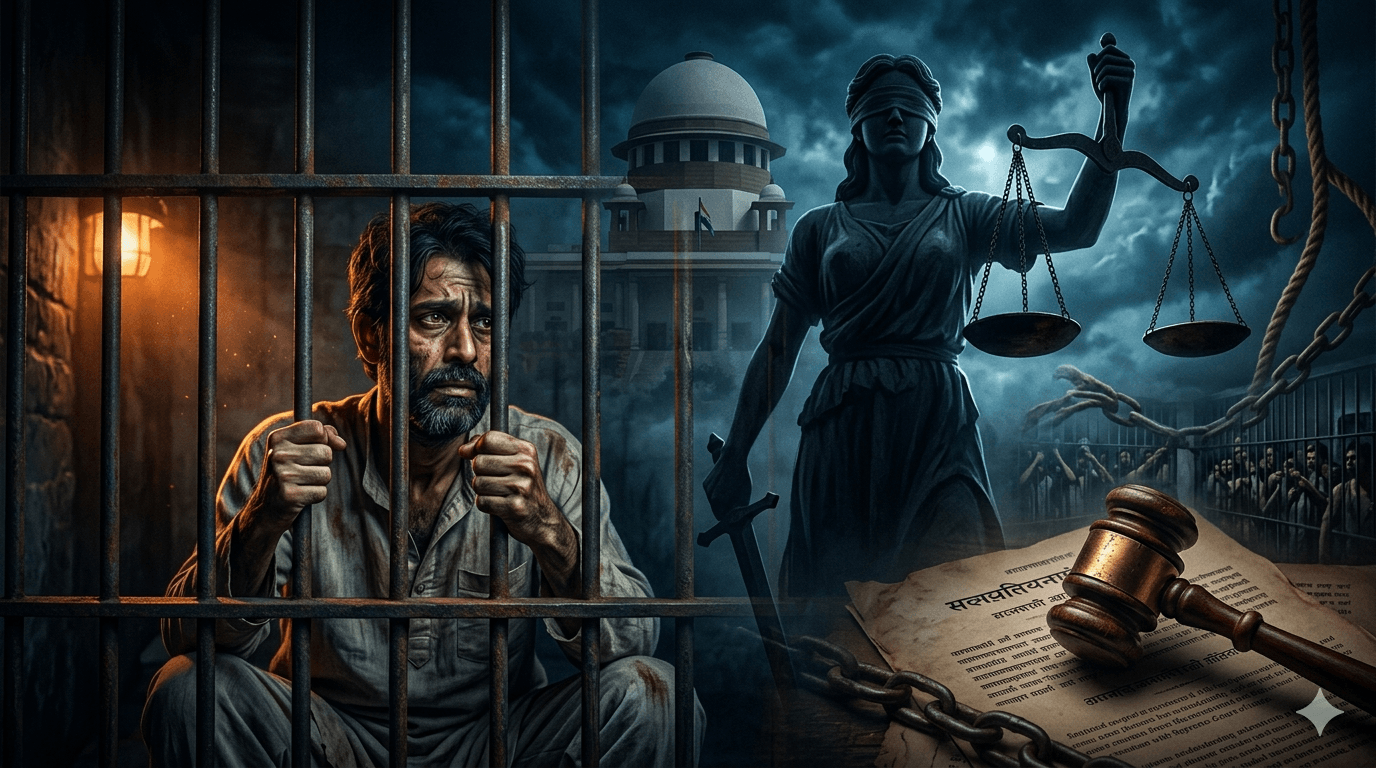
"I must admit — many within the judiciary continue to suffer from the 'more loyal than the king' syndrome. As a result, people continue to languish in jails for months and months together."— Justice Ujjal Bhuyan, Supreme Court of India · March 22, 2026 · SC Bar Association National Conference
When a sitting judge of India's Supreme Court stands before a national conference and publicly admits that parts of the judiciary itself are betraying the cause of liberty — you stop and pay attention. On March 22, 2026, Justice Ujjal Bhuyan did exactly that. With data, with precision, and with a phrase that cuts like a verdict: the more loyal than the king syndrome. This powerful indictment deserves every Indian's attention — because 4.4 lakh undertrial prisoners are paying the price for it.
The more loyal than the king syndrome is damning in its specificity. It does not accuse the judiciary of taking orders. It accuses it of something worse — of having so deeply internalized the security-state mindset that it has become the state's most enthusiastic jailer, even when the state itself has not asked for it. Judges denying bail in deserving cases. Not because the law demands it. Not because the facts require it. But because a culture of deference — to power, to the police chargesheet, to the mere invocation of PMLA or UAPA — has become the default setting in far too many courtrooms.
The law says bail is the rule and jail is the exception. The culture in many courtrooms has quietly reversed this principle — and lakhs of uncelebrated lives are being destroyed as a result.
Behind Justice Bhuyan's warning about the more loyal than the king syndrome are not abstractions. They are people. There are, as of the latest data, approximately 4.4 lakh undertrial prisoners in Indian jails — accounting for a staggering 76% of the total prison population. These are not convicts. These are accused persons — legally presumed innocent under Article 21 of the Constitution — who are locked away while the system decides, at its own glacial pace, whether they did anything wrong at all.
This analysis by Adv. Mamta Shukla at Vijay Foundations is not a critique of every judge or every court. It is an examination of a systemic culture — the more loyal than the king syndrome — that Justice Bhuyan has now placed on the official record. It asks what this syndrome is, where it comes from, who it crushes, and critically, how it can be fixed.
Section 1: What Is the "More Loyal Than the King" Syndrome?
The phrase itself has a long political history. In British India, "more loyal than the king" described Indian bureaucrats and local administrators who enforced colonial rule more zealously than the British officers who wrote the rules. They weren't compelled — they volunteered their excessive compliance, often to signal their own reliability to power. Today, this more loyal than the king syndrome has found a new home: inside India's courts.
Justice Bhuyan applied this phrase to a contemporary judicial phenomenon: judges who reflexively deny bail, refuse to independently evaluate police chargesheets, and treat the invocation of draconian laws — like the PMLA and UAPA — as sufficient grounds for indefinite pre-trial detention. They are not following mandatory instructions. They are choosing a posture of alignment with prosecutorial power that the law itself does not require of them.
The Supreme Court has repeatedly held — from Hussainara Khatoon v. State of Bihar (1979) to Satender Kumar Antil v. CBI (2022) — that bail is the rule and jail is the exception, and that the right to a speedy trial is a fundamental right under Article 21. A court denying bail after prolonged detention without trial is not just harsh — it is constitutionally suspect. The judges exhibiting the more loyal than the king syndrome are not following a legal mandate. They are substituting a security-state preference for constitutional principle.
Justice Bhuyan also highlighted a parallel troubling trend: the reckless registration of FIRs for trivial matters — public demonstrations, student agitations, social media posts, and memes. The pattern that emerges is a conveyor belt: over-criminalize at the entry point, then deny bail at the court stage. The result is pre-trial incarceration that the Constitution never intended and the judiciary was designed to prevent.
Section 2: The Numbers That Make This a Crisis
Justice Bhuyan did not speak in generalities when he warned of the more loyal than the king syndrome. He cited specific figures. And those figures tell a story of systemic failure so stark that every Indian citizen should hear them.
The PMLA Reality
As of March 31, 2025, the Enforcement Directorate had filed 7,771 Enforcement Case Information Reports (ECIRs) and made 1,031 arrests. Trials concluded in just 47 cases. Justice Bhuyan's question was rhetorical but devastating: how do you justify keeping people in jail for months and years when the maximum sentence for the offence is 7 years — and the trial hasn't even begun?
The UAPA Conviction Catastrophe
Data furnished by the Ministry of Home Affairs to the Lok Sabha reveals the true picture of UAPA — a law under which bail is nearly impossible to obtain:
| Year | Arrests Under UAPA | Convicted | Conviction Rate | Not Convicted |
|---|---|---|---|---|
| 2019 | 1,984 | 34 | 1.74% | ~98% |
| 2020 | 1,321 | 80 | 6% | ~94% |
| 2021 | 1,621 | 62 | ~3% | ~97% |
| 2022 | 2,636 | 41 | ~1.5% | ~98% |
| 2023 | 2,941 | 118 | ~4% | ~96% |
Justice Bhuyan's conclusion was precise: with a conviction rate of under 5% and a 95% chance of acquittal, why should accused persons be confined to jail for 5 or 6 years without charges even being framed? As he stated — this more loyal than the king syndrome cannot be a model for Viksit Bharat.
The Broader Undertrial Emergency
The PMLA and UAPA numbers sit atop a far wider undertrial catastrophe documented by the India Justice Report 2025. The decade from 2012 to 2022 saw prison population rise by 49% while prison capacity grew by only 27%. Fifty-five percent of Indian prisons are overcrowded. Twelve prisons operate at over 400% capacity. And in 301 prisons across the country, every single inmate is an undertrial — not one convict among them.
Section 3: Six Causes of the Syndrome
The more loyal than the king syndrome in bail matters is not an accident. It is the predictable output of a system shaped by multiple overlapping pressures. Understanding them is the only path to dismantling them.
Career Risk Aversion
A district judge who grants bail and the accused later absconds faces professional consequences. A judge who unjustly denies bail faces none. The system creates asymmetric risk that systematically punishes courage and rewards overcaution — producing bail denials as the path of least resistance.
Deference to Police Chargesheet
Many lower courts treat the filing of a chargesheet as near-conclusive proof of guilt rather than the beginning of a process. Independent judicial assessment of evidence quality — required before denying bail — is often replaced by uncritical acceptance of whatever the investigation agency presents.
Special Law Architecture
Laws like PMLA's "twin conditions" require accused persons to effectively prove their innocence at the bail stage itself. Courts then interpret these already-restrictive provisions maximally, creating virtually insurmountable bail barriers entirely contrary to constitutional liberty norms.
No Cost for Over-Detention
When an accused is jailed for 3 years and then acquitted, there is effectively no accountability for anyone in the system. The accused alone bears the full catastrophic cost: lost income, destroyed family, broken health, and social stigma that survives even full acquittal.
Caste and Class Blind Spots
The more loyal than the king syndrome hits hardest at those who cannot hire good lawyers, cannot navigate complex legal systems, and cannot reach the Supreme Court when a lower court wrongly denies bail. Structural biases mean this syndrome functions as a targeted weapon against the marginalised.
Media and Public Pressure
In high-profile cases framed in national security or anti-corruption terms, the media ecosystem creates parallel pressure on courts. Granting bail to a figure who has been demonized in 24-hour news coverage becomes politically charged. Judges, being human, are not immune to this atmosphere.
Section 4: Who Bears the Heaviest Burden?
The more loyal than the king syndrome does not fall equally on all Indians. Its weight is distributed with brutal precision along lines of caste, class, and community.
The Profile of India's Undertrial Prisoner
- ⚠73.8% belong to Scheduled Castes, Scheduled Tribes, or Other Backward Classes — the most marginalized communities are also the most imprisoned before any conviction.
- ⚠A significant majority cannot afford adequate legal representation. In Bihar, 60% of undertrials are from communities with no means to hire a lawyer or pay bail.
- ⚠Many are jailed for bailable offences — minor theft, public order violations — but cannot pay even modest bail amounts. The law permits their release; poverty traps them inside.
- ⚠Student protesters, journalists, activists, and dissidents — people exercising fundamental rights — are increasingly caught in the undertrial system under UAPA charges that carry a sub-5% conviction rate.
- ⚠In 301 Indian prisons, every single inmate is an undertrial. These facilities contain no convicts at all — only people awaiting a trial that may never come in time.
- ⚠By 2030, the India Justice Report projects the undertrial population will rise from 4.34 lakh to over 5.26 lakh — a crisis accelerating, not improving, because of the more loyal than the king syndrome left unchecked.
When 95% of those arrested under UAPA are not ultimately convicted, the law is not catching terrorists. It is catching people — and the judiciary's more loyal than the king syndrome is the lock on their cells.
Section 5: What the Constitution Actually Demands
The more loyal than the king syndrome is not just morally troubling. It operates in direct tension with settled constitutional law. The Supreme Court has produced a remarkable body of jurisprudence on undertrial rights — jurisprudence that many lower courts simply disregard in practice.
In Hussainara Khatoon v. State of Bihar (1979), the Supreme Court first recognised that the right to a speedy trial is a fundamental right under Article 21 — and that persons jailed longer than the maximum sentence for their alleged offence must be released immediately. In Satender Kumar Antil v. CBI (2022), the Court issued comprehensive bail guidelines, reiterating that bail is the rule and jail is the exception. These rulings are binding. And yet: 4.4 lakh undertrials, 11,448 of them detained for more than five years, tell us they are honoured primarily on paper.
"In Viksit Bharat, there should be more space for dissent and debate. Dissent should not be criminalised. There should be more tolerance towards divergent views and criticism."— Justice Ujjal Bhuyan · Supreme Court of India · March 22, 2026
Section 6: Seven Reforms That Could Actually Work
Justice Bhuyan's indictment of the more loyal than the king syndrome is powerful because it comes from within the institution. But naming the problem is only half the task. Here are the reforms that evidence and legal scholarship most strongly support — to build a judiciary where liberty is the first instinct, not the last resort.
- 01
Mandatory Bail Review Timelines
Parliament should legislate firm timelines: if a chargesheet is not filed within the statutory period, bail must be automatically granted by operation of law. If an accused has been detained beyond 50% of the maximum sentence without trial beginning, bail must be presumptively granted unless the prosecution can show extraordinary cause. The current system allows indefinite drift. Mandatory timelines would force courts to confront their own delays.
- 02
Reform PMLA's "Twin Conditions" for Bail
The PMLA requires accused persons to effectively prove their innocence at the bail stage. With 7,771 ECIRs filed, 1,031 arrests, and only 47 completed trials, laws whose bail conditions are harsher than their conviction record justifies are punishing the accused before trial rather than protecting society. Parliament must revisit these conditions in light of their documented real-world impact.
- 03
Institutional Accountability for Over-Detention Patterns
There must be a formal, corrective process — not punitive — by which judges who systematically exhibit the more loyal than the king syndrome are identified. Currently, the asymmetric risk structure rewards denial and punishes grant. This must be rebalanced through judicial performance metrics that include over-detention outcomes alongside other measures of court efficiency.
- 04
Expand and Empower Undertrial Review Committees
UTRCs have increased releases from 3% in 2019 to 6% in 2022 — a movement in the right direction that remains an indictment in absolute terms. Every district must have a functioning UTRC with real resources, legal aid, and binding monthly reporting to the High Court. Magistrates should be evaluated partly on UTRC performance outcomes.
- 05
10,000 Additional Judges — Non-Negotiable
India has approximately 21,000 judges for 1.4 billion people — one judge per 50,000 citizens. Individual judges handling 2,000 cases cannot give bail decisions the attention constitutional principle requires. Without adequate judicial strength, every other reform addressing the more loyal than the king syndrome is performative. This is the infrastructure question that underlies the entire crisis.
- 06
Decriminalize Minor Offences and Expand Automatic Bail
A significant number of India's undertrials are jailed for offences that pose no threat to public safety — traffic violations, petty disputes, minor regulatory infractions. These should either be decriminalized or made automatically bailable with no financial surety requirement. Keeping a person in jail for 8 months for an offence carrying a 3-month sentence maximum is not criminal justice — it is institutional malfunction dressed as law enforcement.
- 07
UAPA Application Review: Data Must Govern Use
A law producing sub-5% conviction rates across five consecutive years is either being misapplied or poorly drafted. Either way, Parliament must review its scope, bail restrictions, and application patterns. Justice Bhuyan's call for dissent not to be criminalised speaks directly to this: if the more loyal than the king syndrome is being used to silence students, journalists, and social media users through UAPA, and 95% of those people are ultimately not convicted, the law is protecting no one — it is serving the syndrome.
If the more loyal than the king syndrome remains unchecked, the India Justice Report 2025 projects India's prison population will exceed 6.88 lakh by 2030 against a sanctioned capacity of only 5.15 lakh. The undertrial population alone is expected to climb to over 5.26 lakh. India already spends as little as Rs 47 per prisoner per day in some states — less than the cost of a cup of coffee — while warehousing unconvicted citizens for years. This is not just a constitutional crisis. It is a fiscal and humanitarian catastrophe in slow motion.
The Verdict Is On The System
Justice Bhuyan spoke on March 22, 2026 — the day before Martyrs' Day, the anniversary of Bhagat Singh's execution by a colonial state that also believed in locking people away without fair trial. The historical resonance is not accidental. The more loyal than the king syndrome he named is the colonial reflex wearing a democratic costume.
India built its Constitution on the ruins of exactly this kind of system. Article 21 — the right to life and personal liberty — was not written as a suggestion. It was written as an unbreachable guarantee. When 4.4 lakh people sit in jails, unconvicted, many for charges whose evidence is so weak that 95% of similar cases end without conviction, that guarantee is being violated — not by a foreign colonial power, but by the republic's own institutions.
The judiciary was designed to be the last line of defence between the citizen and state overreach. When the more loyal than the king syndrome takes hold — when judges become more state-minded than the state itself — they fail not only the accused. They fail the Constitution they swore to uphold.
Justice Bhuyan said what needed to be said. The question now is whether the institution has the collective courage to cure the more loyal than the king syndrome — or whether 4.4 lakh people will continue to pay, in years of their lives, for a malaise their own courts have now admitted exists.