ICC Cannot Hide the Instigator: The Bombay High Court's Landmark POSH Ruling
When an Internal Complaints Committee selectively uses a retraction letter to close a case while hiding the identity of the person named as the instigator, it fails its own statutory duty — and the Bombay High Court has now said so, unequivocally.
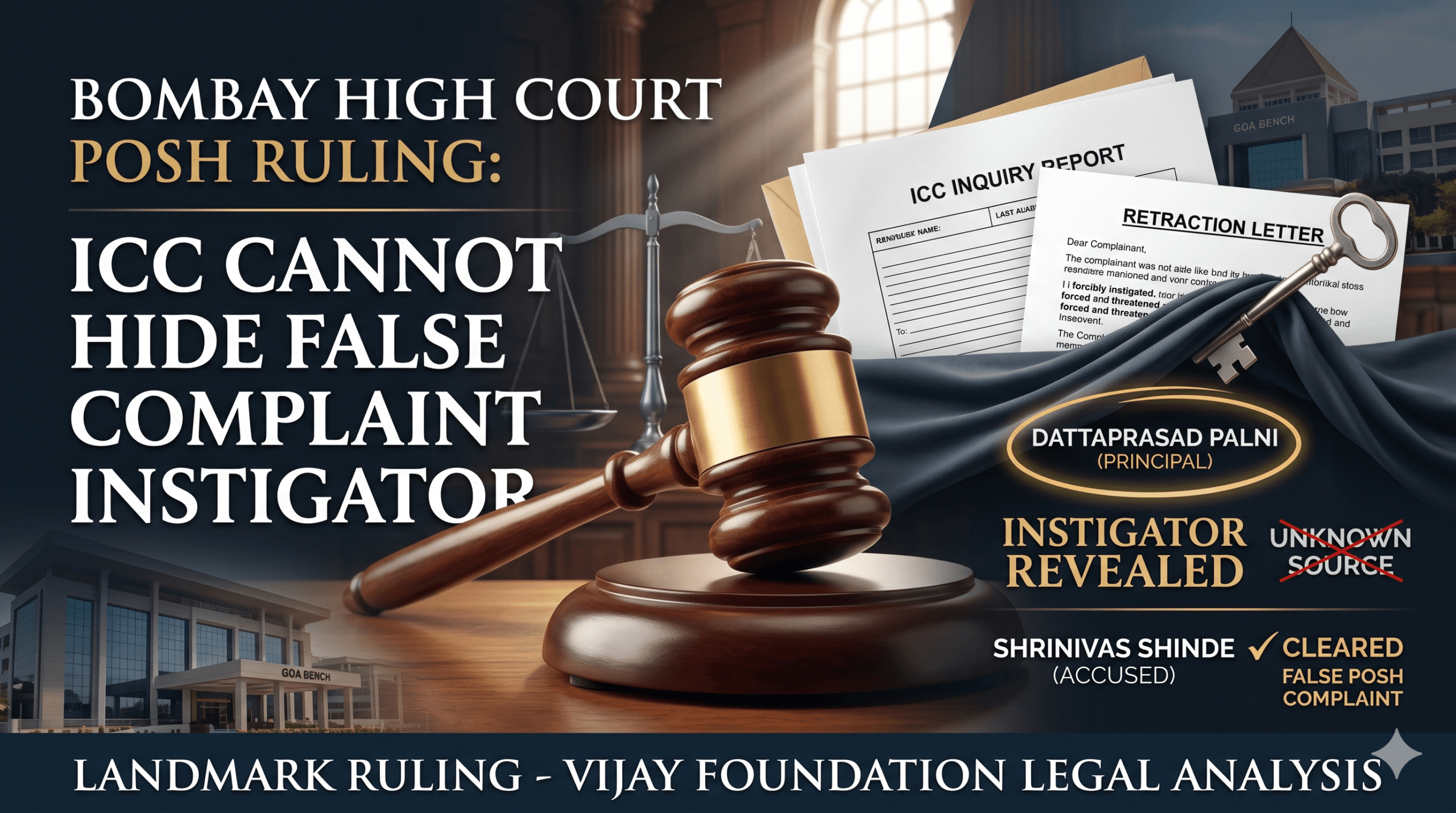
The false POSH complaint case at a glance
Shrinivas Shinde, a Lower Division Clerk at the Directorate of Skill Development & Entrepreneurship in Goa, found himself at the center of a false POSH complaint filed by a female colleague. The complaint, however, unraveled quickly — not because the accused mounted a strong defence, but because the complainant herself retracted it in a detailed letter dated January 6, 2025.
In that letter, the complainant stated she had been "forcibly instigated to sign on a pre-prepared sexual harassment complaint" against Shinde, and that she had been "forced and threatened" by the institution's Principal, Dattaprasad Palni, into doing so. The complaint, she said, was designed to defame Shinde and destroy his service career.
The case falls under the Sexual Harassment of Women at Workplace (Prevention, Prohibition and Redressal) Act, 2013 — popularly known as the POSH Act — which mandates every workplace with 10 or more employees to constitute an Internal Complaints Committee (ICC). At Vijay Foundation, we regularly conduct POSH awareness workshops precisely to prevent such misuse and institutional failures.
"I was forcibly instigated to sign on a pre-prepared sexual harassment complaint against my colleague Shri. Srinivass Shinde… at the instance of Shri. Dattaprasad Palni, Principal."
What the ICC did wrong
The ICC accepted the retraction. It closed the proceedings and classified the complaint as malicious. It also waived penalties against the complainant. So far, so reasonable. But here is where things went wrong: despite accepting a retraction that explicitly named the institute's Principal as the orchestrator, the ICC's final report described the instigator as an "unknown source."
In doing so, the ICC tried to have it both ways — rely on the retraction letter to close the case, while simultaneously ignoring the most damning part of that very letter. Shinde, now officially cleared but without acknowledgment of who had weaponized the POSH mechanism against him, challenged this before the Industrial Tribunal. The Tribunal dismissed his appeal as not maintainable. He then moved the Bombay High Court.
This kind of selective use of evidence by ICCs is precisely what our Free Legal Aid initiative educates workers about — ensuring both accused and complainants understand their rights under the POSH framework.
How the case unfolded
- 2024Complaint filedFemale colleague files a sexual harassment complaint against Shrinivas Shinde. ICC initiates preliminary inquiry under Section 9 of the POSH Act.
- January 6, 2025Complainant retractsShe submits a detailed retraction letter naming Principal Dattaprasad Palni as the person who prepared the complaint and coerced her into signing it under threat of "dire consequences."
- Early 2025ICC closes the case — partiallyICC classifies the complaint as malicious and closes proceedings. Waives penalties against the complainant but records the instigator as an "unknown source," omitting Palni's name entirely from its inquiry report.
- Mid 2025Industrial Tribunal dismisses appealShinde appeals under Section 18 of the POSH Act. The Tribunal dismisses it, holding the appeal is not maintainable since no "direct injury" has been shown.
- April 20, 2026Bombay High Court rulesJustice Dr. Neela Gokhale sets aside the Tribunal's order, modifies the ICC report to name Palni, and clarifies the limits of Section 14 of the POSH Act. Full text available on Bar & Bench.
What the court actually held
The ICC's conclusion shall now read: "Respondent No. 3 (Palni) instigated Respondent No. 4 (female colleague) to file a false sexual harassment case against the Petitioner." — Read full judgment coverage on LiveLaw
Breaking down the key legal findings
This judgment touches several distinct legal questions worth unpacking separately. Read the full text of the POSH Act 2013 alongside this analysis for complete context.
1. The consistency principle
The Court's most consequential observation is a principle of consistency: an adjudicatory body cannot selectively accept parts of a document while ignoring other parts of the same document. The ICC accepted the retraction to close the case but refused to accept the specific identification of the instigator within that very retraction. The Court held this was legally unsustainable.
2. Who is a "person aggrieved" under Section 18?
The Tribunal had dismissed Shinde's appeal on the ground that he suffered no "direct injury" since the complaint was already closed in his favour. The High Court rejected this reading. If the ICC's report contains an incorrect finding — even one that omits rather than explicitly implicates — the person who was the subject of the original complaint retains the right to challenge it. The omission of the instigator's name was itself the grievance.
This interpretation aligns with the Supreme Court's expansive reading of the POSH Act, which has consistently held that narrow interpretations of the statute's provisions create procedural and psychological barriers for all parties involved.
3. The limits of Section 14
Section 14 of the POSH Act allows penalties for a false POSH complaint or malicious intent. But the Court read the provision narrowly: it applies to the complainant (or whoever filed on her behalf), not to a third party who instigated the filing. The legislature did not extend Section 14 to instigators. This is a statutory gap the judgment explicitly acknowledges but declines to fill by judicial creativity — pointing Shinde to other available legal forums instead.
What this means in practice
- 1ICCs must be internally consistent. You cannot cherry-pick parts of a document. If you rely on a retraction to close a case, you must also record whatever that retraction reveals about the origins of the complaint. Vijay Foundation's POSH training programs cover ICC best practices in detail.
- 2Accused employees have broader appeal rights than previously understood. The Tribunal's "direct injury" test was wrong. Incorrect or incomplete findings in ICC reports can themselves constitute grievances under Section 18.
- 3Instigators fall through a legislative gap. The POSH Act's penalty framework does not reach third parties who orchestrate a false POSH complaint. Victims of such manipulation must seek remedies elsewhere — defamation, criminal intimidation, or departmental proceedings. Our Free Legal Aid team can guide you on the right forum.
- 4Power asymmetry is a real risk. The facts here — a senior principal allegedly coercing a junior employee to file a false complaint against a colleague — illustrate how the POSH mechanism can be weaponized by those with institutional power. This judgment is a corrective signal.
- 5Transparency in ICC reports matters. ICC findings become the record on which appeals are decided. Vague or deliberately incomplete language in those reports now carries legal risk for the committee. See the Ministry of Women & Child Development's ICC Handbook for reporting standards.
Vijay Foundation provides free POSH awareness workshops for organizations, schools, and government institutions across Delhi-NCR. If your workplace ICC needs training or guidance, reach out to us.
POSH Workshops Free Legal Aid Contact UsA statutory gap the legislature must address
The Court's refusal to stretch Section 14 to cover instigators is legally sound — but it exposes a real gap in the POSH architecture. The Act was designed to protect women from harassment. It was not designed to anticipate situations where a woman is herself a victim of coercion — forced to become the instrument of a false POSH complaint by someone who is not the accused and not the subject of the complaint.
In such scenarios, the complainant is as much a victim as the accused. The instigator — who may be the most morally culpable actor in the entire episode — escapes POSH consequences entirely. The judgment is candid about this. Shinde is told he may pursue "appropriate proceedings before a competent forum," but no such dedicated mechanism exists within the Act itself.
The Supreme Court's August 2025 direction ordering a district-level POSH compliance survey signals the apex court's close attention to implementation gaps. A legislative amendment to Section 14 extending its scope to instigators would be a logical next step. Vijay Foundation has been advocating for stronger workplace safety frameworks through our grassroots programs.
In summary
The Bombay High Court has drawn a clear line: an ICC that accepts a retraction letter must accept all of it — including the parts that are inconvenient or politically sensitive. Omitting a named instigator from the record is not caution; it is an error. The ruling strengthens procedural accountability of ICCs while honestly acknowledging the legislative limits of Section 14. For HR practitioners, legal compliance officers, and those advising on POSH implementation, the message is straightforward: completeness and consistency in ICC findings are not optional.