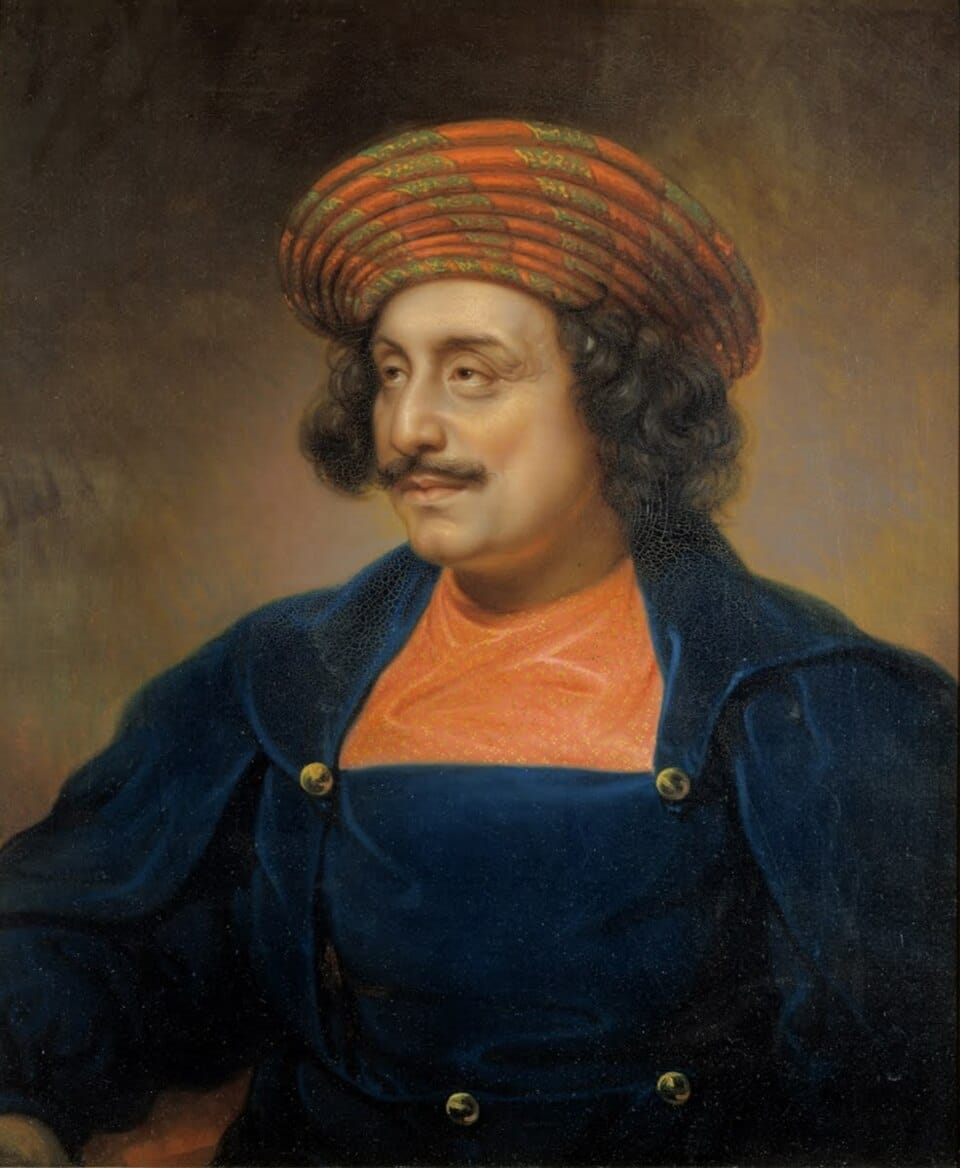
Imagine a time when a widow was not allowed to grieve in peace — when society demanded she follow her husband into the flames. Imagine a land brilliant with ancient philosophy, yet suffocating under the weight of superstition and rigid orthodoxy. Now imagine one man — solitary, relentless, and blazingly clear-eyed — deciding that enough was enough. That man was Raja Ram Mohan Roy, and what he did in his sixty-one years on earth still shapes the India we live in today.
Born on 22 May 1772 in the village of Radhanagar, Hooghly district, Bengal — the same date we mark his birth anniversary today — Ram Mohan Roy did not merely reform; he re-imagined what India could be. Rabindranath Tagore called him a "luminous star in the firmament of Indian history." History has gone further, calling him the "Father of Indian Renaissance" and the "Father of Modern India."
The Making of a Revolutionary Mind
Ram Mohan was born into a prosperous, orthodox Brahmin family — a milieu that could have easily made him a defender of tradition. Yet from his earliest years, something rebellious stirred within him. By the age of fifteen, he had already mastered Bengali, Persian, Arabic, and Sanskrit — and with each language came a new worldview that challenged the last.
He was sent to Patna for advanced studies in Persian and Arabic, where he read the Quran, the works of Plato and Aristotle in Arabic translation, and the mystical poetry of Sufi saints. Later, in Varanasi, he dove deep into the Vedas, Upanishads, and Hindu philosophy. He would eventually learn Hebrew and Greek purely to read the Bible in its original texts — a breathtaking intellectual commitment that shows just how seriously he took the pursuit of truth.
"He was not anti-Hindu — he was anti-hypocrisy. He loved the Vedantic core of Hinduism; he despised the corrupt practices layered over it across centuries."
His questioning of idol worship at a young age reportedly caused a fierce family conflict, and he left home for a period, wandering across the subcontinent. These travels exposed him to the full breadth of India's diversity and suffering — and lit a fire in him that would never go out.
The Reformer Awakens: 1814 and Beyond
From 1814 onwards, Ram Mohan Roy devoted his life entirely to religious, social, and political reform. He had spent years as a revenue official under the East India Company — close enough to British power to understand it, independent enough to resist its cultural arrogance. Now, he turned his formidable mind toward the twin crises of colonial subjugation and internal social decay.
He was among the first Indians to recognize that India's weakness before colonialism was partly fuelled by the chains it had placed on its own people — the oppression of women, the rigidity of caste, the tyranny of superstition. Liberate the Indian mind, he argued, and India would find its strength.
Against Sati & Child Marriage
Campaigned relentlessly for over a decade to end widow immolation and the marriage of young girls.
Against Caste Rigidity
Challenged the birth-based caste hierarchy, arguing it had no sanction in the original Vedic texts.
For Modern Education
Advocated science, mathematics, and English alongside Indian philosophy for a holistic education.
For a Free Press
Founded India's first vernacular newspapers and fought colonial censorship with constitutional arguments.
Abolishing Sati: A Battle He Made Personal
No achievement of Ram Mohan Roy's life carries more moral weight — or more personal anguish — than the abolition of Sati. This was the horrific practice by which a widow was compelled (often coerced, sometimes dragged) to throw herself onto the funeral pyre of her dead husband. It was celebrated in some quarters as an act of devotion. Roy saw it for what it was: murder dressed in ritual clothing.
In 1811, the horror struck Ram Mohan Roy's own household. His sister-in-law was forced onto the funeral pyre following his brother's death. He witnessed it. He could not stop it. That moment branded itself into his soul and transformed personal grief into political purpose.
"Of all the human sacrifices permitted in India, the most horrifying is undoubtedly that of the living wife on the funeral pile of the deceased husband."
— Raja Ram Mohan Roy, 1818For over a decade, he waged war on multiple fronts — writing pamphlets, confronting orthodox priests in open debate, petitioning colonial authorities, and mobilizing public opinion. He even translated Hindu scriptures to show that the texts did not sanction Sati; it was pure priestly manipulation.
His efforts culminated in a monumental victory: Governor-General Lord William Bentinck officially banned Sati on 4 December 1829 through Bengal Regulation XVII. When orthodox groups petitioned London to overturn the ban, Ram Mohan Roy personally traveled to England and argued the case before Parliament. The ban held. As a lawyer, I find this act of legal advocacy across continents — before modern transport or communication — nothing short of extraordinary.
Brahmo Samaj: The Soul of the Reform Movement
In 1828, Ram Mohan Roy founded what would become one of the most influential socio-religious movements in Indian history: the Brahmo Samaj (originally Brahmo Sabha). The name means "Society of God" — a congregation stripped of idol worship, caste distinctions, and empty ritual, founded on the bedrock principle that one God unites all humanity.
The Brahmo Samaj was not anti-Hindu — it was, in Roy's vision, a return to the true Hinduism of the Upanishads, purged of medieval distortions. It advocated:
Monotheism — worship of one formless God, rejecting idol worship and polytheistic rituals.
Equality regardless of caste, creed, or sex — radical for an era when a Brahmin's shadow could "pollute" a lower-caste man.
Opposition to polygamy and child marriage, and support for widow remarriage — positions that made enemies in every drawing room in Calcutta.
Interfaith dialogue — Roy's movement studied Christianity, Islam, and Hinduism with equal respect, seeking the common moral thread.
The Brahmo Samaj would go on to inspire India's greatest minds — including Rabindranath Tagore, Keshab Chandra Sen, and countless freedom fighters. It was not merely a religion; it was a social revolution wrapped in a prayer.
Champion of Modern Education
Roy understood something that many Indian intellectuals of his era resisted: the future would be shaped by science, reason, and empirical inquiry — not by blind devotion to ancient texts. He wanted India to embrace both its rich philosophical heritage and the best of Western learning.
He was a fierce advocate for English-medium education — not out of colonial submission, but because he recognized English as the gateway to medicine, law, science, and international discourse. When authorities proposed a Sanskrit college that would teach only traditional subjects, Roy penned a famous letter arguing that it would only "load the minds of youth with grammatical niceties" rather than preparing them for the modern world.
His educational legacy includes:
Women's Rights: The Loudest Voice in the Room
Long before the word "feminism" entered any Indian vocabulary, Raja Ram Mohan Roy was doing the work. His entire reform agenda was, at its heart, a campaign for the dignity and rights of women. He did not see women's liberation as a secondary concern — he saw it as the very foundation of a just society.
Beyond the abolition of Sati, he campaigned against:
Child Marriage
Fought against the marriage of girls before puberty, which destroyed childhoods and produced desperate widows.
Polygamy
Challenged the Kulin Brahmin practice of marrying multiple wives, which treated women as tradeable commodities.
Inheritance Rights
Argued that Hindu scriptures entitled women to inheritance rights — a legal argument far ahead of his time.
Right to Education
Believed women's education was non-negotiable and actively established schools open to girls.
As an advocate myself, I am struck by how Roy framed women's rights not just as moral imperatives but as legal claims — citing scripture, invoking natural law, and presenting rational arguments that colonizers and orthodox priests alike found difficult to dismiss. He was, in many ways, India's first women's rights lawyer.
Press Freedom: The Fourth Reform Nobody Talks About Enough
Ram Mohan Roy was not just a social reformer — he was a journalist and a fierce defender of press freedom. In an era when the colonial government routinely silenced Indian voices, he used the power of the printed word to shape public opinion and hold power accountable.
He founded some of India's earliest newspapers:
Sambad Kaumudi (Bengali) — one of the first Bengali-language newspapers, covering social issues, reform, and politics with fearless commentary.
Mirat-ul-Akhbar (Persian) — India's first Persian-language journal, aimed at the educated Muslim readership and advocating cross-religious understanding.
Fought Press Ordinance — when the British government passed the Press Ordinance of 1823 to censor newspapers, Roy submitted a formal petition to the Supreme Court and the Privy Council in London — one of the earliest recorded legal challenges to colonial censorship in India.
His argument — that a free press was essential to good governance and the enlightenment of the public — would echo through India's constitutional debates more than a century later. Article 19 of our Constitution, guaranteeing freedom of speech and expression, owes a distant but real debt to Ram Mohan Roy's lonely legal battle in 1823.
His Enduring Legacy: The India He Dreamed Of
Raja Ram Mohan Roy died on 27 September 1833 in Stapleton, Bristol, England — far from home, but never far from his purpose. He was in England as the ambassador of Mughal Emperor Akbar II, arguing for the rights of Indian subjects before the British Parliament. Even in death, he was on a mission.
His grave stands today in Arnos Vale Cemetery, Bristol — a pilgrim site for those who understand what he represented. In 2020, the city of Bristol unveiled a restored memorial to him, a recognition that his work transcended India's borders.
Within India, his legacy is woven into the fabric of modern life:
The abolition of Sati (1829), the founding of modern educational institutions, the establishment of the Brahmo Samaj, the campaign for a free press, and the demand for women's rights — every one of these threads runs directly into the Constitution of India, framed more than a century after his death.
He influenced Ishwar Chandra Vidyasagar (widow remarriage), Swami Dayananda Saraswati (Arya Samaj), and even the young B. R. Ambedkar, who would cite the Bengal Renaissance as the intellectual foundation for constitutional democracy in India. He inspired Mahatma Gandhi's methods of non-violent civil advocacy. He was, in the truest sense, the headwater of the river that became modern India.
And let us not forget: Ram Mohan Roy achieved all of this without a political party, without a mass movement in the modern sense, and without social media. He had a pen, a printing press, a ferocious intellect, and the moral clarity to know which side of history he stood on.
"What kind of a country do we wish to be?"
That is the question Ram Mohan Roy placed before India in the early 1800s. He answered it himself — with his entire life. An India that treats every human being with dignity. An India where women are free. An India where reason lights the way. That India is still being built. But it was Ram Mohan Roy who laid the first stone.
— Adv. Mamta Shukla, Vijay Foundations