
Empty Atriums, Empty Promises — What Dead Malls Reveal About Society, Law & Community Rights
From the economics of retail collapse to the invisible human cost borne by workers, women, and marginalised communities — a legal and social analysis of the global dead-mall phenomenon.
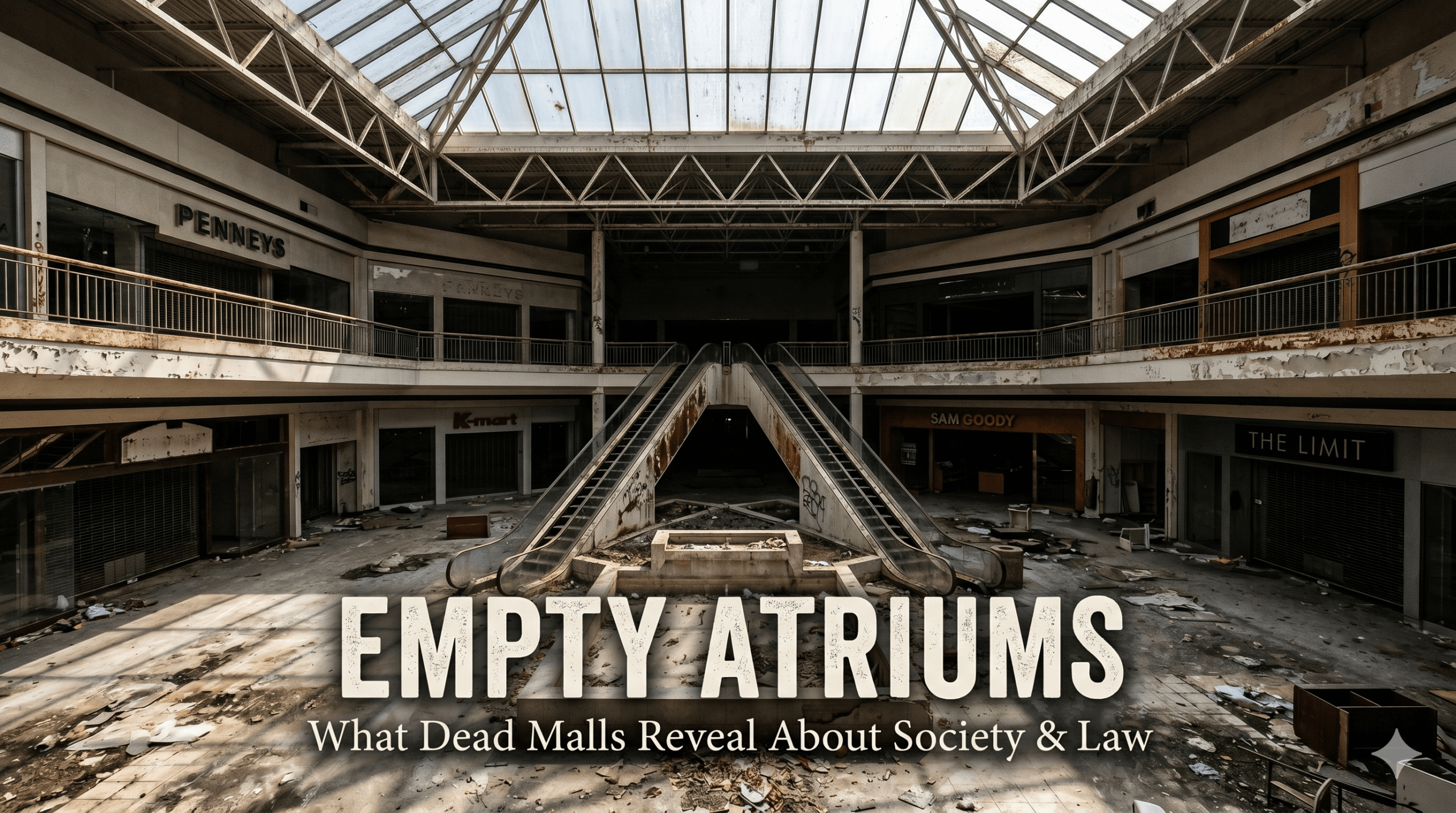
Walk into an abandoned shopping mall, and silence greets you like a verdict. The escalators stand frozen. The fountain — once the heartbeat of the atrium — has run dry. Sunlight falls through cracked skylights onto floors that last felt footsteps years ago. Store directories still list boutiques that shuttered a decade back. This is what economists politely call a "dead mall." But as someone who has spent years working at the intersection of law, human rights, and social equity, I see something more troubling in those empty halls: the physical architecture of broken promises to communities, workers, and women who depended on these spaces for their livelihoods and dignity.
The dead mall is not merely an economic curiosity — it is a social document. And it demands to be read.
The Utopian Dream That Built the Atrium
The enclosed shopping mall was not born from greed. It was born from a genuinely democratic, community-centred vision. Victor Gruen — an Austrian-Jewish architect who fled Nazi persecution — arrived in an America of sprawling, car-dependent suburbs horrified by the absence of communal gathering places. His solution was the enclosed mall, with its defining feature: the soaring, glass-capped atrium.
In 1956, Gruen's Southdale Mall in Edina, Minnesota opened — the world's first climate-controlled enclosed shopping centre. It featured a dramatic central atrium, escalators, two floors of retail, and even a garden with live birds. He envisioned it as the American equivalent of a European piazza: a true third place where communities could gather regardless of weather or social class.
"Gruen wanted to recreate the pedestrian experience of European cities — designing a place for community in the deserts of suburbia."— Architectural historians on Victor Gruen's vision
The irony cuts deep: Gruen later disowned the very concept he invented. Watching his utopian design metastasize into car-dependent retail monocultures, he returned to Vienna in 1968, bitter and disillusioned. But the mall — and its magnificent atrium — had already seduced the world. By 1986, 25,000 shopping malls of various sizes dotted the American landscape alone.
The Numbers Behind the Collapse
The decline of the shopping mall is one of the most dramatic commercial collapses in modern economic history. According to data from Capital One Shopping Research, from 1986 to 2017, an average of 764 malls closed every single year. Between 2017 and 2022, this accelerated to 1,170 closures per year. Today, around 1,150 malls remain — down from a peak of 25,000.
When a large anchor store (Sears, Macy's, JCPenney) shutters, it doesn't merely leave empty square footage — it removes the primary footfall magnet that sustained surrounding smaller retailers. Neighbouring stores experience a 30–40% drop in customer traffic within months. One closure triggers another — a "death spiral" that no mid-tier mall has escaped once it begins. This is not just an economic pattern; it is a community crisis affecting hundreds of employees and local suppliers simultaneously.
The Atrium: Architecture of an Era
Of all the spaces inside a shopping mall, none is more architecturally significant than the atrium. These towering interiors — sometimes rising six or seven storeys, capped with glass skylights — were designed to create a sense of occasion. Borrowing from 19th-century European arcades like the Galleria Vittorio Emanuele II in Milan, the atrium declared: this space is worthy of your presence.
In their emptied state, these design choices create something surreal. The same features that made atriums exciting — the echo, the scale, the dramatic quality of light — now produce an almost unbearable melancholy. A single footstep can be heard from fifty metres away. Pigeons nest in the rafters. Water stains map the slow failure of skylights. Time itself seems to have congealed.
"Their empty atriums, pastel storefronts, and retro signage feel like someone pressed 'pause' on an entire decade — nostalgic monuments to a cultural era that vanished almost overnight."— The Scroller, on the aesthetics of dead malls
- Rolling Acres Mall, Akron, Ohio: Once among America's largest malls, its glass atrium now admits sunlight through structural fractures, while original 1980s directory fonts remain eerily intact.
- Charlestowne Mall, Illinois: Skylights intact, teal interiors preserved — it looks precisely "like it is waiting for shoppers who will never return."
- Dixie Square Mall, Illinois: Abandoned since 1978, used as a film set for the original Blues Brothers. Its atrium has since fully collapsed under decades of neglect.
- Hawthorne Plaza Mall, Los Angeles: A 40-acre site shuttered in the late 1990s, visible from major highways as a concrete testament to retail mortality.
The Invisible Human Cost
Behind every vacant storefront inside these dead malls is a human story that rarely makes the economic headlines.A single large mall might employ 3,000 to 5,000 people: sales workers, cleaning staff, security personnel, food court vendors, maintenance workers, and administrative teams. A disproportionate share of these workers were women, young people, migrants, and members of marginalised communities — individuals for whom flexible retail employment represented not just income, but economic entry.
When a mall dies, these workers are rarely the ones who receive severance negotiations or transition packages. The formal retailer may offer some legal minimum. But the informal economy surrounding the mall — small food vendors, kiosk operators, daily-wage cleaning staff — simply loses its ground without recourse. This is where the gap between commercial law and social justice becomes most visible and most painful.
Women constitute the majority of retail sector workers globally. In India, mall employment has been one of the key pathways to economic independence for women from lower-middle-income urban households. When retail spaces close without adequate social protection frameworks, women absorb a disproportionate share of economic shock. Vijay Foundation's gender equality work consistently reveals that economic displacement is one of the most powerful drivers of vulnerability for women in Delhi-NCR. The proliferation of dead malls is not just an urban aesthetic problem — the closure of these retail hubs is directly a women's rights issue.
Legal Dimensions: Rights in Empty Spaces
Workers' Rights and Labour Law
Under India's Industrial Relations Code, 2020 and the Code on Social Security, 2020, workers in establishments above threshold sizes are entitled to prior notice of closure, gratuity, and provident fund settlements. However, informal retail workers engaged by small kiosk operators on casual contracts often fall entirely outside statutory protection — a legislative lacuna that demands urgent civil society attention.
Property and Tenancy Law
Retail lease agreements in India are governed by the Transfer of Property Act, 1882. When these properties transform into dead malls and landlords seek to redevelop, anchor tenants with long-term leases often have substantial legal protections — injunctive relief, damages. Smaller tenants, however, rarely negotiate equivalent protections and are frequently the first displaced.
Right to Fair Compensation and Urban Land Use
When dead malls are finally demolished and the land is repurposed — into apartments, tech campuses, or mixed-use complexes — questions of urban land rights come into sharp focus. India's Right to Fair Compensation and Transparency in Land Acquisition Act, 2013 provides frameworks primarily for government acquisition. The repurposing of private commercial property in ways that affect surrounding communities calls for a broader public-interest legal conversation.
The death of commercial retail spaces is never a purely private affair. These spaces were built on land that once belonged to communities, financed by banks with public deposits, operated by workers protected by public labour law, and patronised by citizens whose consumer taxes funded the surrounding infrastructure. When they fail, the community has a legitimate interest in how the aftermath is managed.
Vigorous enforcement of existing workers' rights legislation, proactive legal aid for displaced informal workers, and inclusive urban planning frameworks that centre housing and public use over speculative redevelopment are all achievable within existing legal architecture. What is missing is political will — and organised civil society pressure. This is precisely why organisations like Vijay Foundation exist: to bridge the gap between law on paper and justice in practice.
From Ruins to Revival: What Can Be Done
Communities and developers worldwide have discovered that a dead mall is not a problem — it is a canvas. The same vast floor plates, large parking areas, and dramatic atriums that defined retail commerce can serve entirely different social functions:
Not all malls are dying equally. According to Cushman & Wakefield, Class A malls generating over $500 per square foot annually maintained a healthy 5.6% vacancy rate in 2024. Indoor mall foot traffic rose 9.7% year-over-year in March 2024, exceeding pre-pandemic levels. Malls that reinvented themselves around experiences, dining, and community events are genuinely thriving. The lesson: spaces that serve community needs outlast spaces that merely serve commercial transactions.
The Indian Perspective: Malls, Markets & Social Equity
India's retail story is younger, but the growing phenomenon of dead malls is no less instructive.Organised retail expanded rapidly after 2000, with malls emerging as symbols of liberalisation and aspirational consumption across Delhi, Mumbai, Bangalore, and Hyderabad. By the mid-2010s, "ghost malls" — vacant, underperforming retail spaces — began emerging in Tier 2 and Tier 3 cities where development had outpaced purchasing power.
The India Retail Report documents consistently high vacancy rates, warning that the trajectory toward dead malls is accelerating in non-metro Indian cities like Lucknow, Kanpur, and Agra reporting vacancies exceeding 40–60%. Unlike in the U.S. where e-commerce is the dominant culprit, India's mall vacancies reflect a more complex interplay of over-supply, poor location planning, inadequate anchor strategy, and the persistent dominance of traditional kirana markets that continue to serve the majority of India's shoppers.
What is particularly concerning from a social-justice lens is the concentration of underperforming malls in areas where lower-middle-income communities had begun to access organised employment for the first time. In Delhi-NCR — where Vijay Foundation operates — several malls in outer ring areas house significant numbers of women workers in retail and food-service roles. The precarity of these employment relationships, combined with the structural fragility of the malls themselves, creates compounding vulnerability that our women empowerment programmes must be equipped to address.
Vijay Foundation's Free Legal Aid programme under Article 39A provides professional counselling on POCSO, RTI, disability rights, and labour rights — including workers navigating disputes from retail closures. Our POSH compliance and training ensures retail employers meet workplace safety obligations for women. And our social awareness campaigns address economic vulnerability caused by unplanned urbanisation. If you are a displaced retail worker needing legal guidance, contact us here.
What the Empty Atrium Truly Means
Stand in the centre of a dead mall atrium. Look up through the cracked skylight. What you are seeing is not simply a failed real estate investment. You are seeing the physical residue of a 20th-century promise — that abundance could be made communal, that commerce could sustain community, that a great glass-roofed space could be simultaneously a marketplace and a piazza.
The atrium — soaring, dramatic, democratic in its welcome — was the architectural statement of that belief. It said: this place matters, and so do you, for being here. Now those same spaces echo only with absence. We must ask what replaced them — and the honest answer is a screen, a click, a cardboard box on a doorstep.
As legal professionals, advocates, and civil society organisations, our role is to ensure that the conversation about dead malls is held not only in boardrooms and property meetings — but also in courtrooms, community halls, and legislative chambers where the rights of the most vulnerable are decided. The empty atrium should prompt us not merely to mourn, but to organise.
"The dead mall is not a ruin. It is an invitation — to reimagine who public space serves, and to fight for the communities that commercial logic left behind."— Adv. Mamta Shukla, Vijay Foundation