Investigative Brief · Parts I–III
2026 Guide to the Ethics of Smart Glasses & Digital Rights
How modern wearable technology is quietly dismantling the social contract of public visibility — and what we must do to restore it.
Introduction: The Unspoken Rule of Visibility
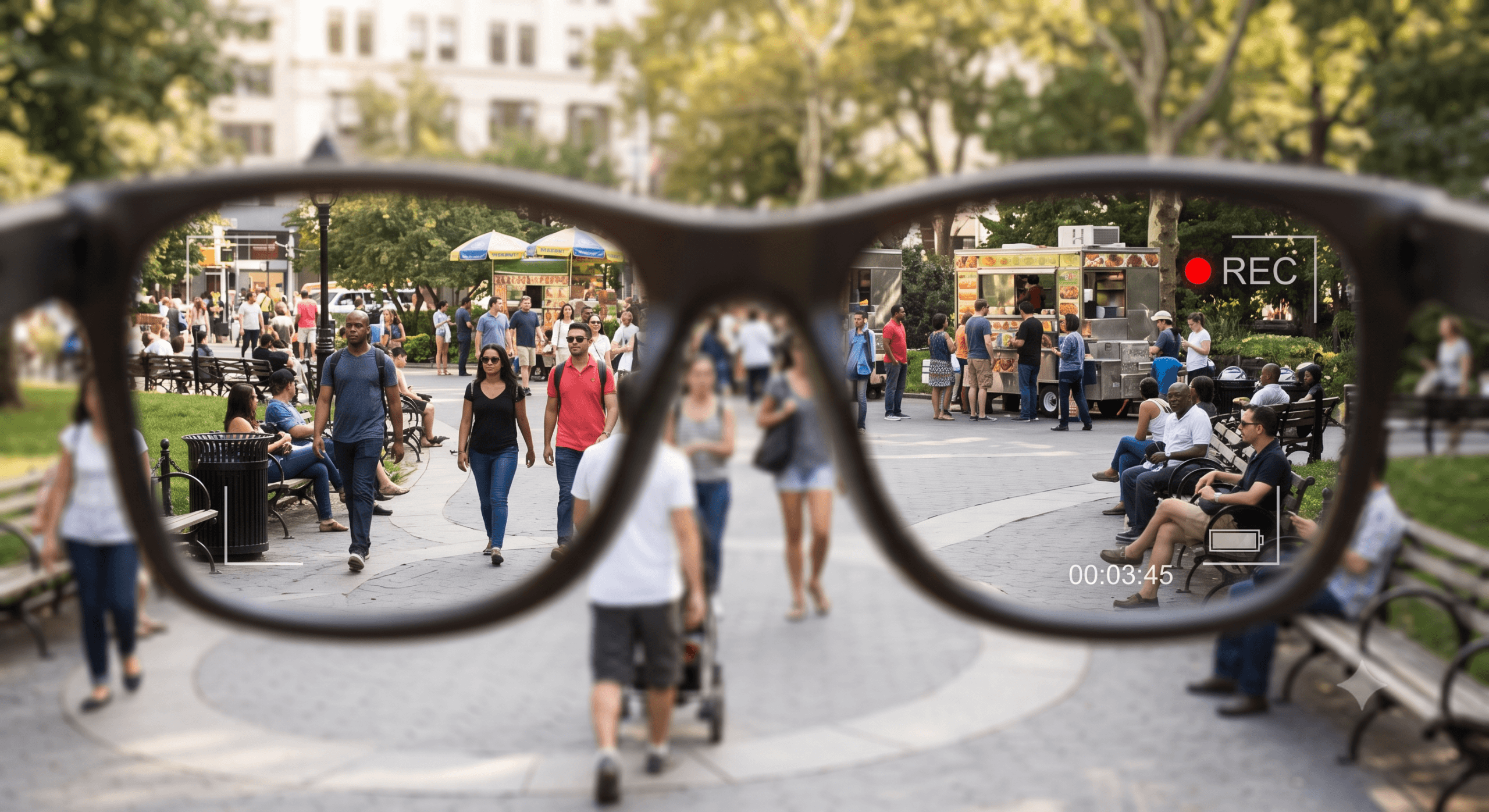
When discussing the ethics of smart glasses, we have to confront the unspoken rule of visibility. For most of history, seeing someone has been a two-way act. You look at me, I can look back and know it. Even the earliest cameras preserved that symmetry — a lens pointed at you was a visible, physical thing, and you could object to it, turn from it, or simply know your image was being taken.
That mutual awareness wasn't written into any law. It didn't need to be. It was built into the shape of the technology itself.
The shift this creates isn't really about cameras — humanity has lived alongside cameras for well over a century. It's about the disappearance of the cue. When recording no longer looks like recording, an entire social contract that depended on visibility quietly stops functioning, and nobody voted on the replacement.
Part 1: The Vanishing Camera
There used to be a rule, unspoken but universal: if you could see the lens, you knew where you stood. A phone raised in a bar, a camera at a party — whatever discomfort it caused, it was at least visible. That visibility was the whole basis of consent in public life. Imperfect, but legible.
Smart glasses quietly retire that rule.
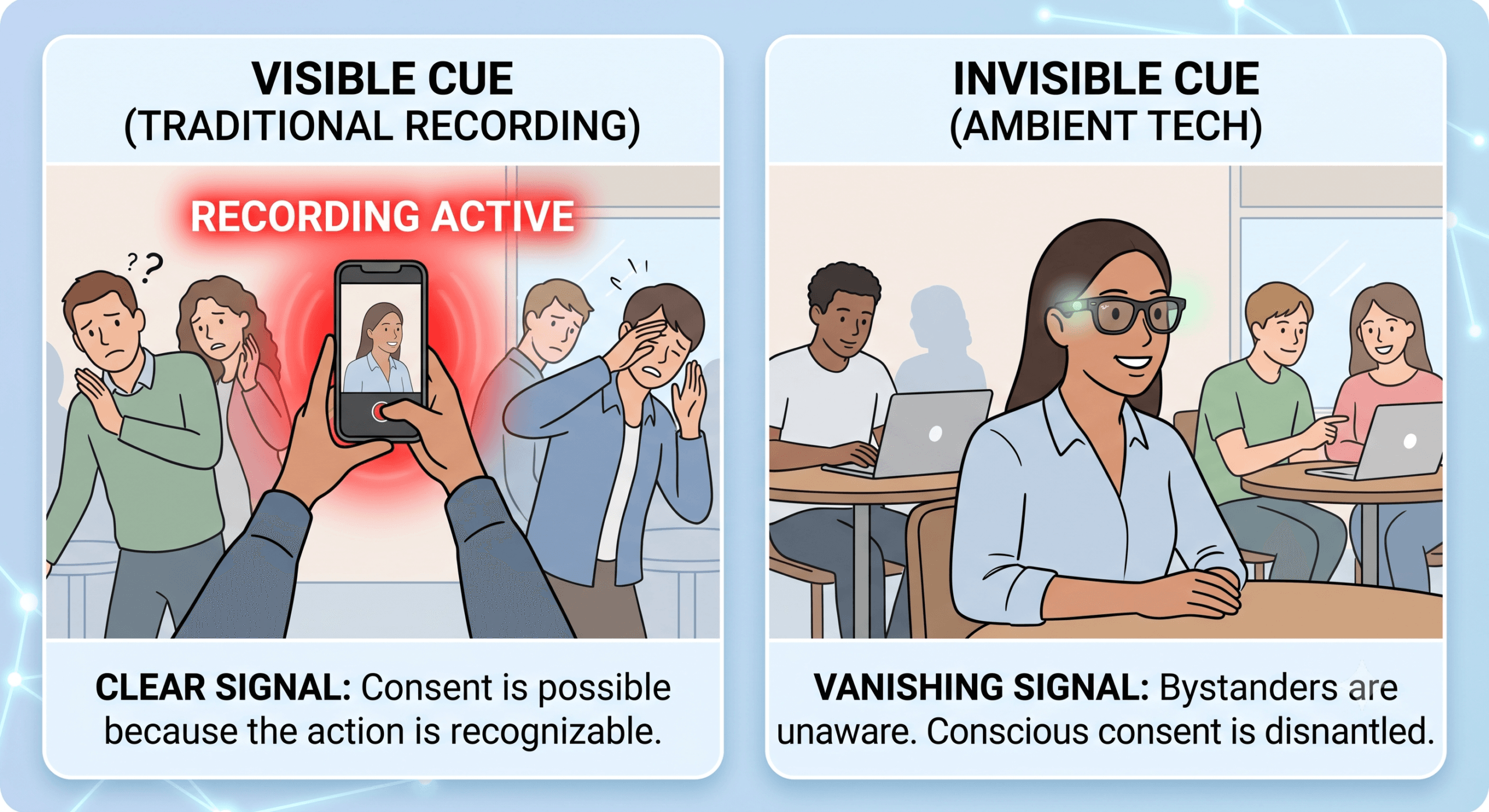
A pair of Ray-Ban Metas looks, from three feet away, like a pair of Ray-Bans. A small LED is supposed to light up when recording is active — but unless you know to look for it, it changes nothing about how people behave around you. Gyms have already reported members being filmed without consent through smart glasses, with the risk considered even greater in locker rooms, yoga studios, and pools.
These aren't hypotheticals. They're happening in ordinary places, to ordinary people, right now.
The pattern also shows up in more deliberate form. A BBC investigation found dozens of male influencers using Meta's smart glasses to secretly film women in public — approaching them, flirting, recording the interaction from a first-person view that looked casual — while the women had no idea a camera was running.
The format now has a recognizable shape on social media: a stranger walks up, the "conversation" happens, and only the wearer knows it was content all along. What makes this different from a classic hidden camera is scale and normalcy.
A hidden camera is rare and requires intent. Smart glasses are sold at Best Buy, styled by a fashion brand, worn by millions of people with zero intention of secretly filming anyone — which is exactly what makes the technology so disorienting. The harm doesn't require malice. A nurse checking a chart, a parent at pickup, a friend at dinner — any of them might be wearing a device that's quietly recording, without anyone involved deciding that should happen.
Institutional Challenges in the Age of Ambient Tech
This is why institutions built around "put the phone away" are finding that gesture meaningless. Schools, courtrooms, therapy offices, and places of worship all depended on recognizable recording devices; now they face a category of device that doesn't announce itself.
Even Meta seems to know this — when Mark Zuckerberg testified before Congress, his own team had to remove their Meta glasses before entering.
None of this means the technology is uniquely evil, or its wearers uniquely careless. Most people who put on a pair in the morning are thinking about hands-free directions, not surveillance. The problem is structural: an entire category of device has entered public life with no shared understanding of what the light means, no consistent expectation of when it's on, and no real mechanism for a bystander to say no.
That gap — between what the technology can do and what the people standing next to it can consent to — is the subject of this series. Next: what happens once that footage leaves the wearer's control entirely.
Part 2: Who's Watching the Watchers?
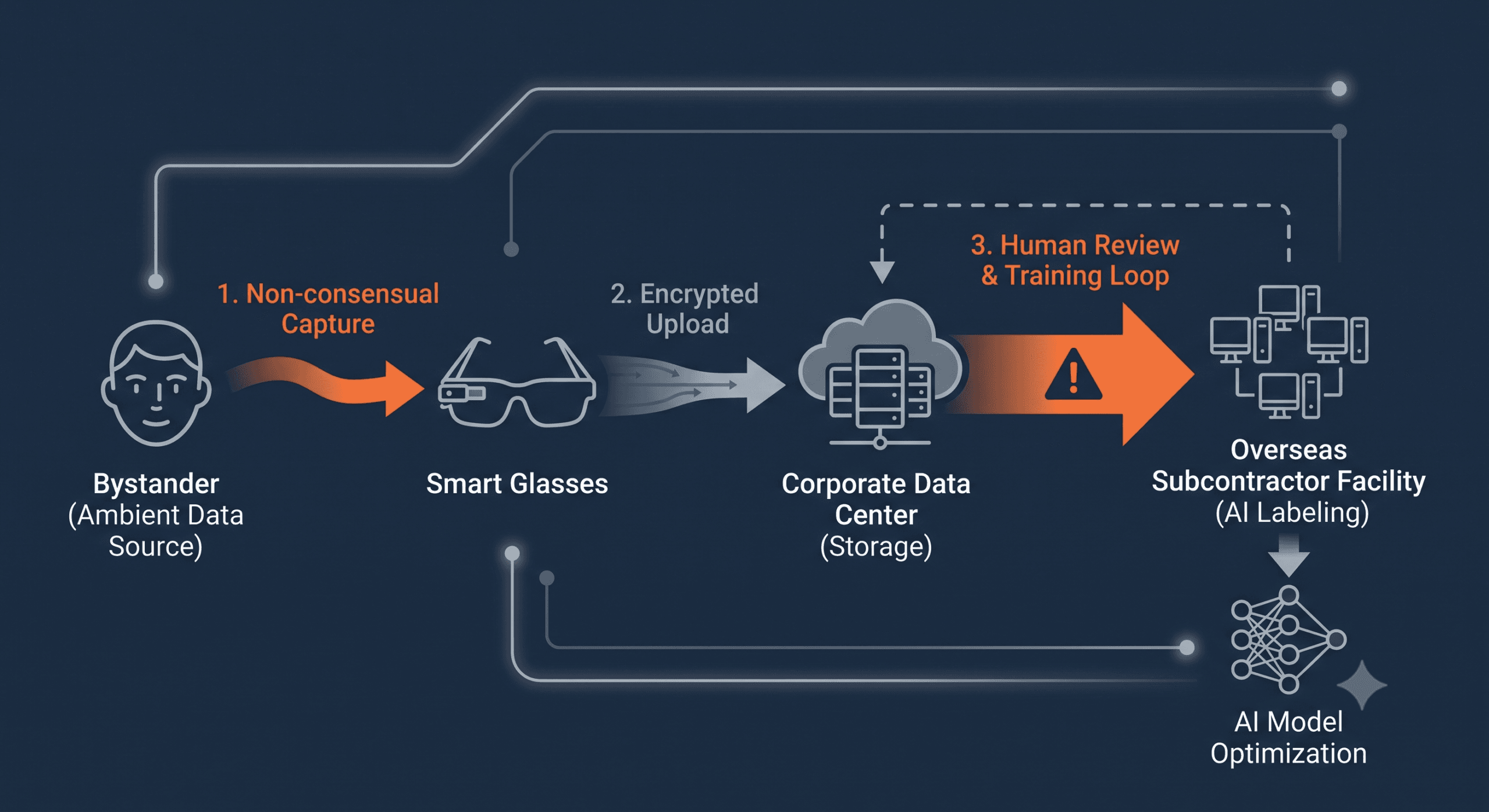
If Part 1 was about the stranger standing next to you, Part 2 is about everyone standing behind that stranger — the company, the contractors, the data pipeline you never see and never agreed to.
When Meta first made its Ray-Ban smart glasses available for preorder in September 2023, the marketing was unambiguous: "built with privacy at their core." That promise sat behind Super Bowl ads and over seven million sales by 2025. According to a federal lawsuit filed in March 2026, it's also not quite what happened.
The suit follows an investigation by two Swedish newspapers, which found workers at a Kenya-based subcontractor reviewing footage from users' glasses as part of an AI training pipeline — footage that reportedly included nudity, sexual activity, and people using the bathroom.
In one case described in the complaint, a man left his glasses recording on a bedside table; his partner entered and changed clothes in front of the camera, unaware. That footage was allegedly sent to Kenya for labelling, without her knowledge — she wasn't the customer, and had no way to opt out of a system she didn't know existed.
This is where the ethical question moves from the sidewalk to the server room. It's one thing to ask whether a stranger consented to being filmed. It's another to ask whether a company's promise of privacy matched its own internal handling of that footage.
Meta's defence rests on disclosure: contractors may review shared content to improve the product, as stated in the privacy policy. That's a legally real argument, but worth sitting with. A privacy policy is a document almost nobody reads in full, written to be defensible rather than clear, covering a use case most users would never think to hunt for.
The Legal Landscape and BIPA
It's also worth naming who pays when that gap closes badly. The person whose bedroom footage got reviewed wasn't the customer. Neither was the woman filmed for content, nor the gym member caught in someone else's frame.
Meta's users are one layer of this problem; everyone who was never a user but shows up in someone else's footage is another — and current law protects them almost not at all. A few statutes, like Illinois' Biometric Information Privacy Act (BIPA), require consent before biometric data is collected, with real penalties attached.
But BIPA is one state law among very few, written before any device captured ambient biometric data from every stranger in frame. None of this requires believing one company is uniquely villainous. It reflects a structural pattern: when a device's value depends on ambient, always-on data collection, the incentive to build narrow, privacy-protective defaults competes directly with the incentive to keep the data flowing.
Regulators are starting to notice — the UK's Information Commissioner's Office opened an investigation into the same reporting — but that moves slowly, and the product is already on seven million faces. Which leaves the real question: if the market alone won't protect the people who never agreed to appear in its footage, what would?
Part 3: Building a Culture of Consent
Law, design, and culture each have a piece of the answer — and none of them can carry it alone.
Law is playing catch-up. BIPA-style statutes require consent before biometric data is collected, but only a handful of states have them. Eleven states require all-party consent to record a private conversation, yet no published court case has tested how that applies to a device that's always listening. Europe's GDPR is stronger on paper, but enforcement against a consumer gadget worn by millions is a different animal from regulating a data broker. The honest takeaway: legislation will help, eventually, but it's not arriving fast enough to be the whole answer.

Design could close more of the gap than law can, faster. A recording light that's genuinely hard to miss — not a discreet dot but something unmistakable — would restore some of the visibility that made the old social contract work. Default settings that require active, specific opt-in for any human review of footage, rather than a general clause in the terms of service, would shift the burden back onto companies instead of bystanders.
None of this is technically hard. It simply hasn't been the default, because visible, restrictive defaults are worse for engagement and data collection than invisible, permissive ones.
Culture is the slowest-moving piece, and the one that ultimately decides whether the other two matter. Institutions — hospitals, schools, gyms, therapy offices — are already writing their own policies about when smart glasses can be worn on-site, effectively rebuilding the "put your phone away" norm one building at a time.
That patchwork approach is imperfect, but it's also the only mechanism moving at the speed the technology demands.
None of these three fixes is sufficient by itself, and that's the point. Law sets the floor, design sets the default, and culture decides what's actually normal to do — and normal to refuse. Right now all three are behind the technology. Closing that gap is a societal project, not a settled one, and it's the size of the effort described in Parts 1 and 2: rebuilding, deliberately, a version of consent that this category of device broke by simply existing.
Conclusion: Reclaiming Our Right to Sight
The proliferation of smart glasses proves that technological innovation often outpaces the legal frameworks meant to govern it. We have transitioned from an era where recording was a distinct, physical action into an era of ambient surveillance, where the act of capturing data is indistinguishable from simply looking.
Key Takeaways:
- The Vanishing Cue: We have lost the visual indicators that traditionally allowed us to consent to or refuse recording in public.
- The Data Pipeline: Wearable tech captures not just the user's life, but the lives of bystanders, often funneling that sensitive data into corporate AI training systems.
- The Tri-Pillar Solution: True digital safety requires a combination of robust legislation, privacy-by-design engineering, and proactive institutional policymaking.
At the Vijay Foundation, our commitment to Women Empowerment and Legal Awareness drives us to ensure vulnerable groups are protected from digital exploitation. Rebuilding this social contract requires vigilance from all of us. If you are an institution looking to draft modern privacy policies, or an individual seeking guidance on digital rights, we urge you to stay informed and demand stronger defaults from the technology you interact with every day.
Frequently Asked Questions: The Ethics of Smart Glasses
1. Are smart glasses actually recording all the time?
2. Doesn't the LED light solve the consent problem?
3. Is it illegal to film someone without their knowledge?
4. What's actually being alleged in the Meta lawsuit?
5. What can I do if I think I've been filmed without consent?
6. Should I just avoid places where people might wear these?
7. How does ambient recording disproportionately affect women in public?
8. How can institutions like schools or gyms protect against smart glasses?
9. What is BIPA and why is it important for wearable tech?
10. Can privacy by design fix the smart glasses consent issue?
- Bartone et al. v. Meta Platforms, Inc. et al., No. 3:26-cv-01897 (N.D. Cal., filed March 4, 2026)
- BBC News — Investigative Reporting on Smart Glasses and Covert Filming
- Information Commissioner's Office (UK) Regulatory Inquiries
- Illinois Biometric Information Privacy Act (BIPA) Statutes
- Supreme Court of India - Right to Privacy (Puttaswamy Judgment Context)