
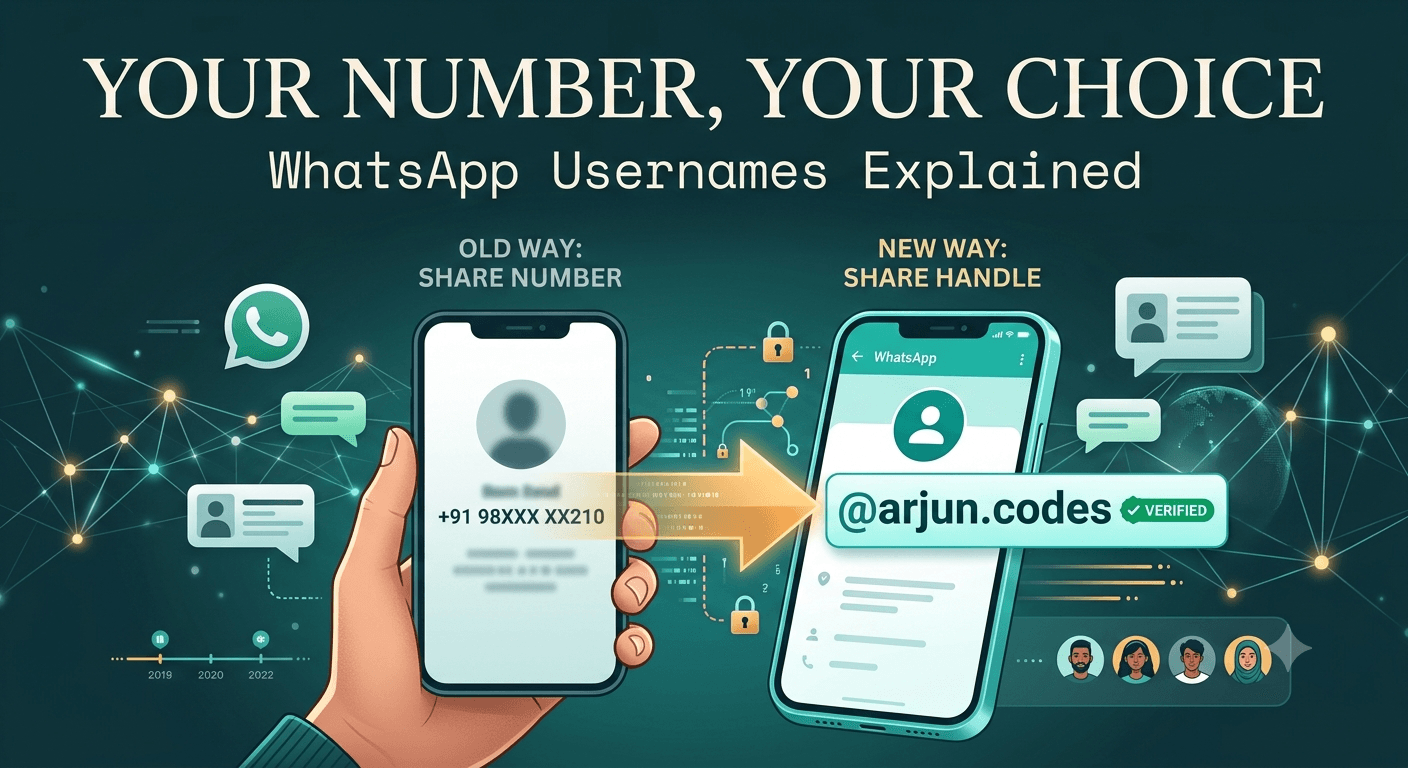
Your number, your choice.
After 17 years of using your phone number as your identity, WhatsApp is finally letting you hide behind a handle instead. Here's everything worth knowing — the upside, the risk, and who it actually changes things for.
Written by Adv. Mamta Shukla · Published by vijayfoundations.com
WhatsApp has confirmed it: usernames are coming. Having WhatsApp usernames explained is essential right now, as your phone number no longer has to be the price of admission to a conversation.
01 WhatsApp Usernames Explained: What's actually changing
WhatsApp usernames let you create a unique handle — something like @yourname — and hand that out instead of your number when you meet someone new. Once a person has your username, they can find and message you inside the app. Your number stays completely hidden from them.
Your phone number doesn't disappear — it still powers login, verification, and account recovery. It just stops being the thing you're forced to give away every time you want to chat.
- Optional. Nothing changes if you don't set one up.
- 3–35 characters — lowercase letters, numbers, periods, and underscores only.
- Must contain at least one letter, and can't start with "www." or end in ".com" / ".net".
- No public directory, no autocomplete. People need your exact handle to reach you.
- Creators and businesses can carry over their Instagram or Facebook handle.
- An optional username key adds a second code strangers need before they can message you.
02 Why WhatsApp is doing this
When getting WhatsApp usernames explained to everyday users, WhatsApp's VP of Product, Alice Newton-Rex, framed it as a trust problem, not just a features problem: meeting someone new and having to hand over your number can feel like an oversized commitment, because that number is tied to banking apps, IDs, and years of personal data. A username lets a conversation start without that exposure.
"When someone new walks into your life — a classmate, a neighbour, someone you meet at an event — sharing a phone number can feel like a big step."
— WhatsApp, company blog postThere's a competitive angle too. Telegram has had usernames since 2013, Signal since 2022. For an app built on the promise of privacy, not offering this was a conspicuous gap.
03 The advantages
Real privacy control
Your number touches banking, IDs, and years of data. Explore our digital privacy updates to see why protecting your primary phone number is a genuine upgrade.
Less spam and scam exposure
Numbers get scraped and sold. A username, especially with a key, is far harder to guess or harvest at scale.
One identity, everywhere
Creators and small businesses can finally use the same handle across Instagram, Facebook, and WhatsApp.
Survives a number change
Switch SIMs or countries and your username still works — no more "lost contact" chaos.
Safer for at-risk users
Journalists, activists, and people avoiding unwanted contact get a way to talk without disclosing a traceable number.
04 The disadvantages
Impersonation risk
Fake handles like @yourbank_support are a real threat. Verification helps, but enforcement at 3B users is hard.
Fragmented identity
Some contacts know you by number, others by handle — confusing during the transition, especially for less tech-savvy users.
Handle-squatting
Good usernames will go fast, Twitter/Instagram-style. Latecomers may be stuck with awkward variants.
Deadlines for businesses
Companies must adopt new customer-tracking IDs before rollout hits their market, or risk losing contact entirely.
05 Pros vs. cons, at a glance
Pros
- Number stays hidden from new contacts
- Harder for scrapers and spammers to target you
- One consistent handle across Meta apps
- Survives SIM or country changes
- Safer option for at-risk users
- Fully optional — no forced switch
Cons
- Opens the door to impersonation scams
- Mixed number/username contacts get confusing
- Good handles will be squatted fast
- Hard deadline for businesses to adapt
- No search means you must actively share it
- Learning curve for less tech-savvy users
06 Who this actually affects
To keep WhatsApp usernames explained clearly across all demographics, here is a quick breakdown of how this rollout shifts daily habits:
| Group | What changes for them |
|---|---|
| Everyday users | More control over who can reach them — but only if a username is shared thoughtfully, not carelessly. |
| Businesses | A branding opportunity, paired with a hard operational deadline to update CRMs and chatbots. |
| Creators / public figures | Consistent branding across Meta apps, less risk of a leaked personal number. |
| Scammers | New contact-rate limits and abuse-pattern detection are aimed squarely at blunting this. |
07 FAQs
Q. Is a username compulsory?
No. It's fully optional. If you never set one up, WhatsApp works exactly as it does today, with your number as your identifier.
Q. Will people still be able to see my phone number?
Only people who already have your number saved, or who you choose to share it with. New contacts who reach you via username never see it.
Q. Can someone find me by searching my name?
No. There's no public directory or autocomplete. A person needs your exact username — and, if you set one, your username key — to message you for the first time.
Q. Can I change or remove my username later?
Yes. WhatsApp has said you can edit or turn off your username at any point from Settings.
Q. Do I still need a phone number to use WhatsApp?
Yes. A number is still required to create and verify the account — usernames sit on top of that, they don't replace it.
Q. What happens to my existing chats and contacts?
Nothing changes for people who already have your number saved. The username only matters for new contacts going forward.
Q. When will I get access?
Reservations opened June 29, 2026. The first countries went live July 7, 2026, with a global rollout continuing through September 2026.
08 The bigger picture
As millions of users get WhatsApp usernames explained to them over the 2026 global rollout, this update will quietly rewrite the platform's identity model. For nearly two decades, "your number is your account" was the whole point of the app's simplicity. Usernames don't kill that system, but they do loosen WhatsApp's most fundamental design choice, nudging it closer to how social platforms — rather than phone books — work.
Bottom line: usernames won't replace your phone number on WhatsApp — but for the first time in the app's history, you get to choose exactly what you give away.