Every Punchline
Now Ships With Fine Print
The mic drops. The clip goes viral. Somewhere, a lawyer refreshes their inbox. Here's what every comedian, meme-maker, and digital creator needs to know before the next joke goes live, because Comedy's Punchline Now Comes with Legal Fine Print.
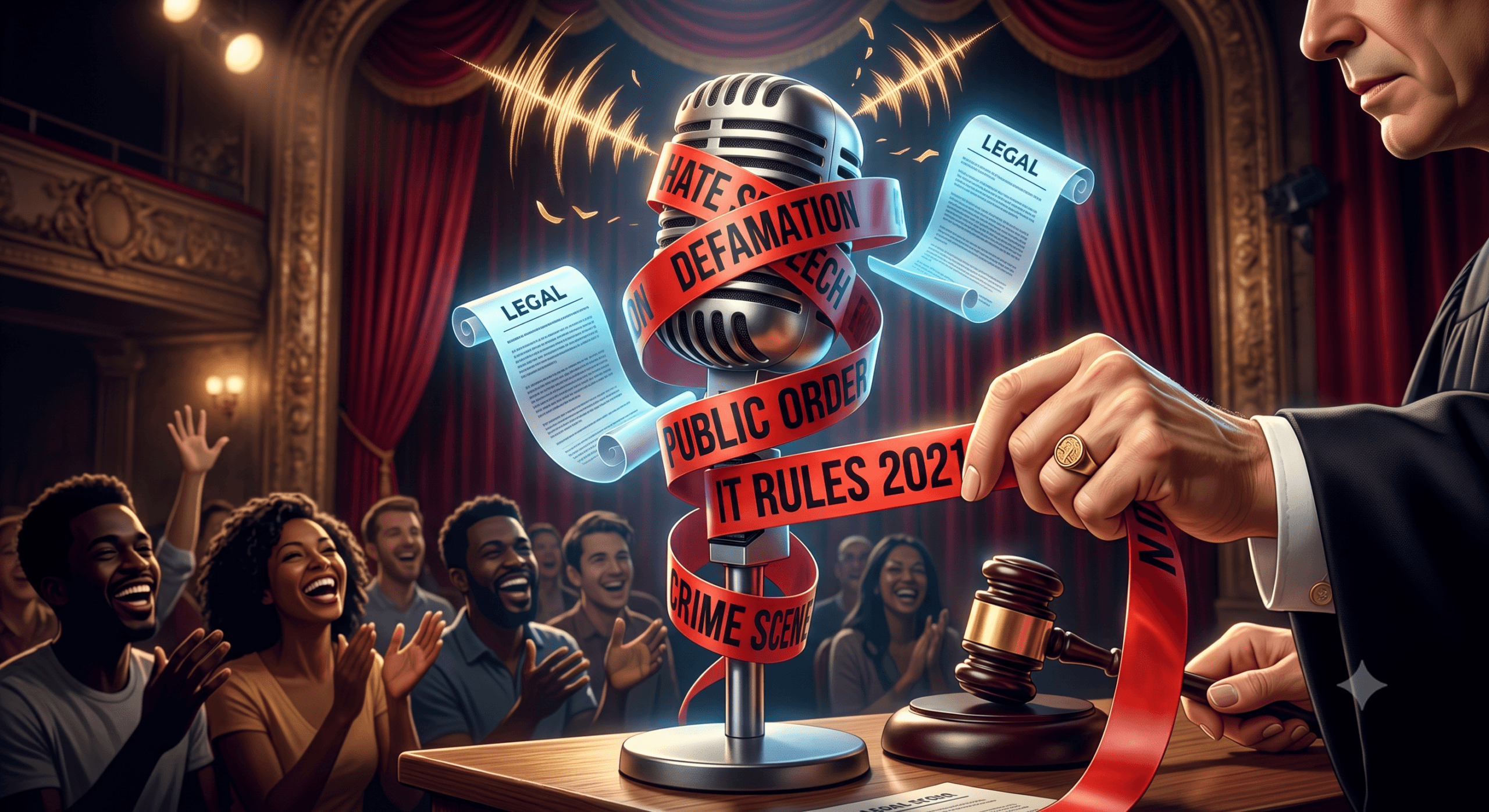
Comedy has always poked at power, tested taboos, and said the quiet part out loud. That hasn't changed. What has changed is the room. Today, Comedy's Punchline Now Comes with Legal Fine Print. A bit that once landed for two hundred people in a basement club now lands for two million people who never bought a ticket — and some of them are lawyers.
Stand-up sets, memes, satire pages, and reels don't stay where they're posted anymore. A single clip can be reposted, subtitled, stitched, and reacted to in a different country by lunchtime — stripped of the room's laughter, the setup, and the context that made it a joke in the first place. That's the real shift: it's not that comedy got riskier, it's that comedy got louder than any one audience.
Why Comedy's Punchline Now Comes with Legal Fine Print Today
Four things happen the moment a joke leaves the stage and becomes a link:
A joke can go viral before the comedian's even off stage. It can reach people it was never written for. It can be clipped down to the one line that sounds worst on its own. And once it's public, it's public around the clock — which is exactly when complaints about defamation, religious sentiment, hate speech, or public order tend to arrive. For a sense of how quickly online context collapses into legal exposure, see our earlier report on the $200,000 discrimination case that started with a single lunchroom remark.
Freedom of Speech, With an Asterisk
In India, comedy stands on solid legal ground. Article 19(1)(a) of the Constitution hands every citizen — comedians included — the fundamental right to freedom of speech and expression. Satire, parody, and stage humour are generally read as protected creative expression, not exceptions to it.
Read plainly, that means comedians are protected — and comedians are also expected to know where the protection stops. It's not censorship by default. It's a boundary condition, the same way any right in a shared society has edges. In today's digital era, this means that Comedy's Punchline Now Comes with Legal Fine Print.
The Docket: When a Bit Becomes a Case File
Not every edgy joke ends up in front of a judge. But these five categories are where most real complaints start — think of it as the case file comedy keeps bumping into.
Defamation
A joke built on a false factual claim about a real person — not a clearly absurd exaggeration, but something presented as true — can expose the comedian to civil or criminal defamation proceedings under Section 499 of the Indian Penal Code.
Fiction and satire are safer than false "facts" dressed as jokes.Hate Speech
Material that encourages hostility toward a community or protected group can cross from "edgy" into territory covered by criminal law, regardless of comedic intent.
Punching at ideas ages better than punching at identities.Religious Sentiment
Remarks read as deliberately insulting to religious beliefs or practices routinely trigger complaints, even when the comedian intended playful ribbing rather than provocation.
Intent rarely survives the clip; framing usually does.Obscene Content
Content judged legally obscene, or offensive well beyond accepted community standards, can face restriction independent of how funny the room found it.
"It killed live" isn't a legal defence online.Public Order
Content capable of provoking violence or disturbing public peace draws scrutiny fastest of all five — because the concern isn't the joke, it's what happens after people hear it. Platforms themselves carry due-diligence duties here under the IT (Intermediary Guidelines and Digital Media Ethics Code) Rules, 2021.
Reach changes responsibility, even when the joke doesn't change.The Internet Doesn't Forget the Joke — or Forgive the Clip
A live show ends when the lights come up. A digital post doesn't. It stays searchable indefinitely, gets re-edited and re-shared without its original context, reaches cultures the comedian never wrote for, and sits under both platform content rules and national law at the same time. That's four kinds of exposure a stage performance simply never had. It's the same dynamic we traced in our piece on cybersquatting and how ordinary online activity collides with Indian law — content built for one context, judged in another.
None of this means creators should self-censor into blandness. It means the smart ones now treat "will this travel well without me in the room" as part of writing the joke — not an afterthought after it's already trending. When Comedy's Punchline Now Comes with Legal Fine Print, understanding the law is just as important as understanding the audience.
Before You Hit Publish
A quick backstage checklist, the way a comic runs their set list before walking out.
Legal Literacy Is a Creative Skill Now
Knowing where the lines are doesn't shrink a comedian's material — it protects it. Because Comedy's Punchline Now Comes with Legal Fine Print, creators who understand the legal shape of their work argue their case with more confidence, spend less time fighting avoidable disputes, and earn more trust from the audiences and platforms they depend on. Legal awareness isn't the opposite of edge. It's what lets edge survive contact with a global audience.
Quick Answers
Yes. Comedy generally falls under Article 19(1)(a)'s freedom of speech and expression, subject to the reasonable restrictions set out in Article 19(2) — read the full clauses on the official Constitution of India portal.
Yes — depending on the specifics, complaints around defamation, hate speech, obscenity, or public order can and do arise from stand-up and online content.
No. The Constitution explicitly allows reasonable restrictions under Article 19(2), so the right comes with defined boundaries.
Social media has massively widened who sees a joke and when, putting content in front of far more diverse audiences — and far more applicable laws — than a live show ever reached. This is precisely why Comedy's Punchline Now Comes with Legal Fine Print.
Verify facts before stating them, avoid defamatory claims, understand the legal boundaries that apply to your content, and get real legal advice before publishing anything genuinely sensitive. Vijay Foundation offers free legal aid for those who need it.
The Mic Is Still Open. Just Know the House Rules.
Comedy has always challenged ideas, sparked conversations, and reflected society. However, as Comedy's Punchline Now Comes with Legal Fine Print, the objective of the law is not necessarily to silence humor but to ensure that freedom of expression is exercised responsibly.