When Textbooks Clothe History:
The NCERT Dancing Girl Controversy
A 4,500-year-old Harappan figurine was digitally altered in a Class 9 arts textbook — and historians, educators, and the public said no. Here's why the NCERT Dancing Girl Controversy matters.
At first glance, it appears to be a small editorial decision buried inside a freshly printed school textbook. On closer inspection, it reveals something far larger: a question about who controls how history is taught. The NCERT Dancing Girl Controversy highlights whether discomfort with the past is ever a legitimate reason to alter it.
In June 2026, it emerged that NCERT's new Class 9 arts textbook, Madhurima, carried a digitally altered image of the iconic Harappan "Dancing Girl" — a 4,500-year-old bronze figurine whose bare torso had been shaded over to make the image "age-appropriate" for fourteen-year-olds. The reaction from historians, educators, and the public was swift and unambiguous: this was not protecting children. It was distorting archaeology. At VijayFoundations, we believe education policy deserves close public scrutiny — and this case is a textbook example of why.
"The notion that nudity is inappropriate is, in my opinion, an obsolete Victorian view. Yet we speak of decolonising Indian education." — Michel Danino, NCERT Textbook Development Committee
What Actually Happened in the NCERT Dancing Girl Controversy
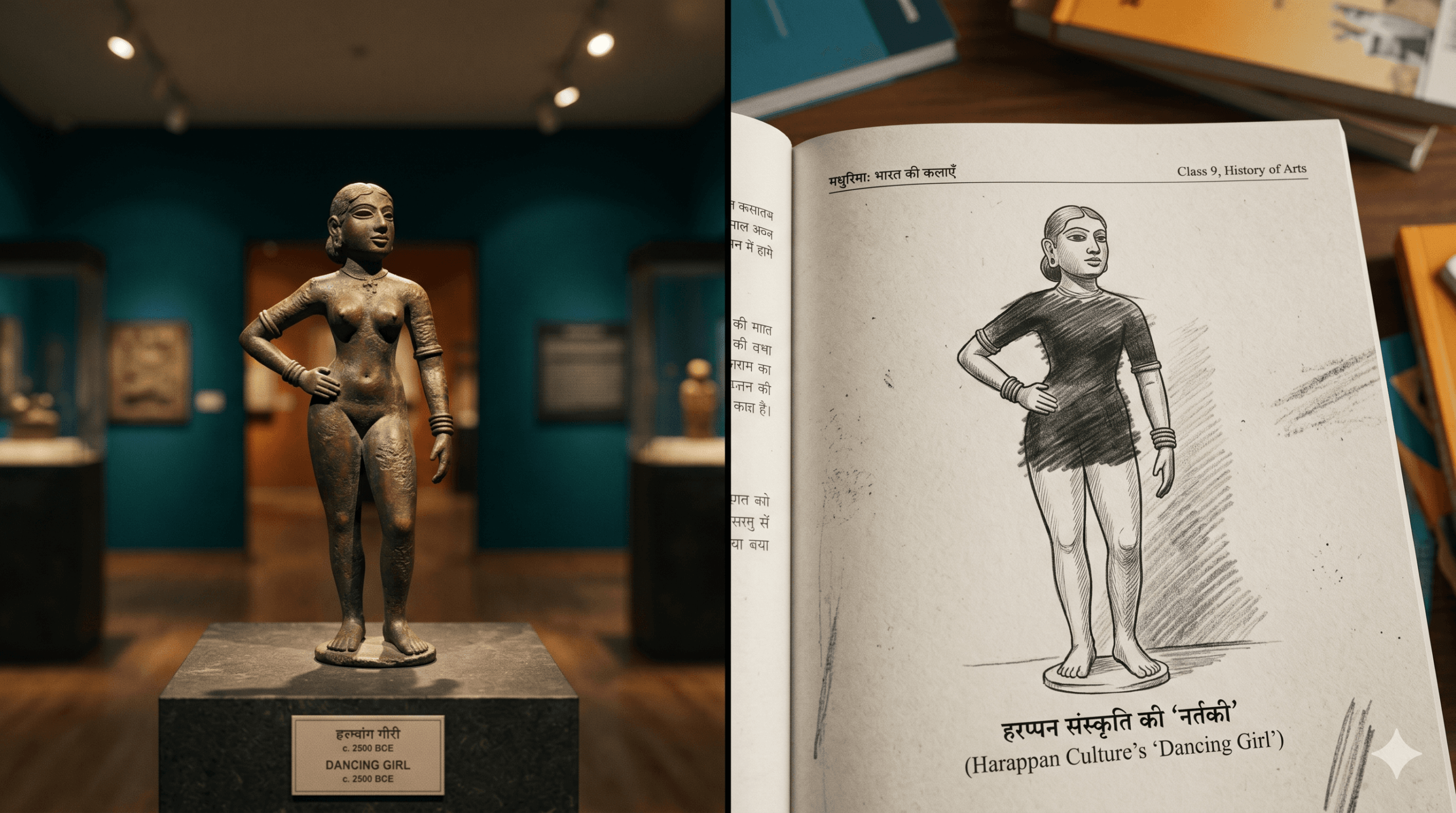
The altered image appeared in Chapter 1, "History of Arts," of Madhurima — NCERT's newly introduced arts education textbook for Class 9 students. The original bronze figurine, discovered at Mohenjo-daro and housed in the National Museum, New Delhi, depicts a young woman standing with one hand on her hip and a slightly lifted chin. She is unclothed above the waist, consistent with artistic conventions of the Indus Valley Civilisation.
In the textbook version, dark shading was applied across the figurine's upper body, obscuring the anatomical details visible in the original sculpture. The effect was unmistakable: the artefact appeared to be wearing a garment. The textbook offered no note or explanation for this deviation from the source material.
The same Dancing Girl figurine appeared in NCERT's Class 6 Social Science textbook, The Beginning of Indian Civilisation, in a form much closer to the original bronze sculpture — making the modification in the Class 9 book impossible to attribute to a simple printing error or stylistic choice.
Michel Danino, who headed the textbook development committee for NCERT's Class 6 Social Science books, confirmed he had been told the figurine was considered "not age-appropriate" for younger students. "Our team disagreed; we even checked with teachers of Class 6, and they told us there was never a problem with the Dancing Girl," he told PTI.
Who Is the Dancing Girl?
The Dancing Girl is one of the most recognisable artefacts of the Indus Valley Civilisation and among the most important objects in Indian cultural heritage. Discovered at Mohenjo-daro (in present-day Pakistan) in 1926 by British archaeologist Ernest Mackay, the small bronze figure stands just 10.8 cm tall. She wears bangles on her arms, a necklace, and nothing else — a detail that had never been an issue in the century since her discovery. Yet, the NCERT Dancing Girl Controversy changed how this was briefly presented.
Historians regard her not as an erotic object but as a testament to the extraordinary artistic sophistication of a civilisation that flourished more than four millennia ago. The Madhurima textbook itself acknowledges this, noting that the figurine was created using the lost-wax casting technique — a method still practised in West Bengal, Jharkhand, and Chhattisgarh today.
Lost-Wax Mastery
Her creation required metalworking knowledge that would not appear in Europe for centuries — evidence of Harappan civilisation's advanced craftsmanship.
Posture as Language
Her stance — one knee bent, chin raised, hand on hip — communicates confidence and artistic intention. Context matters in reading this posture.
National Museum, Delhi
The original figurine has been on public display for decades, seen by millions of visitors including school children on field trips.
25+ Years in Textbooks
The original image appeared in NCERT publications for over a quarter century with no complaints from teachers, parents, or students.
The Problem with Moral Retouching
The argument advanced to justify the alteration was that younger students might be uncomfortable with nudity. This is difficult to sustain on multiple fronts.
First, there is the question of precedent. Students encounter anatomical diagrams in biology textbooks, sculptures from ancient Greece and Rome in world history, and classical artworks in every museum they visit on school trips. The educational context consistently distinguishes art and archaeology from other forms of imagery — and that distinction has served Indian students well for generations.
The "age-appropriate" framing reflects a moral framework often traced to Victorian-era attitudes imported during colonial rule — attitudes that considered the unclothed human form inherently indecent. Applying this framework to a pre-colonial Indian artefact, in a chapter of an arts textbook explicitly designed to educate students about India's own heritage, is more than inconsistent. It is historically ironic in the worst possible way, particularly when NCERT itself has spoken of "decolonising" Indian education. UNESCO's guidance on culture in education explicitly warns against the sanitisation of heritage in classrooms.
Second, altering an archaeological artefact for a textbook is not an editorial choice — it is the introduction of inaccuracy into a formal educational record. The NCERT Dancing Girl Controversy stems from this very fact: the Dancing Girl does not wear clothing. To illustrate her as if she does is to present students with a false version of a primary historical source. In an arts textbook, of all places, that is a serious failure.
Third, the assumption that students must be shielded from an ancient bronze sculpture fundamentally underestimates both their intelligence and their capacity for contextualised learning. A well-written caption explaining the significance of the artefact and the cultural world from which it emerged would serve a far greater educational purpose than digitally modifying the object itself. As we have explored in our digital rights coverage, the instinct to sanitise rather than contextualise rarely serves the public it claims to protect.
Pushback, and the Reversal
The criticism was rapid, broad, and came from credible quarters. Archaeologists, historians, artists, educators, and cultural commentators publicly objected to the alteration. The controversy spread widely on social media. NCERT referred the matter to the concerned department for review.
The speed of NCERT's reversal is notable. The NCERT Dancing Girl Controversy demonstrates that public criticism, scholarly intervention, and informed debate can still influence institutional decisions — and that there are limits to what educators and the public will accept when it comes to the presentation of India's own cultural heritage.
The Bigger Picture: A Pattern Worth Watching
It would be a mistake to dismiss this as an isolated editorial error. The Dancing Girl was also quietly clothed at the 2023 International Museum Expo, generating criticism that was largely ignored. The recent NCERT Dancing Girl Controversy suggests not a coincidence, but a pattern: a broader cultural discomfort with presenting India's ancient past on its own terms.
"To alter such an object is not merely to modify an image. It is to interfere with evidence."
Museums, archives, and educational institutions have a distinct responsibility in this regard. Their role is not to make history conform to present-day tastes, but to help society understand the past in its original context. The distinction matters enormously. Historical education is not an exercise in moral approval. It is an exercise in understanding. The Archaeological Survey of India itself presents the Dancing Girl without modification in all its official documentation — a standard schools would do well to follow.
When a textbook chapter explicitly asks students to analyse the Dancing Girl's posture, mimic it, and sketch it — and simultaneously presents them with a falsified image of that very figure — there is a fundamental contradiction at the heart of the lesson itself.
What It Means for Education
The NCERT Dancing Girl Controversy raises a set of questions that Indian educators and policymakers would do well to sit with, not just in the context of this one figurine, but more broadly:
Context Over Censorship
A well-written caption contextualising an artefact does more for a student's education than any digital modification ever could.
Trusting Students
Fourteen-year-olds encounter ancient art in museums globally without harm. Shielding them from India's own heritage sends the wrong message about that heritage's worth.
Accuracy as a Duty
A textbook is a formal educational document. Introducing inaccuracy — however well-intentioned — is a failure of that document's core purpose.
Whose Heritage?
If India's own students cannot see India's own artefacts as they actually exist, something is deeply wrong with how that heritage is being stewarded.
The good news is that the system, when subjected to informed public pressure, corrected itself. NCERT's willingness to reverse the decision promptly, acknowledge the concern, and commit to restoring the original image is the outcome that education should always produce when it goes wrong: correction, transparency, and a return to honesty.
Final Thoughts
The Dancing Girl has stood, unaltered, for 4,500 years. She survived the rise and fall of the civilisation that created her, survived excavation, survived a century in museums and textbooks, and survived the digital age — until a single editorial decision in a school textbook briefly clothed her in contemporary discomfort. Now resolved, the NCERT Dancing Girl Controversy asks whether the institutions entrusted with teaching India's history have fully understood why accuracy matters.
Share Your Thoughts →