 Civil Procedure · Evidence Law
"Where proof ends and ambush begins — the line the law draws in every courtroom."
Evidence Beyond Pleadings: Where Proof Ends and Ambush Begins
The law does not insist that parties plead every piece of evidence. It insists that they plead the case.
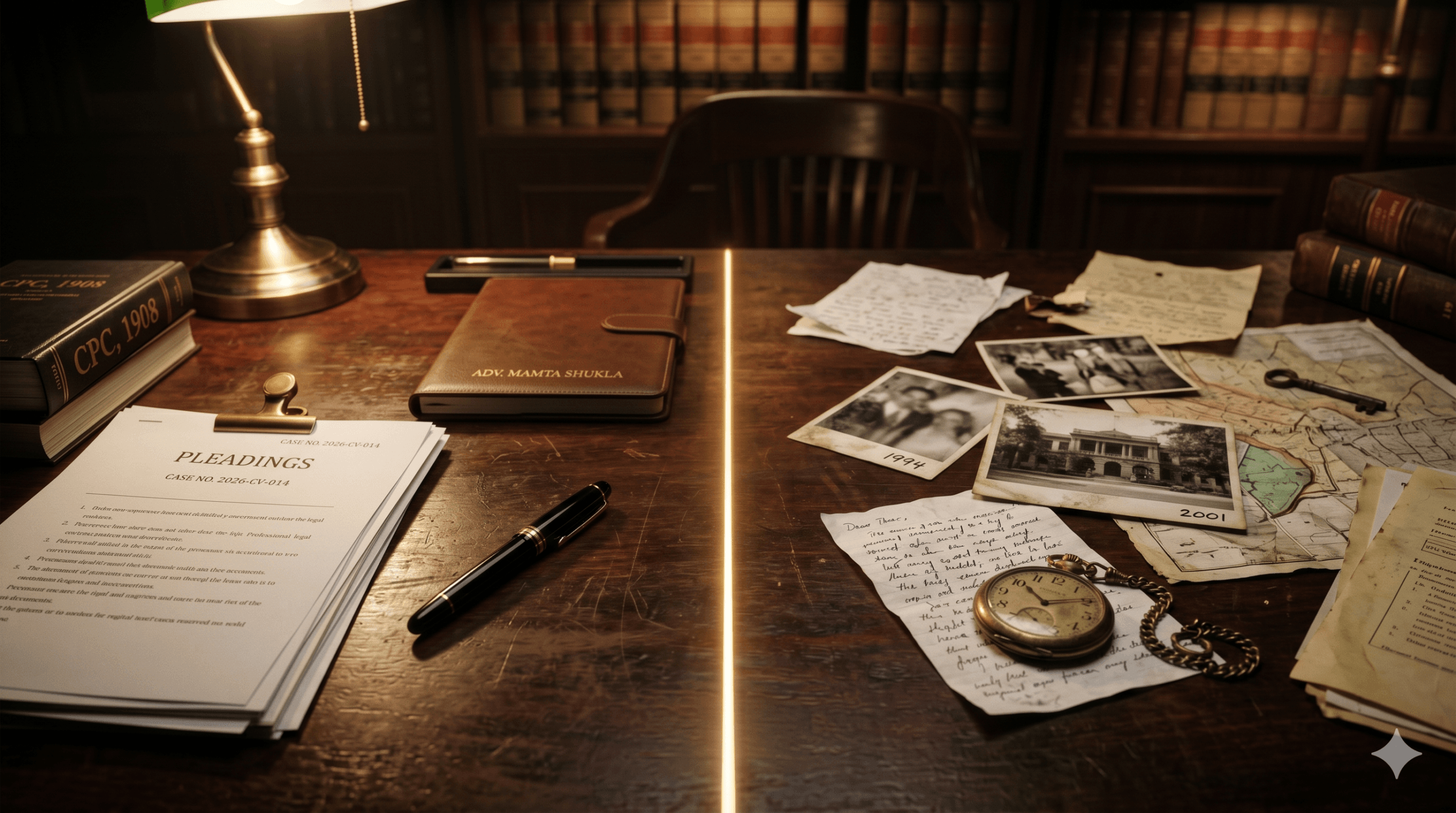
In every courtroom battle, two distinct but intertwined concepts govern the flow of litigation: pleadings and evidence. Confusing one for the other — or allowing one to silently substitute the other — is where procedural justice quietly breaks down. Understanding where proof legitimately ends and tactical ambush begins—often resulting from adducing evidence beyond pleadings—is not merely academic; it is the cornerstone of fair trial jurisprudence in India and beyond.
What Are Pleadings, Really?
Pleadings are the formal written statements — plaint, written statement, replication — through which parties define the contours of their dispute. Under Order VI of the Code of Civil Procedure, 1908, pleadings must contain a concise statement of material facts, not the evidence by which those facts are to be proved. This distinction is fundamental and deliberate.
A plaintiff who claims breach of contract must plead that the contract existed, was breached, and caused loss. They need not list every invoice, email, or witness at the pleading stage. The facts are the case; the evidence is the ammunition used to prove it.
"Pleadings must contain facts, not evidence. Evidence is what proves the facts pleaded — it cannot create new facts mid-trial." — Settled principle under CPC Order VI Rule 1
The Rule Against Evidence Beyond Pleadings: Facts vs. Evidence
Courts have consistently held that while a party is bound by its pleadings, it is not required to plead every document or witness it intends to rely upon. The Supreme Court in Bachhaj Nahar v. Nilima Mandal (2008) reaffirmed that relief can only be granted on the basis of pleaded facts — evidence beyond pleadings cannot supply a missing cause of action.
This creates a precise boundary: you may produce evidence your opponent didn't expect, but you cannot prove a case you never pleaded. The first is litigation strategy. The second is ambush.
When Does Proof Become Ambush?
"Trial by ambush" refers to a party springing material facts or claims on the opponent without notice through proper pleadings. This violates the foundational rule of audi alteram partem — the right to be heard — because you cannot respond to what you were never told was in issue.
Indian courts have drawn this line firmly. In Om Prakash v. Ram Kumar (AIR 1991 SC 1367), the Supreme Court held that allowing a party to introduce a new case through evidence, unsupported by pleadings, causes prejudice that no cross-examination can cure. The surprise is structural, not just tactical.
Compare this with legitimate surprise evidence — a document the opponent didn't anticipate, a witness whose testimony is more detailed than expected. These are permissible because the factual foundation was already laid in the pleadings. The opponent had the opportunity to gear up for that dispute; they simply chose not to.
Amendment of Pleadings: The Safety Valve
The procedural system is not merciless. Order VI Rule 17 of the CPC permits amendment of pleadings at any stage, provided it does not cause irreparable injustice to the other side. Courts have liberally allowed amendments that clarify or supplement the existing case — but have firmly refused amendments that introduce a wholly new cause of action or change the character of the suit.
This balance — flexibility before ambush, strictness after — reflects the law's pragmatic wisdom. Litigation is human; mistakes happen. But there must be a point where the adversary is entitled to know what case they are meeting.
Practical Implications for Litigants and Lawyers
For a practicing advocate, avoiding the trap of evidence beyond pleadings has three direct consequences. First, draft pleadings with foresight — every material fact you might need to prove should be at least broadly pleaded, even if evidence is gathered later. Second, object early when opposing counsel adduces evidence of unpleaded facts; raising the objection in cross-examination rather than at judgment preserves the record. Third, use amendment strategically — if new facts emerge during discovery or investigation, seek amendment before trial commences rather than attempting to introduce them through back-door evidence.
For reference on global standards, the International Commission of Jurists and comparative studies on Law Commission of India reports on civil procedure reform confirm that the pleading–evidence divide is a universal principle of procedural fairness, not merely a local technicality.
"A party cannot be condemned on an issue neither raised in pleadings nor tried by consent. Justice must be transparent in its operation, not just in its result." — Principle of procedural fairness
Conclusion
The line between legitimate proof and courtroom ambush is drawn by the pleadings themselves. The law gives parties the fullest freedom to gather and present evidence — but only within the factual territory they mapped out at the outset. Stray beyond that map by offering evidence beyond pleadings, and you are no longer proving a case: you are creating one. That is precisely what civil procedure will not allow. Plead your case fully, plead it honestly, and the evidence will follow. The court will do the rest.