
When Every Hour Counts: Emergency Arbitration and India's Moment of Reckoning
Before a tribunal is even formed, a business can bleed out. Emergency arbitration was built to stop that — and lawmakers are finally deciding whether to give emergency arbitration in India the legal spine it deserves.
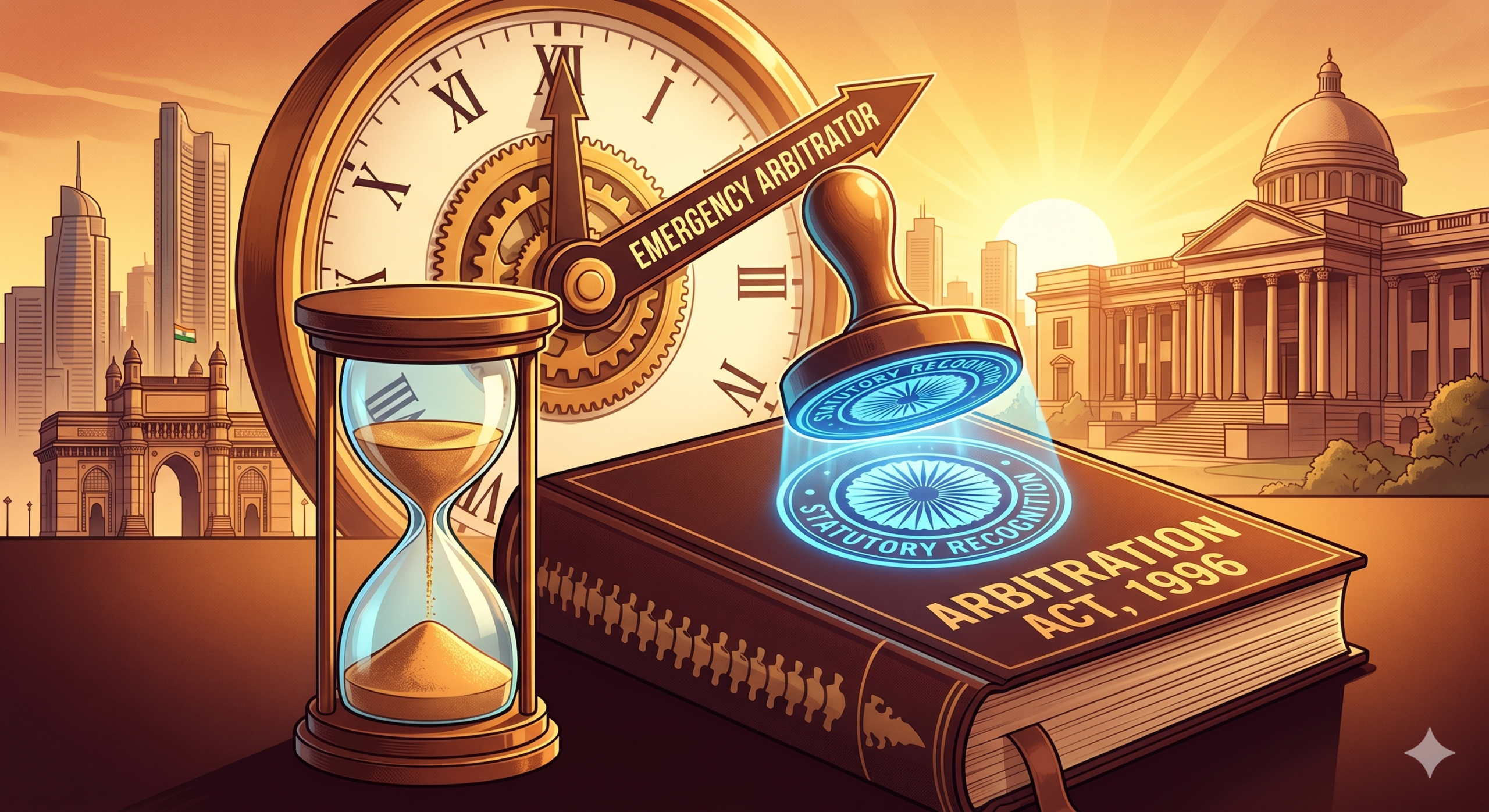
Picture this. Two Indian companies are locked in a joint venture dispute. One partner, suspecting the other of siphoning shared assets, files for arbitration. But here is the brutal arithmetic of Indian commercial justice: constituting a three-member tribunal under the Arbitration and Conciliation Act, 1996 takes weeks. Sometimes months. By the time the tribunal is seated, the assets are gone. The arbitration "wins" — but the victory is hollow without reliable emergency arbitration in India.
This is not a hypothetical. It is the lived reality that the demand for emergency arbitration in India was intended to prevent. And for a country that has loudly declared its ambitions to become a global arbitration hub, India's continued silence on formally recognising this mechanism is less an oversight and more a credibility gap in modern dispute resolution.
The clock problem for emergency arbitration in India
Under the existing framework, a party in distress has two options. It can run to a domestic court under Section 9 of the Arbitration Act for interim measures — navigating congested dockets, lawyer delays, and the inherent adversarialism of court proceedings. Or it can wait for a tribunal under Section 17. Neither option is designed for genuine emergencies, which is exactly why emergency arbitration in India is so critical.
A tech company discovers mid-dispute that its partner is about to transfer proprietary source code to a competitor. An arbitration clause governs the relationship. The next available court date is three weeks out. The code transfer is scheduled for Tuesday. Emergency arbitration — where an arbitrator can be appointed within a day and an order granted within 48 hours — is the only meaningful remedy available. Without statutory recognition, enforcing an order for emergency arbitration in India is a gamble.
Emergency arbitration was not invented by academics dreaming up elegant procedures. It was engineered by institutions responding to exactly these panicked, real-money, real-time crises. The International Chamber of Commerce (ICC) introduced it in 2012. SIAC, LCIA, and the Hong Kong International Arbitration Centre (HKIAC) followed. It has now been invoked hundreds of times globally — and the need for reliable emergency arbitration in India is catching up.
Indian institutions led. Parliament did not follow.
To be fair, India's arbitral institutions were not asleep. The Delhi International Arbitration Centre (DIAC) and the Mumbai Centre for International Arbitration (MCIA) both embedded emergency arbitrator provisions into their rules to facilitate emergency arbitration in India. These rules are operational. Parties can invoke them. Emergency arbitrators can be appointed.
The problem is what happens next. When an emergency arbitrator issues an order — say, freezing an account or restraining a transfer — and the losing party simply ignores it, what is the enforcement mechanism? Under the current statutory text, it is painfully unclear. The Act does not define "emergency arbitrator." It does not explicitly say that such an order can be enforced like an order under Section 17. The institutional rules exist, but they sit on a legislative foundation with a crack running through the middle.
"India has built the institutional architecture for emergency arbitration in India. What it lacks is the statutory skeleton to hold it all together." — Emerging consensus across Indian arbitration practitioners
The Supreme Court stepped in — but that's not enough
In a moment that rewrote the practical landscape, the Supreme Court of India tackled this head-on in the landmark case of NV Investment Holdings LLC v. Future Retail Ltd. (2021). Amazon had obtained an emergency arbitral award from a SIAC emergency arbitrator, blocking Future Group's proposed sale to Reliance, setting a massive precedent for emergency arbitration in India. Future Group tried to argue that such an order was unenforceable in India.
The Supreme Court of India held that an emergency arbitral award passed under SIAC Rules qualifies as an "order" under Section 17(2) of the Arbitration Act and is enforceable in India. It was a judicial leap of considerable courage — and considerable consequence. But it was, ultimately, an act of interpretation, not legislation. The next bench could interpret differently. A High Court already has.
Judicial creativity, however heroic, is a fragile substitute for clear law. When enforcement depends on which court hears the case, which judge sits on the bench, and how creatively they read Section 17, international parties take note — and sometimes take their disputes elsewhere.
What's on the table: the reform proposals
The Law Commission of India, the Ministry of Corporate Affairs, and the DPIIT have each signalled movement towards formal statutory recognition. The contours of proposed amendments for emergency arbitration in India are now reasonably clear in legal circles. Broadly, they would:
Expand the definition of "arbitral tribunal" to explicitly include emergency arbitrators. Clarify that orders passed by emergency arbitrators are enforceable under Section 17 as if passed by a constituted tribunal. Set mandatory time limits on an emergency arbitrator's mandate — typically 14 to 30 days. And crucially, specify that the emergency arbitrator's authority ceases automatically once the main tribunal is constituted, preventing mission creep.
| Feature | Section 9 (Court) | Emergency Arbitration |
|---|---|---|
| Time to relief | Weeks to months | 24–72 hours |
| Forum | Civil court | Arbitral institution |
| Statutory basis (India) | Clear | Uncertain |
| Enforcement | Straightforward | Judge-dependent |
| Third-party reach | Yes | Parties only |
| Suited for international disputes | Partially | Yes |
The safeguard question: preventing abuse
Critics of emergency arbitration in India are not wrong to raise flags. A badly designed mechanism can be weaponised — a resourceful party obtains a quick ex parte order and then deliberately drags its feet on constituting the main tribunal, keeping the emergency order alive indefinitely. It can also create a parallel track that undermines the very tribunal it is supposed to protect.
These concerns are addressable, not fatal. Time limits are non-negotiable — the emergency arbitrator's mandate must lapse automatically, either on tribunal constitution or after a fixed window (India's reform proposals suggest 30 days). The grounds for challenging emergency orders must be narrow and clearly defined. And institutional rules must require the applicant to actively pursue tribunal constitution as a condition of sustaining emergency relief.
Equally important: emergency arbitration in India is not a replacement for courts under Section 9. Courts remain the right forum when third parties are involved, when the emergency arbitrator's jurisdiction is genuinely contested, or when the urgency is so extreme that even institutional timelines are too long. The two mechanisms are designed to complement, not compete with, each other.
"Emergency arbitration should not be seen as an alternative to courts, but rather as a targeted tool to protect parties until the tribunal is ready."
— Adv. Mamta Shukla | Vijay FoundationIndia's race against irrelevance
Singapore amended its International Arbitration Act in 2020 to explicitly recognise emergency arbitrators and make their orders enforceable as if passed by the tribunal. Hong Kong enacted comparable reforms. The UK's Arbitration Act 1996 review is actively considering the same. These are not coincidences — they are competitive signals. When a sophisticated party is structuring a cross-border deal, the enforceability of emergency relief at the chosen seat is a real factor in that choice.
India has the talent, the institutions, and — increasingly — the judicial temperament to be a world-class arbitration seat. What it lacks is the legislative certainty that converts those assets into a genuine competitive offer. Statutory recognition of emergency arbitration in India is not a technical fix at the margins. It is a signal — to foreign investors, to Indian corporates doing business abroad, to international law firms — that India takes its arbitration commitments seriously.
The amendment, when it comes, will be a paragraph in a Bill. But the paragraph will matter enormously — because it will mean that the next time a party needs protection in 48 hours, they won't have to bet on which way a judge reads Section 17. They will know. And that certainty is, in arbitration as in commerce, everything.
Emergency arbitration, at its best, is the quiet professional you hope never to need — but whose number you want in your phone. India is almost ready to put that number in the statute books. Almost.